Health Systems and Population Studies Division, Health Economics and Financing, icddr,b, 68 Shahid Tajuddin Ahmed Sharani, Mohakhali, Dhaka, 1212, Bangladesh.
Leeds Institute of Health Sciences, University of Leeds, 6 Clarendon Way, Woodhouse, LS2 9NL, Leeds, UK.
BMC Health Serv Res. 2022 Jul 8;22(1):885. doi: 10.1186/s12913-022-08254-1.
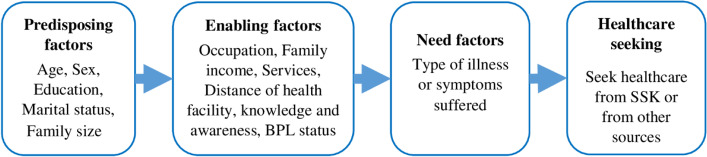
Financing healthcare through out-of-pocket (OOP) payment is a major barrier in accessing healthcare for the poor people. The Health Economics Unit (HEU) of the Ministry of Health and Family Welfare of the government of Bangladesh has developed Shasthyo Suroksha Karmasuchi (SSK), a health protection scheme, with the aim of reducing OOP expenditure and improving access of the below-poverty-line (BPL) population to healthcare. The scheme started piloting in 2016 at Kalihati sub-district of Tangail District. Our objective was to assess healthcare utilization by the enrolled BPL population and to identify the factors those influencing their utilization of the scheme.
A cross-sectional household survey was conducted from July to September 2018 in the piloting sub-district. A total of 806 households were surveyed using a semi-structured questionnaire. Information on illness and sources of healthcare service were captured for the last 90 days before the survey. Multiple logistic regression models were applied to determine the factors related to utilization of healthcare from the SSK scheme and other medically trained providers (MTPs) by the SSK members for both inpatient and outpatient care.
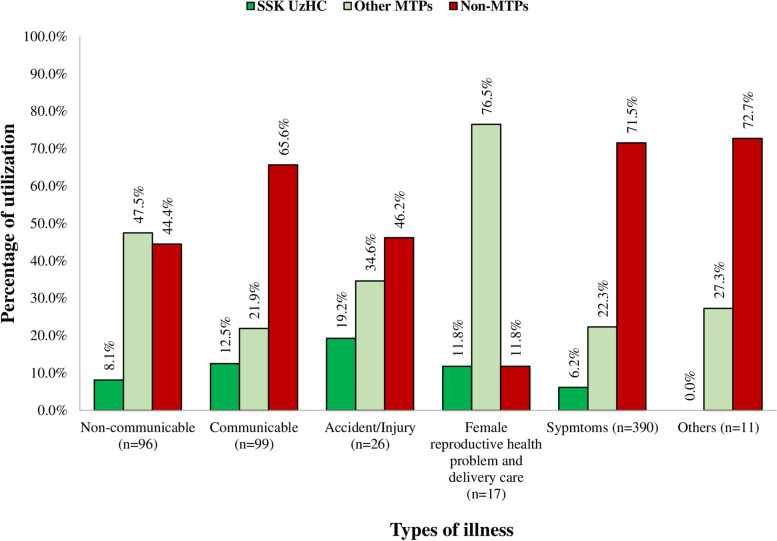
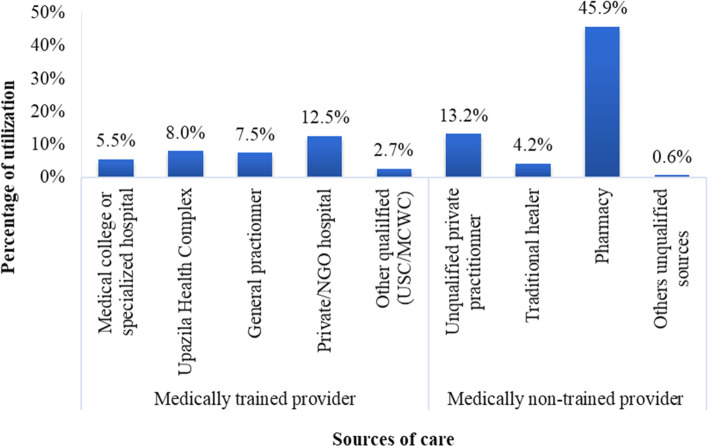
A total of 781 (24.6%) people reported of suffering from illness of which 639 (81.8%) sought healthcare from any sources. About 8.0% (51 out of 639) of them sought healthcare from SSK scheme and 28.2% from other MTPs within 90 days preceding the survey. Households with knowledge about SSK scheme were more likely to utilize healthcare from the scheme and less likely to utilize healthcare from other MTPs. Non-BPL status and suffering from an accident/injury were significantly positively associated with utilization of healthcare from SSK scheme.
Among the BPL population, healthcare utilization from the SSK scheme was very low compared to that of other MTPs. Effective strategies should be in place for improving knowledge of BPL population on SSK scheme and the benefits package of the scheme should be updated as per the need of the target population. Such initiative can be instrumental in increasing utilization of the scheme and ultimately will reduce the barriers of OOP payment among BPL population for accessing healthcare.
通过自费(OOP)支付来为医疗保健提供资金,是贫困人口获得医疗保健的主要障碍。孟加拉国卫生和家庭福利部的卫生经济学股(HEU)制定了 Shasthyo Suroksha Karmasuchi(SSK),这是一项健康保障计划,旨在减少 OOP 支出,并改善贫困线以下(BPL)人口获得医疗保健的机会。该计划于 2016 年在坦格尔区的 Kalihati 分区开始试行。我们的目的是评估登记的 BPL 人口的医疗保健利用情况,并确定影响他们利用该计划的因素。
2018 年 7 月至 9 月在试点分区进行了一项横断面家庭调查。共对 806 户家庭进行了调查,使用了半结构化问卷。在调查前的 90 天内,调查了有关疾病和医疗服务来源的信息。应用多变量逻辑回归模型来确定 SSK 成员在门诊和住院治疗中利用 SSK 计划和其他医疗培训提供者(MTP)的相关因素。
共有 781 人(24.6%)报告患有疾病,其中 639 人(81.8%)从任何来源寻求医疗服务。在调查前的 90 天内,他们中有 8.0%(51 人)从 SSK 计划中寻求医疗服务,28.2%从其他 MTP 中寻求医疗服务。了解 SSK 计划的家庭更有可能利用该计划获得医疗服务,而不太可能利用其他 MTP 获得医疗服务。非 BPL 身份和因事故/受伤而患病与利用 SSK 计划获得医疗服务呈显著正相关。
在 BPL 人口中,与其他 MTP 相比,SSK 计划的医疗保健利用率非常低。应制定有效的策略,提高 BPL 人口对 SSK 计划的了解,并根据目标人口的需求更新计划的福利套餐。这种举措可以提高计划的利用率,并最终减少 BPL 人口获得医疗保健的自费支付障碍。