Clinical Tropical Medicine, QIMR Berghofer Medical Research Institute, Herston, QLD, Australia.
RBWH Infectious Diseases, Bowen Hills and Herston, Australia.
Parasit Vectors. 2022 Jul 8;15(1):242. doi: 10.1186/s13071-022-05371-y.
Although there is unprecedented interest in experimental human hookworm infection, details of hookworm manufacture and characterisation have been sparsely reported. In this report, we detail the production and characterisation of Necator americanus larvae for use in a recently published clinical trial.
Faeces was obtained from an experimentally infected donor. Faecal hookworm DNA was determined by quantitative PCR. Paired samples were incubated in either sterile water or sterile water mixed with antimicrobials (amphotericin and gentamicin). Coproculture was performed by modified Harada-Mori method. The harvested larvae were then processed in either sterile water or antiseptic solution. Larval yield was then calculated (larvae per gram), larval viability was determined by thermally induced motility assay and microbial burden was determined at the day of harvest, at 48 h and at 7 days.
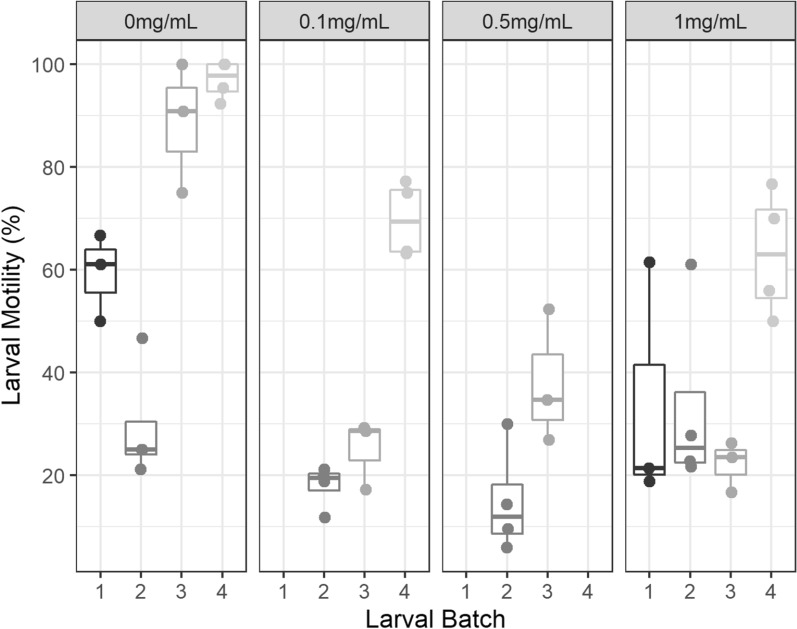
Twenty-eight faecal cultures were performed over 16 months. The faecal hookworm DNA content was variable over this time. There was no association of larval yield with faecal hookworm DNA content. Pre-treatment of faeces with antimicrobials did not influence larval yield. Larval motility was 85.3% (95% CI 79.3-91.3%). Incubation of larvae in antiseptics did not reduce viability at 14 days with a marginal mean of 68.6% (95% CI 59.1-78.1%) washed in water vs. 63.3% (95% CI 53.8 - 72.9%) when incubated in betadine (p = 0.38). Larvae washed in sterile water did not meet microbial bioburden criteria. Incubation in antiseptic resulted in acceptable microbial bioburden at 48 h but not at 7 days. Although the addition of gentamicin did reduce the microbial bio-burden acceptable levels, it was found to significantly lower larval motility at 7 days compared to incubation in sterile water and motility at 7 days 37.8% (95% CI 4.7-70.9%) vs. 67.3% (95% CI 35.2-99.3%, p < 0.001), respectively.
Despite standardised culture methodologies and the use of a single donor, larval yield varied considerably between batches and had no association with faecal hookworm DNA. Larval viability decreases over time and the age of larvae at time of use are likely to be important. Microbial bioburden maybe temporarily reduced by incubation in antiseptics and has little effect on viability. Incubation of larvae in gentamicin is effective at reducing microbial bioburden but is deleterious to larval viability.
尽管人们对实验性人体钩虫感染有着前所未有的兴趣,但有关钩虫制造和特征的细节却鲜有报道。在本报告中,我们详细介绍了用于最近发表的临床试验的美洲钩虫幼虫的生产和特性。
从实验感染的供体中获得粪便。通过定量 PCR 确定粪便钩虫 DNA。将配对样本分别在无菌水或无菌水与抗生素(两性霉素和庆大霉素)混合中孵育。通过改良的原田-森方法进行粪培养。然后将收获的幼虫分别在无菌水或防腐剂溶液中处理。然后计算幼虫产量(每克幼虫),通过热诱导运动试验确定幼虫活力,并在收获当天、48 小时和 7 天测定微生物负担。
在 16 个月内进行了 28 次粪便培养。在此期间,粪便钩虫 DNA 含量变化不定。幼虫产量与粪便钩虫 DNA 含量之间没有关联。用抗生素预处理粪便并不影响幼虫产量。幼虫的运动能力为 85.3%(95%CI 79.3-91.3%)。在 14 天时,用防腐剂孵育的幼虫活力为 68.6%(95%CI 59.1-78.1%),与在水中冲洗的 63.3%(95%CI 53.8-72.9%)相比,略有差异,但在贝他丁中孵育时,差异无统计学意义(p=0.38)。在水中冲洗的幼虫不符合微生物生物负荷标准。孵育在防腐剂中可在 48 小时内达到可接受的微生物生物负荷,但在 7 天内则不能。尽管添加庆大霉素可降低可接受的微生物生物负荷,但与在无菌水中孵育相比,在 7 天时,它显著降低了幼虫的运动能力,为 7 天时 37.8%(95%CI 4.7-70.9%)比 67.3%(95%CI 35.2-99.3%),差异有统计学意义(p<0.001)。
尽管采用了标准化的培养方法和单一供体,但幼虫产量在批次之间差异很大,与粪便钩虫 DNA 无关。幼虫活力随时间推移而下降,使用时幼虫的年龄可能很重要。在防腐剂中孵育可暂时降低微生物生物负荷,但对活力影响不大。在庆大霉素中孵育可有效降低微生物生物负荷,但对幼虫活力有害。