Swiss Tropical and Public Health Institute, Basel, Switzerland.
University of Basel, Basel, Switzerland.
PLoS Negl Trop Dis. 2021 Jan 22;15(1):e0009032. doi: 10.1371/journal.pntd.0009032. eCollection 2021 Jan.
Soil-transmitted helminths infect about one fifth of the world's population and have a negative impact on health. The Kato-Katz technique is the recommended method to detect soil-transmitted helminth eggs in stool samples, particularly in programmatic settings. However, some questions in its procedure remain. Our study aimed to investigate the effect of storage time, storage temperature and stirring of stool samples on fecal egg counts (FECs).
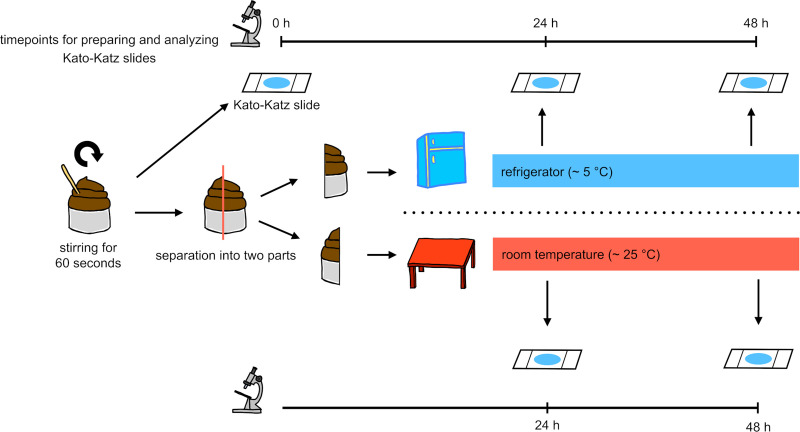
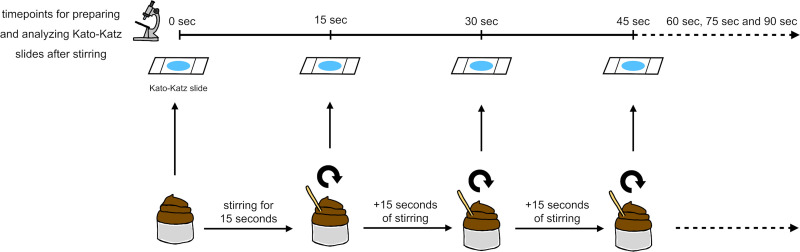
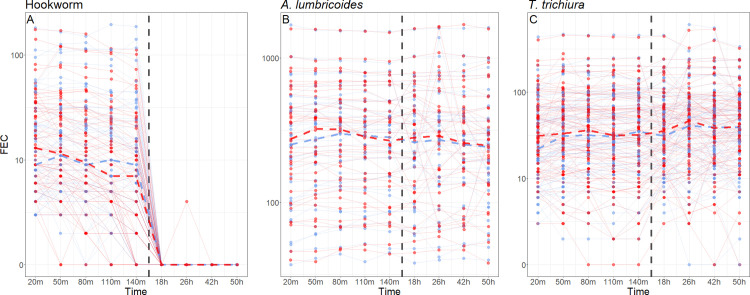
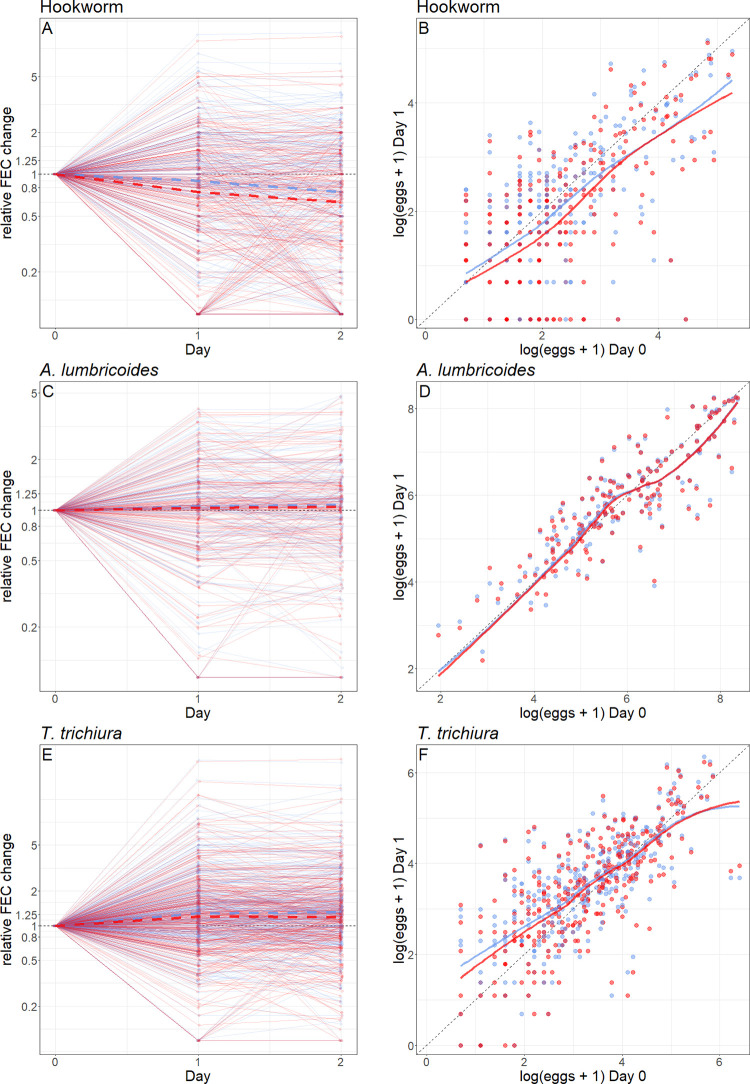
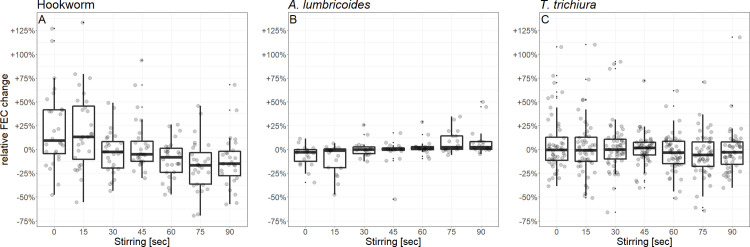
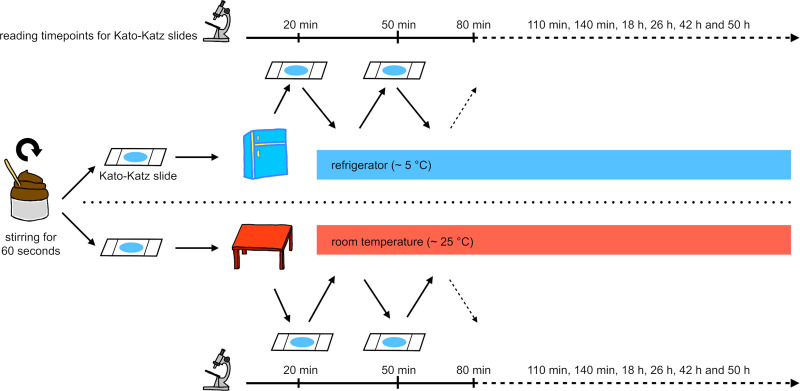
METHODOLOGY/PRINCIPAL FINDINGS: In the framework of a clinical trial on Pemba Island, United Republic of Tanzania, 488 stool samples were collected from schoolchildren. These samples were evaluated in three experiments. In the first experiment (n = 92), two Kato-Katz slides were prepared from the same stool sample, one was stored at room temperature, the other in a refrigerator for 50 hours, and each slide was analyzed at nine time points (20, 50, 80, 110, 140 minutes, 18, 26, 42 and 50 hours). In the second experiment (n = 340), whole stool samples were split into two, one part was stored at room temperature, and the other part was put in a refrigerator for 48 hours. From each part one Kato-Katz slide was prepared and analyzed at three time points over two days (0, 24 and 48 hours). In the third experiment (n = 56), whole stool samples where stirred for 15 seconds six times and at each time point a Kato-Katz slide was prepared and analyzed. Mean hookworm FECs of Kato-Katz slides stored at room temperature steadily decreased following slide preparation. After two hours, mean hookworm FECs decreased from 22 to 16, whereas no reduction was observed if Kato-Katz slides were stored in the refrigerator (19 vs 21). The time x storage interaction effect was statistically significant (coefficient 0.26, 95% CI: 0.17 to 0.35, p < 0.0001). After 24 hours mean hookworm FECs dropped close to zero, irrespective of the storage condition. Whole stool samples stored at room temperature for one day resulted in a mean hookworm FEC decrease of 23% (p < 0.0001), compared to a 13% reduction (p < 0.0001) if samples were stored in the refrigerator. Fecal egg counts of A. lumbricoides and T. trichiura remained stable over time regardless of storage temperature of whole stool samples. Finally, we found a significant reduction of the variation of hookworm and T. trichiura eggs with increasing rounds of stirring the sample, but not for A. lumbricoides. For hookworm we observed a simultaneous decrease in mean FECs, making it difficult to draw recommendations on stirring samples.
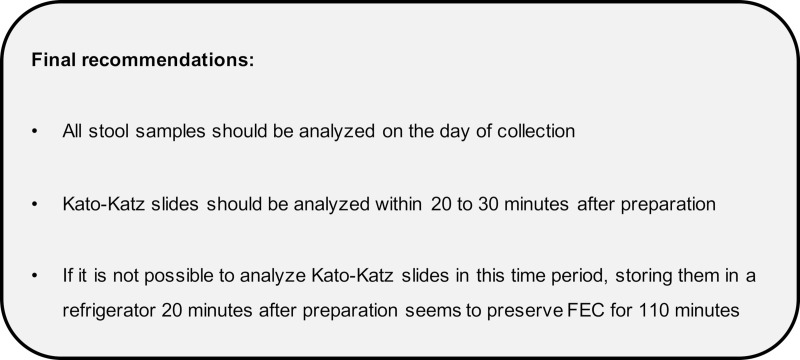
CONCLUSIONS/SIGNIFICANCE: Our findings suggest that stool samples (i) should be analyzed on the day of collection and (ii) should be analyzed between 20-30 minutes after slide preparation; if that is not possible, Kato-Katz slides can be stored in a refrigerator for a maximum of 110 minutes.
土壤传播的蠕虫感染了世界上大约五分之一的人口,并对健康产生负面影响。加藤氏厚涂片检查法是检测粪便样本中土壤传播的蠕虫卵的推荐方法,特别是在项目实施中。然而,其操作过程中仍存在一些问题。我们的研究旨在研究粪便样本的储存时间、储存温度和搅拌对粪便虫卵计数(FEC)的影响。
方法/主要发现:在坦桑尼亚联合共和国奔巴岛的一项临床试验框架内,从 488 名学童中收集了粪便样本。这些样本在三个实验中进行了评估。在第一个实验中(n=92),从同一份粪便样本中制备了两张加藤氏厚涂片,一张在室温下储存,另一张在冰箱中储存 50 小时,每张载玻片在九个时间点(20、50、80、110、140 分钟、18、26、42 和 50 小时)进行分析。在第二个实验中(n=340),将整个粪便样本分成两份,一份在室温下储存,另一份在冰箱中储存 48 小时。从每份样本中制备一张加藤氏厚涂片,并在两天内三个时间点进行分析(0、24 和 48 小时)。在第三个实验中(n=56),整个粪便样本搅拌 15 秒 6 次,每次制备并分析一张加藤氏厚涂片。在室温下储存的钩虫 FEC 随着载玻片的制备而稳步下降。两小时后,钩虫 FEC 从 22 降至 16,而如果将加藤氏厚涂片储存在冰箱中则没有减少(19 对 21)。时间 x 储存的交互作用效应具有统计学意义(系数 0.26,95%CI:0.17 至 0.35,p<0.0001)。24 小时后,无论储存条件如何,钩虫 FEC 几乎降至零。与在冰箱中储存相比,室温下储存一天的粪便样本导致钩虫 FEC 下降 23%(p<0.0001)。整个粪便样本的 A. lumbricoides 和 T. trichiura 的粪便虫卵计数随时间保持稳定,而无论整个粪便样本的储存温度如何。最后,我们发现随着搅拌样本次数的增加,钩虫和 T. trichiura 卵的变异显著减少,但 A. lumbricoides 则没有。对于钩虫,我们观察到平均 FEC 同时下降,因此难以提出关于搅拌样本的建议。
结论/意义:我们的研究结果表明,(i)粪便样本应在收集当天进行分析,(ii)应在载玻片制备后 20-30 分钟内进行分析;如果无法做到这一点,加藤氏厚涂片可以在冰箱中最多储存 110 分钟。