Nilima Nilima, Mani Kalaivani, Kaushik Siddharth, Rai Shesh Nath
Department of Biostatistics, All India Institute of Medical Sciences, New Delhi 110029, India.
Department of Electrical Engineering, Indian Institute of Technology Delhi, New Delhi 110016, India.
Cancers (Basel). 2022 Jun 23;14(13):3076. doi: 10.3390/cancers14133076.
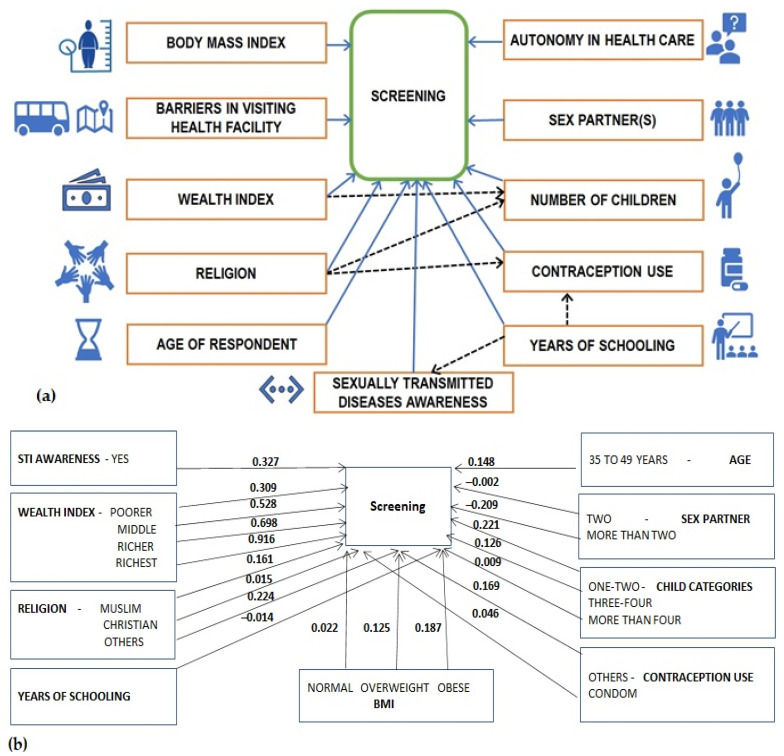
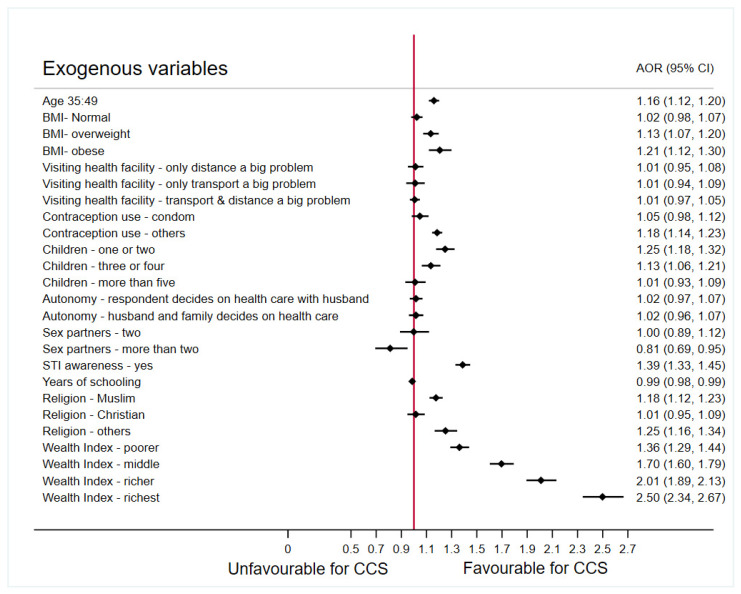
Exploring the barriers and facilitators of cervical cancer screening (CCS) is essential to reduce the incidence and mortality, particularly in low and middle-income countries. The present study investigates the direct, indirect, and total effects of the barriers and facilitators on CCS in India through the generalized structural equation modeling using data from women files of the fourth round of the National Family Health Survey (NFHS-4). Generalized structural equation models were used to quantify the hypothetical pathway via fitting a series of regression equations. Age, body mass index, religion, years of schooling, awareness of sexually transmitted infection, contraception use, lifetime number of sex partners, number of children, and wealth index were shown to have significant direct effects on the CCS. Older women had 1.16 times the odds of getting screened for cervical cancer as compared to their younger counterpart. The odds of CCS among the women in richest wealth quintile is 2.50 times compared to the poorest. Those who are aware of STIs have 1.39 times the odds of getting screened for cervical cancer. Wealth index, years of schooling, and religion have a substantial indirect and total impact on the CCS. The findings will aid in policy formulations for enhancing the CCS in India.
探索宫颈癌筛查(CCS)的障碍和促进因素对于降低发病率和死亡率至关重要,尤其是在低收入和中等收入国家。本研究通过使用来自第四次全国家庭健康调查(NFHS-4)女性档案的数据,采用广义结构方程模型,调查了印度CCS的障碍和促进因素的直接、间接和总体影响。广义结构方程模型用于通过拟合一系列回归方程来量化假设路径。年龄、体重指数、宗教、受教育年限、性传播感染意识、避孕措施使用、性伴侣终身数量、子女数量和财富指数对CCS有显著的直接影响。与年轻女性相比,老年女性接受宫颈癌筛查的几率是其1.16倍。最富有财富五分位数组的女性进行CCS的几率是最贫穷组的2.50倍。知晓性传播感染的女性接受宫颈癌筛查的几率是其1.39倍。财富指数、受教育年限和宗教对CCS有重大的间接和总体影响。这些发现将有助于制定印度加强CCS的政策。