School of Social Sciences, Western Sydney University, Penrith-2751, New South Wales, Australia.
Translational Health Research Institute (THRI), Western Sydney University, Sydney, New South Wales, Australia.
Int J Equity Health. 2020 Mar 26;19(1):42. doi: 10.1186/s12939-020-01159-7.
Resource-constrained countries (RCCs) have the highest burden of cervical cancer (CC) in the world. Nonetheless, although CC can be prevented through screening for precancerous lesions, only a small proportion of women utilise screening services in RCCs. The objective of this study was to examine the magnitude of inequalities of women's knowledge and utilisation of cervical cancer screening (CCS) services in RCCs.
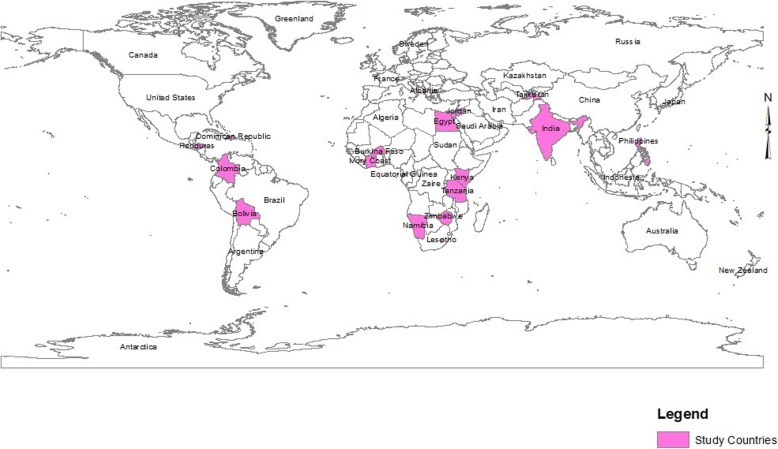
A total of 1,802,413 sample observations from 18 RCC's latest national-level Demographic and Health Surveys (2008 to 2017-18) were analysed to assess wealth-related inequalities in terms of women's knowledge and utilisation of CCS services. Regression-based decomposition analyses were applied in order to compute the contribution to the inequality disparities of the explanatory variables for women's knowledge and utilisation of CCS services.
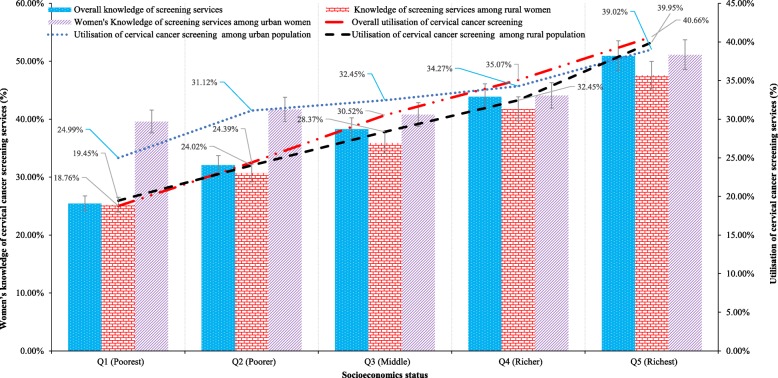
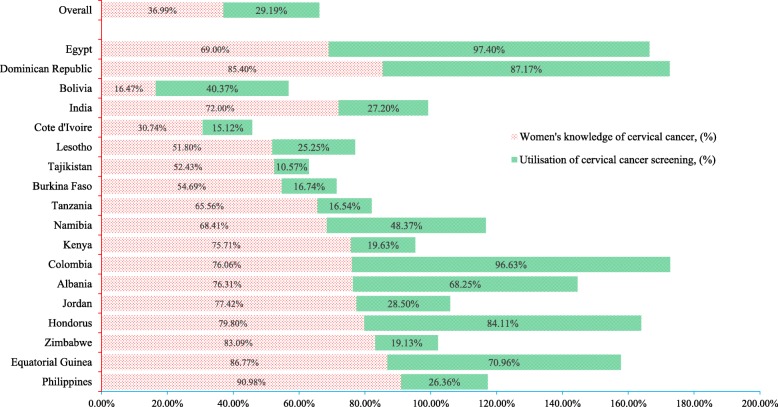
Overall, approximately 37% of women had knowledge regarding CCS services, of which, 25% belonged to the poorest quintile and approximately 49% from the richest. Twenty-nine percent of women utilised CCS services, ranging from 11% in Tajikistan, 15% in Cote d'Ivoire, 17% in Tanzania, 19% in Zimbabwe and 20% in Kenya to 96% in Colombia. Decomposition analyses determined that factors that reduced inequalities in women's knowledge of CCS services were male-headed households (- 2.24%; 95% CI: - 3.10%, - 1.59%; P < 0.01), currently experiencing amenorrhea (- 1.37%; 95% CI: - 2.37%, - 1.05%; P < 0.05), having no problems accessing medical assistance (- 10.00%; 95% CI: - 12.65%, - 4.89%; P < 0.05), being insured (- 6.94%; 95% CI: - 9.58%, - 4.29%; P < 0.01) and having an urban place of residence (- 9.76%; 95% CI: - 12.59%, - 5.69%; P < 0.01). Similarly, factors that diminished inequality in the utilisation of CCS services were being married (- 8.23%;95% CI: - 12.46%, - 5.80%; P < 0.01), being unemployed (- 14.16%; 95% CI: - 19.23%, - 8.47%; P < 0.01) and living in urban communities (- 9.76%; 95% CI: - 15.62%, - 5.80%; P < 0.01).
Women's knowledge and utilisation of CCS services in RCCs are unequally distributed. Significant inequalities were identified among socioeconomically deprived women in the majority of countries. There is an urgent need for culturally appropriate community-based awareness and access programs to improve the uptake of CCS services in RCCs.
资源有限国家(RCCs)在全球范围内承担着最高的宫颈癌(CC)负担。尽管可以通过筛查癌前病变来预防 CC,但在 RCCs 中,只有少数女性利用筛查服务。本研究的目的是评估 RCCs 中妇女对宫颈癌筛查(CCS)服务的知识和利用方面的不平等程度。
分析了来自 18 个 RCC 最新国家层面的人口与健康调查(2008 年至 2017-18 年)的 1802413 个样本观察值,以评估妇女对 CCS 服务的知识和利用方面的财富相关不平等情况。应用基于回归的分解分析方法来计算解释变量对妇女对 CCS 服务的知识和利用不平等的贡献。
总体而言,约有 37%的妇女对 CCS 服务有一定的了解,其中 25%属于最贫穷的五分位数,约有 49%来自最富裕的五分位数。有 29%的妇女利用了 CCS 服务,范围从塔吉克斯坦的 11%、科特迪瓦的 15%、坦桑尼亚的 17%、津巴布韦的 19%、肯尼亚的 20%到哥伦比亚的 96%。分解分析确定,降低妇女对 CCS 服务知识的不平等的因素包括男性为户主的家庭(-2.24%;95%CI:-3.10%,-1.59%;P<0.01)、目前经历闭经(-1.37%;95%CI:-2.37%,-1.05%;P<0.05)、没有医疗援助获取问题(-10.00%;95%CI:-12.65%,-4.89%;P<0.05)、有保险(-6.94%;95%CI:-9.58%,-4.29%;P<0.01)和居住在城市地区(-9.76%;95%CI:-12.59%,-5.69%;P<0.01)。同样,降低 CCS 服务利用不平等的因素包括已婚(-8.23%;95%CI:-12.46%,-5.80%;P<0.01)、失业(-14.16%;95%CI:-19.23%,-8.47%;P<0.01)和居住在城市社区(-9.76%;95%CI:-15.62%,-5.80%;P<0.01)。
RCCs 中妇女对 CCS 服务的知识和利用存在不平等现象。在大多数国家,处于社会经济劣势的妇女之间存在显著的不平等。迫切需要制定文化上适当的基于社区的意识和获取计划,以提高 RCCs 中对 CCS 服务的利用率。