Department of Population Health, Dell Medical School at the University of Texas at Austin, DMS Health Discovery Building, #4.702, 1601 Trinity St., BLDG B STOP Z0500, Austin, TX, USA.
Department of Molecular and Translational Medicine and Family and Community Medicine, Texas Tech University Health Sciences Center El Paso, 5001 El Paso Drive, El Paso, TX, 7990, USA.
BMC Cancer. 2022 Jan 5;22(1):37. doi: 10.1186/s12885-021-09092-w.
Colorectal cancer (CRC) is the second leading cause of cancer deaths in the USA. Although a number of CRC screening tests have been established as being effective for CRC prevention and early detection, rates of CRC screening test completion in the US population remain suboptimal, especially among the uninsured, recent immigrants and Hispanics. In this study, we used a structural equation modelling approach to identify factors influencing screening test completion in a successful CRC screening program that was implemented in an uninsured Hispanic population. This information will enhance our understanding of influences on CRC screening among historically underscreened populations.
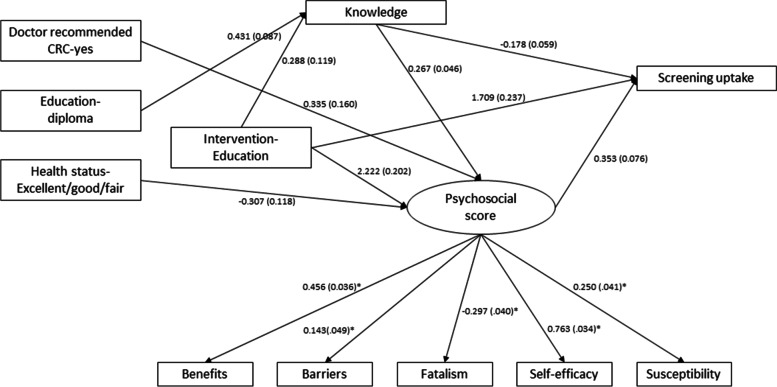
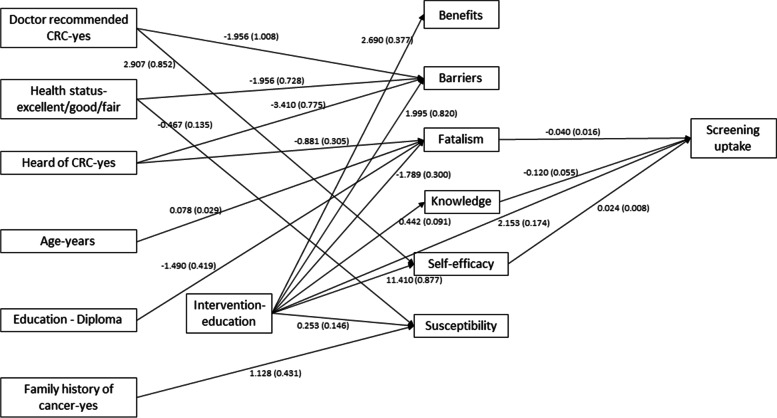
We used generalized structural equation models (SEM) utilizing participant reported information collected through a series of surveys. We identified direct and indirect pathways through which cofactors, CRC knowledge and individual Health Belief Model constructs (perceived benefits, barriers, susceptibility, fatalism and self-efficacy) and a latent psychosocial health construct mediated screening in an effective prospective randomized CRC screening intervention that was tailored for uninsured Hispanic Americans.
Seven hundred twenty-three participants were eligible for inclusion; mean age was 56 years, 79.7% were female, and 98.9% were Hispanic. The total intervention effect was comparable in both models, with both having a direct and indirect effect on screening completion (n = 715, Model 1: RC = 2.46 [95% CI: 2.20, 2.71, p < 0.001]; n = 699, Model 2 RC =2.45, [95% CI: 2.18, 2.72, p < 0.001]. In Model 1, 32% of the overall effect was mediated by the latent psychosocial health construct (RC = 0.79, p < 0.001) that was in turn mainly influenced by self-efficacy, perceived benefits and fatalism. In Model 2, the most important individual mediators were self-efficacy (RC = 0.24, p = 0.013), and fatalism (RC = 0.07, p = 0.033).
This study contributes to our understanding of mediators of CRC screening and suggests that targeting self-efficacy, perceived benefits and fatalism could maximize the effectiveness of CRC screening interventions particularly in Hispanic populations.
结直肠癌(CRC)是美国癌症死亡的第二大主要原因。尽管已经确定了一些 CRC 筛查测试对 CRC 的预防和早期发现有效,但美国人口的 CRC 筛查测试完成率仍不理想,尤其是在没有保险的人群、新移民和西班牙裔中。在这项研究中,我们使用结构方程建模方法来确定在针对无保险西班牙裔人群实施的成功 CRC 筛查计划中影响筛查测试完成的因素。这些信息将增强我们对历史上筛查不足人群中 CRC 筛查的影响因素的理解。
我们使用广义结构方程模型(SEM),利用通过一系列调查收集的参与者报告的信息。我们确定了共同因素、CRC 知识和个体健康信念模型结构(感知益处、障碍、易感性、宿命论和自我效能)以及潜在的心理社会健康结构如何通过中介影响筛查,从而对针对无保险的西班牙裔美国人量身定制的有效前瞻性随机 CRC 筛查干预措施进行筛查。
723 名参与者符合纳入标准;平均年龄为 56 岁,79.7%为女性,98.9%为西班牙裔。在两个模型中,干预的总效果相当,对筛查完成都有直接和间接的影响(n=715,模型 1:RC=2.46 [95%CI:2.20,2.71,p<0.001];n=699,模型 2 RC=2.45,[95%CI:2.18,2.72,p<0.001])。在模型 1 中,潜在心理社会健康结构(RC=0.79,p<0.001)中介了 32%的总效应,而该结构主要受自我效能、感知益处和宿命论的影响。在模型 2 中,最重要的个体中介是自我效能(RC=0.24,p=0.013)和宿命论(RC=0.07,p=0.033)。
这项研究有助于我们了解 CRC 筛查的中介因素,并表明针对自我效能、感知益处和宿命论可能会最大限度地提高 CRC 筛查干预措施的有效性,特别是在西班牙裔人群中。