Department of Clinical and Experimental Medicine, University of Pisa, 56126 Pisa, Italy.
ULB Center for Diabetes Research, Université Libre de Bruxelles, 1050 Brussels, Belgium.
Int J Mol Sci. 2022 Jul 4;23(13):7435. doi: 10.3390/ijms23137435.
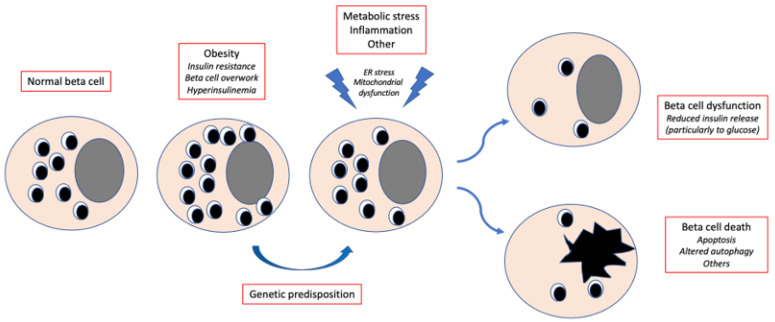
Type 2 diabetes (T2D) has been considered a relentlessly worsening disease, due to the progressive deterioration of the pancreatic beta cell functional mass. Recent evidence indicates, however, that remission of T2D may occur in variable proportions of patients after specific treatments that are associated with recovery of beta cell function. Here we review the available information on the recovery of beta cells in (a) non-diabetic individuals previously exposed to metabolic stress; (b) T2D patients following low-calorie diets, pharmacological therapies or bariatric surgery; (c) human islets isolated from non-diabetic organ donors that recover from "lipo-glucotoxic" conditions; and (d) human islets isolated from T2D organ donors and exposed to specific treatments. The improvement of insulin secretion reported by these studies and the associated molecular traits unveil the possibility to promote T2D remission by directly targeting pancreatic beta cells.
2 型糖尿病(T2D)一直被认为是一种不断恶化的疾病,这是由于胰腺β细胞功能质量的进行性恶化。然而,最近的证据表明,在与β细胞功能恢复相关的特定治疗后,T2D 可能会在不同比例的患者中缓解。在这里,我们回顾了关于以下方面的现有信息:(a)以前暴露于代谢应激的非糖尿病个体中的β细胞恢复;(b)接受低卡路里饮食、药物治疗或减肥手术的 T2D 患者;(c)从“脂肪-糖毒性”条件中恢复的非糖尿病器官供体分离的人胰岛;以及(d)从 T2D 器官供体分离并暴露于特定治疗的人胰岛。这些研究报道的胰岛素分泌改善和相关的分子特征揭示了通过直接靶向胰腺β细胞来促进 T2D 缓解的可能性。