Lin Yu-Kai, Liang Chih-Sung, Tsai Chia-Kuang, Tsai Chia-Lin, Lee Jiunn-Tay, Sung Yueh-Feng, Chou Chung-Hsing, Shang Hung-Sheng, Yang Bing-Heng, Lin Guan-Yu, Su Ming-Wei, Yang Fu-Chi
Department of Neurology, Tri-Service General Hospital, National Defense Medical Center, Taipei 114, Taiwan.
Graduate Institute of Medical Sciences, National Defense Medical Center, Taipei 114, Taiwan.
J Clin Med. 2022 Jun 24;11(13):3655. doi: 10.3390/jcm11133655.
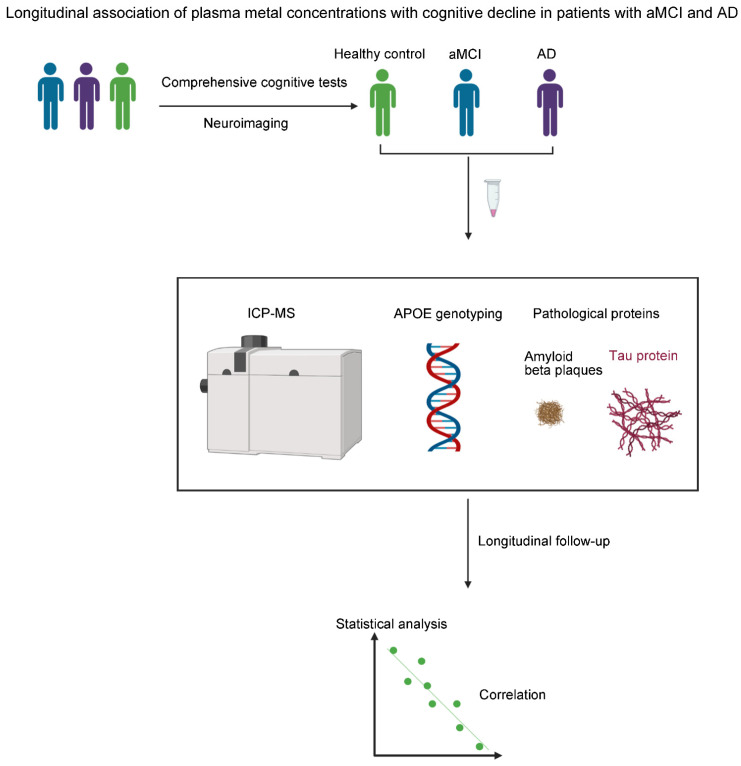
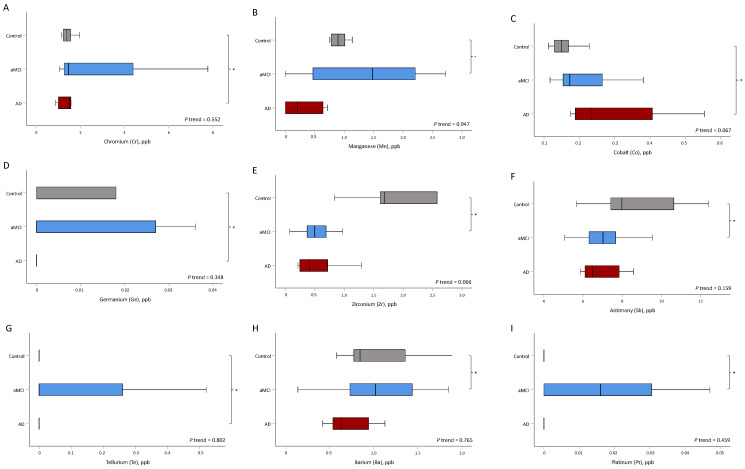
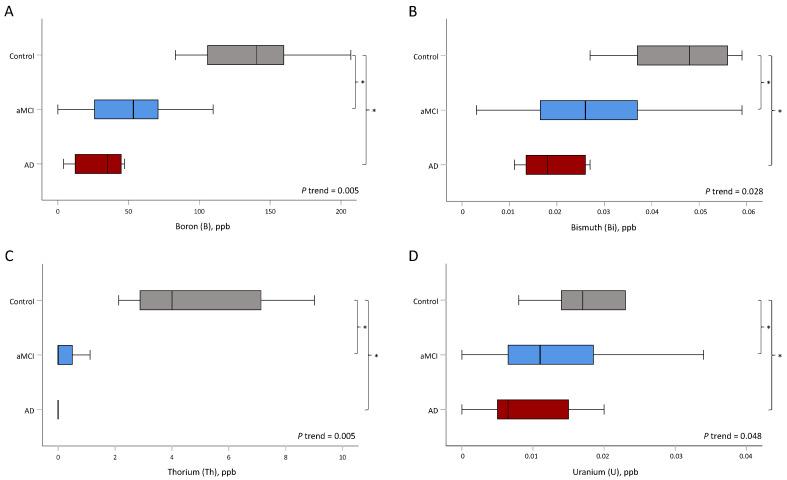
Alzheimer’s disease (AD) involves the abnormal activity of transition metals and metal ion dyshomeostasis; however, the potential of trace metal biomarkers in predicting cognitive decline has not been evaluated. This study aimed to assess the potential of 36 trace elements in predicting cognitive decline in patients with amnestic mild cognitive impairment (aMCI) or AD. Participants (9 controls, 23 aMCI due to AD, and 8 AD dementia) underwent comprehensive cognitive tests, including the Mini-Mental State Examination (MMSE) and trace metal analysis. The correlations between the plasma trace element levels and annual MMSE changes during follow-up were analyzed. We found that an increase in disease severity was linked to lower plasma levels of boron (B), bismuth (Bi), thorium (Th), and uranium (U) (adjusted p < 0.05). Higher baseline calcium levels (r = 0.50, p = 0.026) were associated with less annual cognitive decline; those of B (r = −0.70, p = 0.001), zirconium (r = −0.58, p = 0.007), and Th (r = −0.52, p = 0.020) with rapid annual cognitive decline in the aMCI group; and those of manganese (r = −0.91, p = 0.035) with rapid annual cognitive decline in the AD group. Overall, our exploratory study suggests that plasma metal levels have great potential as in vivo biomarkers for aMCI and AD. Larger sample studies are necessary to confirm these results.
阿尔茨海默病(AD)涉及过渡金属的异常活性和金属离子稳态失衡;然而,痕量金属生物标志物在预测认知衰退方面的潜力尚未得到评估。本研究旨在评估36种微量元素在预测遗忘型轻度认知障碍(aMCI)或AD患者认知衰退方面的潜力。参与者(9名对照者、23名由AD导致的aMCI患者和8名AD痴呆患者)接受了全面的认知测试,包括简易精神状态检查表(MMSE)和痕量金属分析。分析了随访期间血浆微量元素水平与年度MMSE变化之间的相关性。我们发现,疾病严重程度的增加与血浆硼(B)、铋(Bi)、钍(Th)和铀(U)水平降低有关(校正p<0.05)。较高的基线钙水平(r = 0.50,p = 0.026)与年度认知衰退较少相关;aMCI组中,B(r = -0.70,p = 0.001)、锆(r = -0.58,p = 0.007)和Th(r = -0.52,p = 0.020)水平较高与年度认知快速衰退相关;AD组中,锰(r = -0.91,p = 0.035)水平较高与年度认知快速衰退相关。总体而言,我们的探索性研究表明,血浆金属水平作为aMCI和AD的体内生物标志物具有很大潜力。需要更大样本量的研究来证实这些结果。