Key Laboratory for Deep Processing of Major Grain and Oil of Ministry of Education in China, College of Food Science and Engineering, Wuhan Polytechnic University, 68 Xuefu Road, Wuhan 430023, China.
Hubei Key Laboratory for Processing and Transformation of Agricultural Products, College of Food Science and Engineering, Wuhan Polytechnic University, 68 Xuefu Road, Wuhan 430023, China.
Molecules. 2022 Jun 29;27(13):4185. doi: 10.3390/molecules27134185.
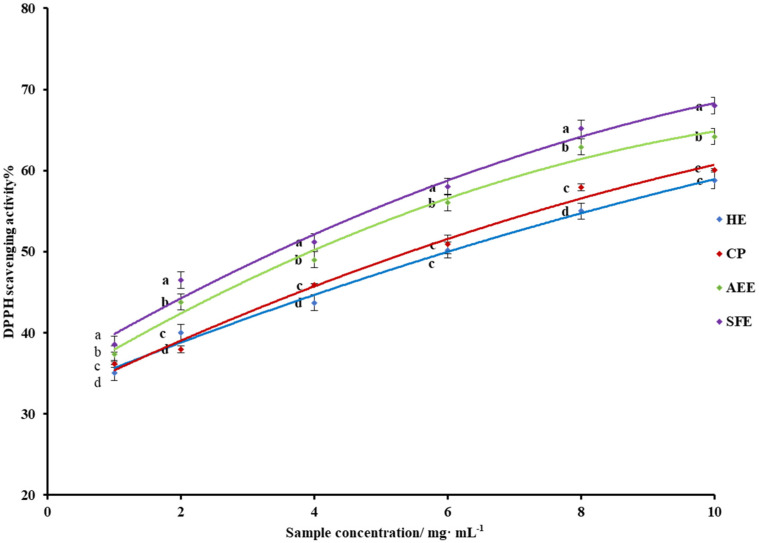
In this study, we investigated and compared the oil yield, physicochemical properties, fatty acid composition, nutrient content, and antioxidant ability of Bunge () kernel oils obtained by cold-pressing (CP), hexane extraction (HE), aqueous enzymatic extraction (AEE), and supercritical fluid extraction (SFE). The results indicated that oil contained a high percentage of monounsaturated fatty acids (49.31-50.38%), especially oleic acid (30.73-30.98%) and nervonic acid (2.73-3.09%) and that the extraction methods had little effect on the composition and content of fatty acids. oil is an excellent source of nervonic acid. Additionally, the HE method resulted in the highest oil yield (98.04%), oxidation stability index (9.20 h), tocopherol content (530.15 mg/kg) and sterol content (2104.07 mg/kg). The DPPH scavenging activity rates of the oil produced by SFE was the highest. Considering the health and nutritional value of oils, HE is a promising method for oil processing. According to multiple linear regression analysis, the antioxidant capacity of the oil was negatively correlated with sterol and stearic acid content and positively correlated with linoleic acid, arachidic acid and polyunsaturated fatty acid content. This information is important for improving the nutritional value and industrial production of
在这项研究中,我们研究并比较了冷榨(CP)、正己烷提取(HE)、水酶提取(AEE)和超临界流体提取(SFE)获得的 仁油的产油量、理化性质、脂肪酸组成、营养成分和抗氧化能力。结果表明, 油含有较高比例的单不饱和脂肪酸(49.31-50.38%),特别是油酸(30.73-30.98%)和神经酸(2.73-3.09%),并且提取方法对脂肪酸的组成和含量影响不大。 油是神经酸的极好来源。此外,HE 法的出油率最高(98.04%),氧化稳定性指数(9.20 h)、生育酚含量(530.15 mg/kg)和甾醇含量(2104.07 mg/kg)最高。SFE 法制备的油的 DPPH 清除率最高。考虑到油的健康和营养价值,HE 是一种很有前途的 油加工方法。根据多元线性回归分析,油的抗氧化能力与甾醇和硬脂酸含量呈负相关,与亚油酸、花生酸和多不饱和脂肪酸含量呈正相关。这些信息对于提高 油的营养价值和工业生产具有重要意义。