Toumi Ines, Zarrouk Olfa, Ghrab Mohamed, Nagaz Kamel
Arid Regions Institute, University of Gabes, Route de Djorf, km 22.5, Medenine 4119, Tunisia.
Association SFCOLAB-Collaborative Laboratory for Digital Innovation in Agriculture, Rua Cândido dos Reis n° 1, Espaço SFCOLAB, 2560-312 Torres Vedras, Portugal.
Plants (Basel). 2022 Jun 23;11(13):1656. doi: 10.3390/plants11131656.
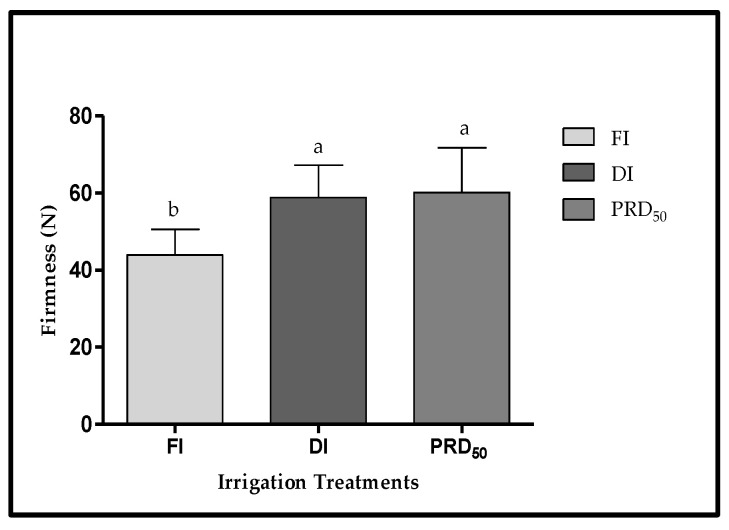
The peach ( L.) is one of Tunisia's major commercial fruit crops and is considered one of the biggest water consumers of all crops. In warm and arid areas of southern Tunisia, irrigation is necessary to ensure orchard longevity and high yield and fruit quality. Nevertheless, under water-scarcity conditions and low water quality, water management should rely on efficient deficit irrigation strategies. In this study, sustained deficit irrigation (DI) and partial root-zone drying (PRD) at 50% of crop evapotranspiration (ETc) were evaluated for their impact on the primary and secondary metabolites of the peach fruit of early cultivar Flordastar grown in the Tataouine region. A full irrigation (FI) treatment at 100%, etc., was used as a control treatment. Color, dry-matter content, firmness, organic acids, sugars, phenolic compounds, vitamin C, β-carotene and minerals were assessed on harvested mature fruits. Dry-matter content and firmness increased significantly under DI and PRD (13% and 15.5%). DI fruit had the highest soluble-solid content (SSC), reaching Brix values of 14.3°. Fruit sorbitol and sucrose contents were not affected by Di and PRD. Higher glucose in fruit juice was observed in PRD (23%) and DI (21.5%) compared to FI, which had the highest malic acid content (33.5-37%). Quinic and citric acids decreased with DI and PRD, while almost all individual phenolic compounds increased with deficit irrigation. Hydroxycinnamates and anthocyanins were significantly higher in fruits harvested from DI and PRD treatments. Proanthocyanidins (catechin and epicatechin) were only improved by DI, while flavone compounds and vitamin C were not affected by irrigation restrictions. β-carotene was higher in fruits yielded under FI (0.71 mg/100 g DM) than DI and PRD (0.21-0.43 mg/100 g DM). Macro- and micronutrients significantly increased in DI and PRD fruit. A significant difference between DI and PRD fruits was observed for Zn and Fe concentrations. This research highlights the positive impact of reduced irrigation on bioactive-fruit quality attributes and the suitability of PRD and DI as tools for irrigation management in arid areas of southern Tunisia, contributing to water-saving in orchards and the improvement of fruit commercial value.
桃子(L.)是突尼斯主要的商业水果作物之一,被认为是所有作物中耗水量最大的作物之一。在突尼斯南部温暖干旱地区,灌溉对于确保果园寿命、高产以及果实品质是必要的。然而,在水资源短缺和水质较差的情况下,水分管理应依赖高效的亏缺灌溉策略。在本研究中,评估了在作物蒸散量(ETc)的50%水平下持续亏缺灌溉(DI)和部分根区干燥(PRD)对生长在塔塔温地区的早熟品种弗罗达斯塔桃子果实初级和次级代谢产物的影响。以100%的充分灌溉(FI)处理作为对照处理。对收获的成熟果实评估颜色、干物质含量、硬度、有机酸、糖类、酚类化合物、维生素C、β-胡萝卜素和矿物质。在DI和PRD处理下,干物质含量和硬度显著增加(分别为13%和15.5%)。DI处理的果实可溶性固形物含量(SSC)最高,达到14.3°Brix值。果实山梨醇和蔗糖含量不受DI和PRD的影响。与FI相比,PRD(23%)和DI(21.5%)处理的果汁中葡萄糖含量更高,而FI处理的果实苹果酸含量最高(33.5 - 37%)。奎尼酸和柠檬酸随DI和PRD处理而降低,而几乎所有的单个酚类化合物随亏缺灌溉而增加。DI和PRD处理收获的果实中羟基肉桂酸和花青素含量显著更高。原花青素(儿茶素和表儿茶素)仅在DI处理下有所提高,而黄酮类化合物和维生素C不受灌溉限制的影响。FI处理下的果实β-胡萝卜素含量(0.71毫克/100克干物质)高于DI和PRD处理(0.21 - 0.43毫克/100克干物质)。DI和PRD处理的果实中大量和微量营养素显著增加。DI和PRD处理的果实中锌和铁浓度存在显著差异。本研究突出了减少灌溉对果实生物活性品质属性的积极影响,以及PRD和DI作为突尼斯南部干旱地区灌溉管理工具的适用性,有助于果园节水和提高果实商业价值。