Hans Christian Andersen Children's Hospital, Odense University Hospital, 5000 Odense, Denmark.
Department of Paediatrics, Holbaek Hospital, 4300 Holbaek, Denmark.
Nutrients. 2022 Jun 29;14(13):2709. doi: 10.3390/nu14132709.
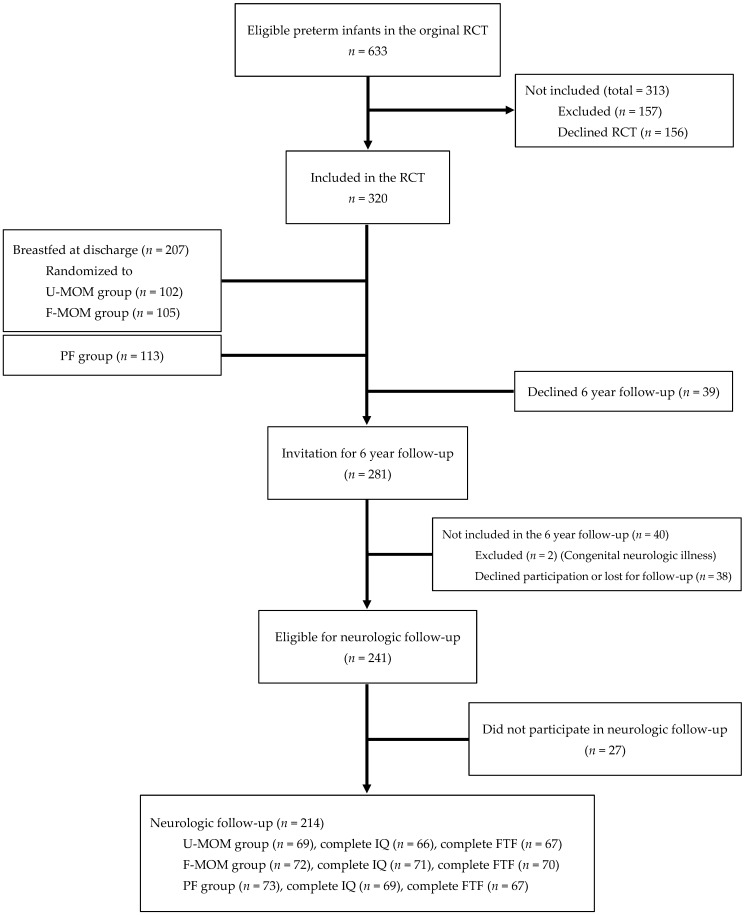
(1) Very preterm infants are at increased risk of cognitive deficits, motor impairments, and behavioural problems. Studies have tied insufficient nutrition and growth to an increased risk of neurodevelopmental impairment; (2) Methods: Follow-up study on cognitive and neuropsychological development at 6 years corrected age (CA) in 214 very preterm infants, including 141 breastfed infants randomised to mother's own milk (MOM) with (F-MOM) or without (U-MOM) fortification and 73 infants fed a preterm formula (PF-group), from shortly before discharge to 4 months CA. Infants with serious congenital anomalies or major neonatal morbidities were excluded prior to intervention. The Wechsler Intelligence Scale for Children IV was used for cognitive testing, and the children's parents completed the Five to Fifteen Questionnaire (FTF); (3) Results: Post-discharge fortification of MOM did not improve either full-scale intelligence quotient (FSIQ) with a median of 104 vs. 105.5 ( = 0.29), subdomain scores, or any domain score on the FTF questionnaire. Compared to the PF group, the MOM group had significantly better verbal comprehension score with a median of 110 vs. 106 ( = 0.03) and significantly better motor skills scores on the FTF questionnaire ( = 0.01); (4) Conclusions: The study supports breastfeeding without fortification as post-discharge nutrition in very preterm infants, and it seems superior to preterm formula.
(1) 极早产儿认知功能缺陷、运动障碍和行为问题的风险增加。研究表明,营养不足和生长不良会增加神经发育受损的风险;(2) 方法:对 214 名极早产儿进行了 6 岁校正年龄(CA)时认知和神经心理学发育的随访研究,包括 141 名母乳喂养的婴儿,随机分为接受母亲自身的母乳(MOM)强化喂养(F-MOM)或不强化喂养(U-MOM)的婴儿以及 73 名接受早产儿配方奶(PF)喂养的婴儿,从即将出院到 4 个月 CA。在干预前排除了有严重先天性畸形或严重新生儿并发症的婴儿。使用韦氏儿童智力量表第四版进行认知测试,儿童的父母完成了 5 到 15 岁问卷(FTF);(3) 结果:MOM 的出院后强化喂养并未改善全智商(FSIQ),中位数为 104 对 105.5( = 0.29),也未改善亚域评分或 FTF 问卷的任何域评分。与 PF 组相比,MOM 组在言语理解评分方面具有显著优势,中位数为 110 对 106( = 0.03),在 FTF 问卷上的运动技能评分也具有显著优势( = 0.01);(4) 结论:该研究支持极早产儿在出院后进行母乳喂养而不强化喂养,且似乎优于早产儿配方奶。