Chen Qilai, Han Tingting, Zeng Jianmin, He Zhilong, Liu Yulin, Sun Jinglin, Tang Minghua, Zhang Zhang, Gao Pingqi, Liu Gang
School of Materials, Sun Yat-Sen University, Guangzhou 510275, China.
Department of Micro and Nano Electronics, School of Electronic Information and Electrical Engineering, Shanghai Jiao Tong University, Shanghai 200240, China.
Nanomaterials (Basel). 2022 Jun 28;12(13):2217. doi: 10.3390/nano12132217.
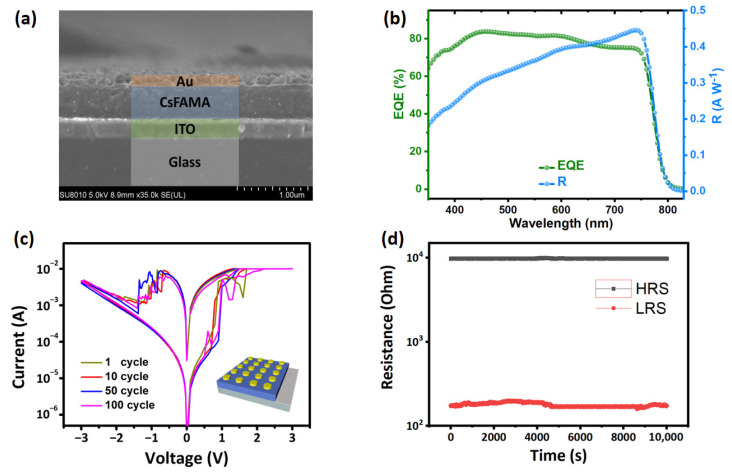
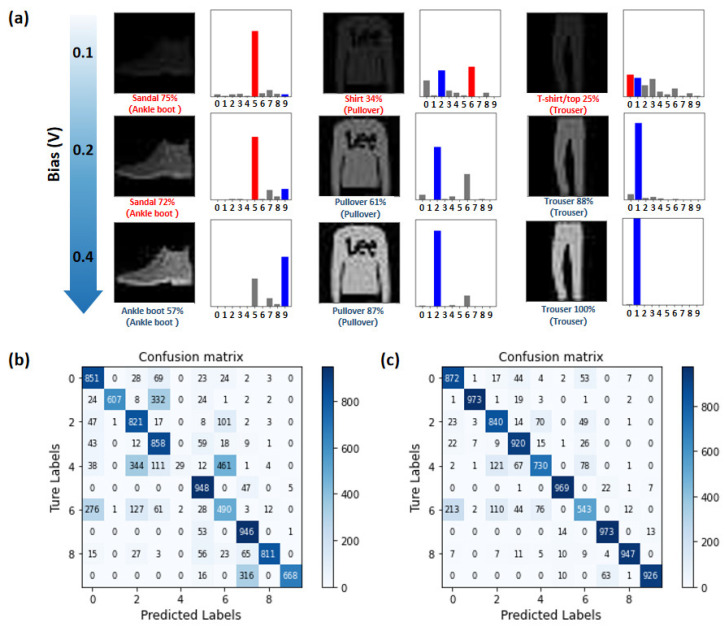
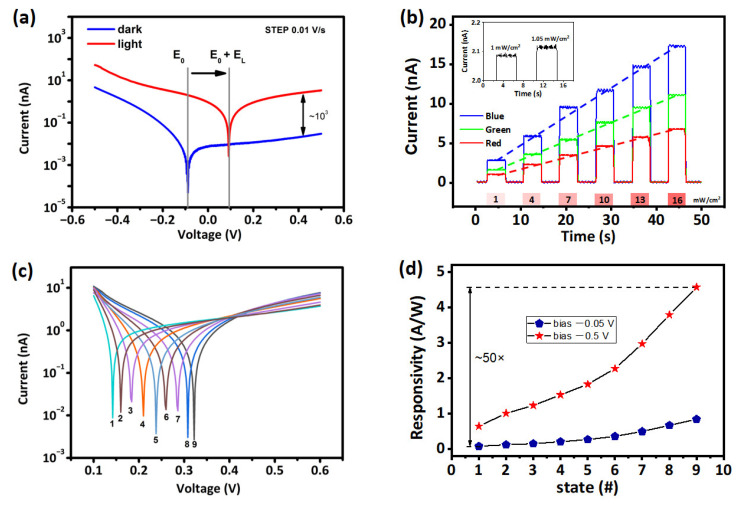
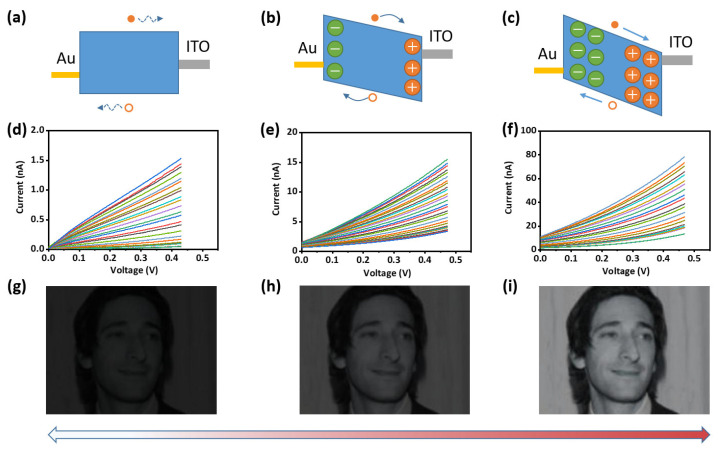
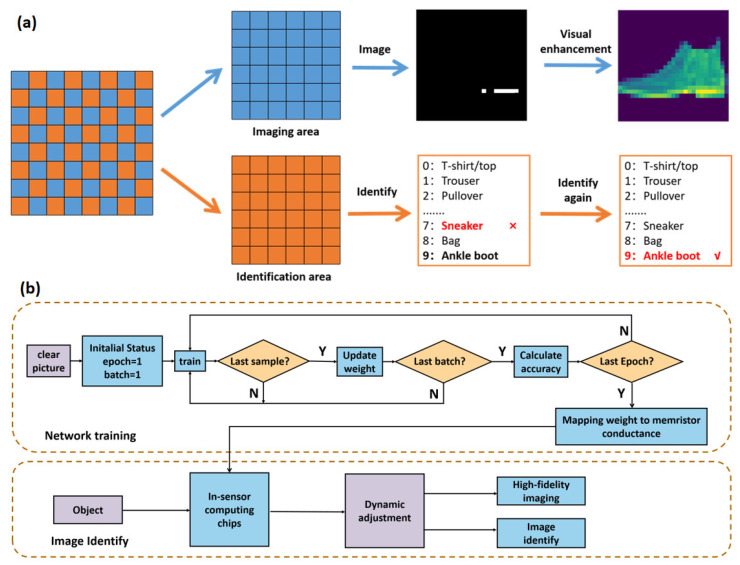
In-sensor computing can simultaneously output image information and recognition results through in-situ visual signal processing, which can greatly improve the efficiency of machine vision. However, in-sensor computing is challenging due to the requirement to controllably adjust the sensor's photosensitivity. Herein, it is demonstrated a ternary cationic halide CsFAMA Pb(IBr) (CsFAMA) perovskite, whose External quantum efficiency (EQE) value is above 80% in the entire visible region (400-750 nm), and peak responsibility value at 750 nm reaches 0.45 A/W. In addition, the device can achieve a 50-fold enhancement of the photoresponsibility under the same illumination by adjusting the internal ion migration and readout voltage. A proof-of-concept visually enhanced neural network system is demonstrated through the switchable photosensitivity of the perovskite sensor array, which can simultaneously optimize imaging and recognition results and improve object recognition accuracy by 17% in low-light environments.
传感器内计算可以通过原位视觉信号处理同时输出图像信息和识别结果,这可以大大提高机器视觉的效率。然而,由于需要可控地调节传感器的光敏性,传感器内计算具有挑战性。在此,展示了一种三元阳离子卤化物CsFAMA Pb(IBr)(CsFAMA)钙钛矿,其在整个可见光区域(400-750nm)的外量子效率(EQE)值高于80%,在750nm处的峰值响应值达到0.45A/W。此外,通过调节内部离子迁移和读出电压,该器件在相同光照下可实现光响应增强50倍。通过钙钛矿传感器阵列的可切换光敏性展示了一个概念验证的视觉增强神经网络系统,该系统可以同时优化成像和识别结果,并在低光环境中将目标识别准确率提高17%。