Department of Physics, Lakehead University, Thunder Bay, ON P7B 5E1, Canada.
Radialis Medical, Thunder Bay, ON P7A 7T1, Canada.
Sensors (Basel). 2022 Jun 21;22(13):4678. doi: 10.3390/s22134678.
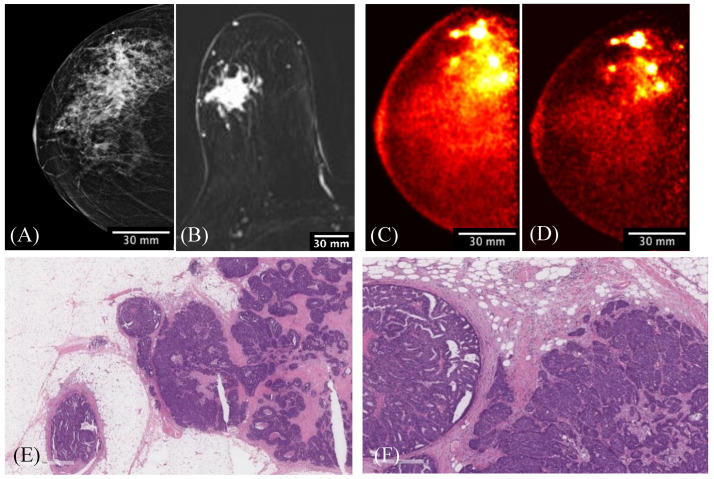
The aim of this study is to evaluate the performance of the Radialis organ-targeted positron emission tomography (PET) Camera with standardized tests and through assessment of clinical-imaging results. Sensitivity, count-rate performance, and spatial resolution were evaluated according to the National Electrical Manufacturers Association (NEMA) NU-4 standards, with necessary modifications to accommodate the planar detector design. The detectability of small objects was shown with micro hotspot phantom images. The clinical performance of the camera was also demonstrated through breast cancer images acquired with varying injected doses of 2-[fluorine-18]-fluoro-2-deoxy-D-glucose (F-FDG) and qualitatively compared with sample digital full-field mammography, magnetic resonance imaging (MRI), and whole-body (WB) PET images. Micro hotspot phantom sources were visualized down to 1.35 mm-diameter rods. Spatial resolution was calculated to be 2.3 ± 0.1 mm for the in-plane resolution and 6.8 ± 0.1 mm for the cross-plane resolution using maximum likelihood expectation maximization (MLEM) reconstruction. The system peak noise equivalent count rate was 17.8 kcps at a F-FDG concentration of 10.5 kBq/mL. System scatter fraction was 24%. The overall efficiency at the peak noise equivalent count rate was 5400 cps/MBq. The maximum axial sensitivity achieved was 3.5%, with an average system sensitivity of 2.4%. Selected results from clinical trials demonstrate capability of imaging lesions at the chest wall and identifying false-negative X-ray findings and false-positive MRI findings, even at up to a 10-fold dose reduction in comparison with standard F-FDG doses (i.e., at 37 MBq or 1 mCi). The evaluation of the organ-targeted Radialis PET Camera indicates that it is a promising technology for high-image-quality, low-dose PET imaging. High-efficiency radiotracer detection also opens an opportunity to reduce administered doses of radiopharmaceuticals and, therefore, patient exposure to radiation.
本研究旨在通过标准化测试和临床成像结果评估,评估 Radialis 器官靶向正电子发射断层扫描(PET)相机的性能。根据美国电器制造商协会(NEMA)NU-4 标准,对灵敏度、计数率性能和空间分辨率进行了评估,并对平面探测器设计进行了必要的修改。通过微热点体模图像显示了对小物体的探测能力。还通过不同注射剂量的 2-[氟-18]-氟-2-脱氧-D-葡萄糖(F-FDG)获得的乳腺癌图像来展示相机的临床性能,并与样本数字全视野乳房 X 线摄影、磁共振成像(MRI)和全身(WB)PET 图像进行定性比较。可以观察到直径为 1.35 毫米的微热点体模源。使用最大似然期望最大化(MLEM)重建,计算得到平面内分辨率为 2.3 ± 0.1 毫米,交叉平面分辨率为 6.8 ± 0.1 毫米。在 F-FDG 浓度为 10.5 kBq/mL 时,系统峰值噪声等效计数率为 17.8 kcps。系统散射分数为 24%。在峰值噪声等效计数率下,总效率为 5400 cps/MBq。达到的最大轴向灵敏度为 3.5%,平均系统灵敏度为 2.4%。临床试验的部分结果表明,该相机能够对胸壁病变进行成像,并识别 X 线检查的假阴性和 MRI 检查的假阳性结果,即使与标准 F-FDG 剂量相比,剂量降低 10 倍(即 37 MBq 或 1 mCi)也是如此。对器官靶向 Radialis PET 相机的评估表明,它是一种用于高质量、低剂量 PET 成像的有前途的技术。高效的放射性示踪剂检测还为减少放射性药物的给药剂量提供了机会,从而减少了患者的辐射暴露。