Vandenberghe Stefaan, Moskal Pawel, Karp Joel S
Department of Electronics and Information Systems, MEDISIP, Ghent University-IBiTech, De Pintelaan 185 block B, Ghent, B-9000, Belgium.
Institute of Physics, Jagiellonian University, Krakow, Poland.
EJNMMI Phys. 2020 May 25;7(1):35. doi: 10.1186/s40658-020-00290-2.
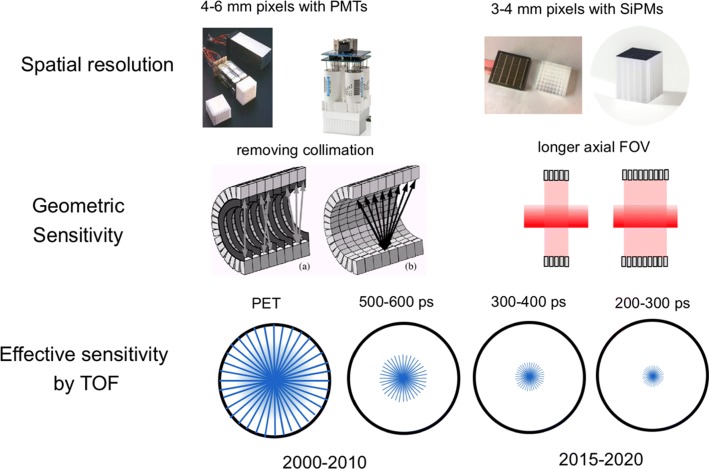
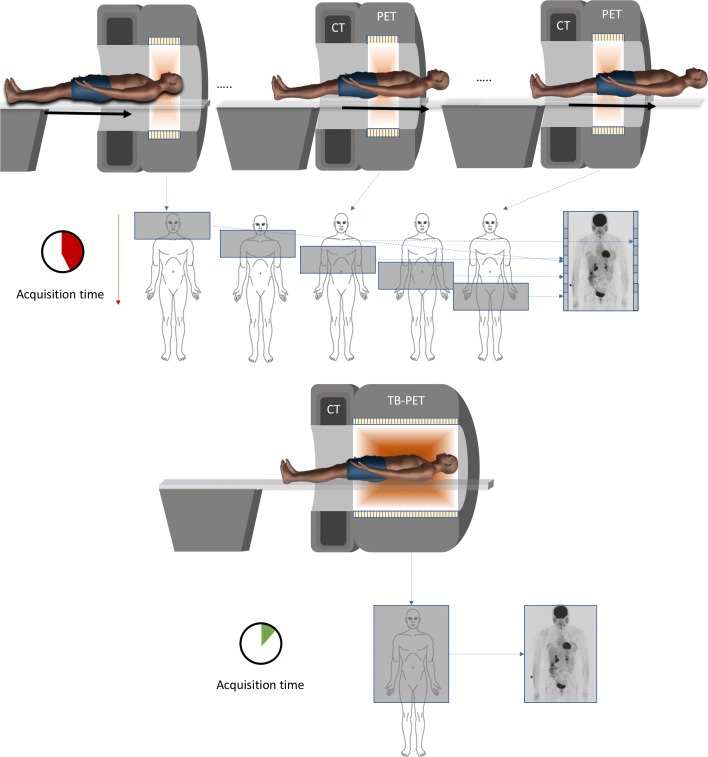
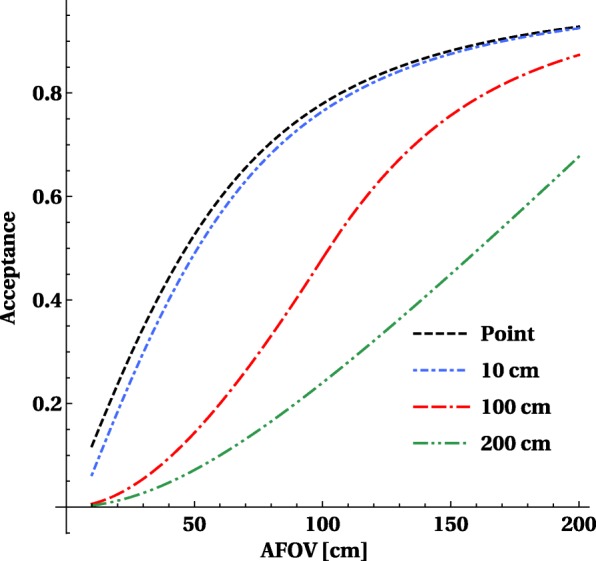
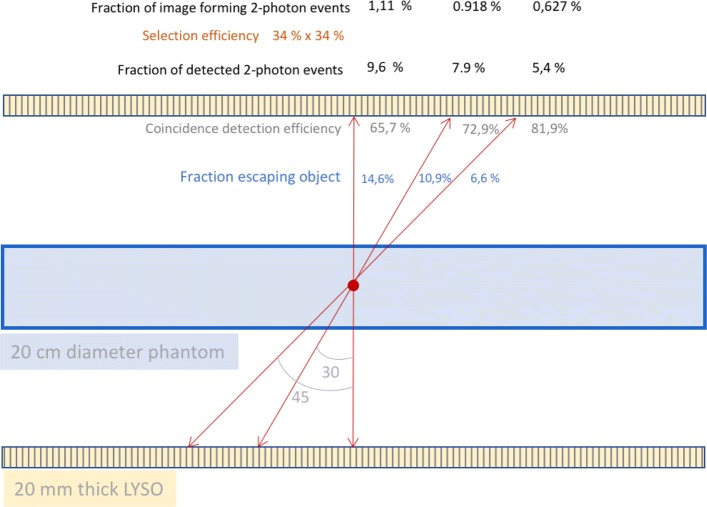
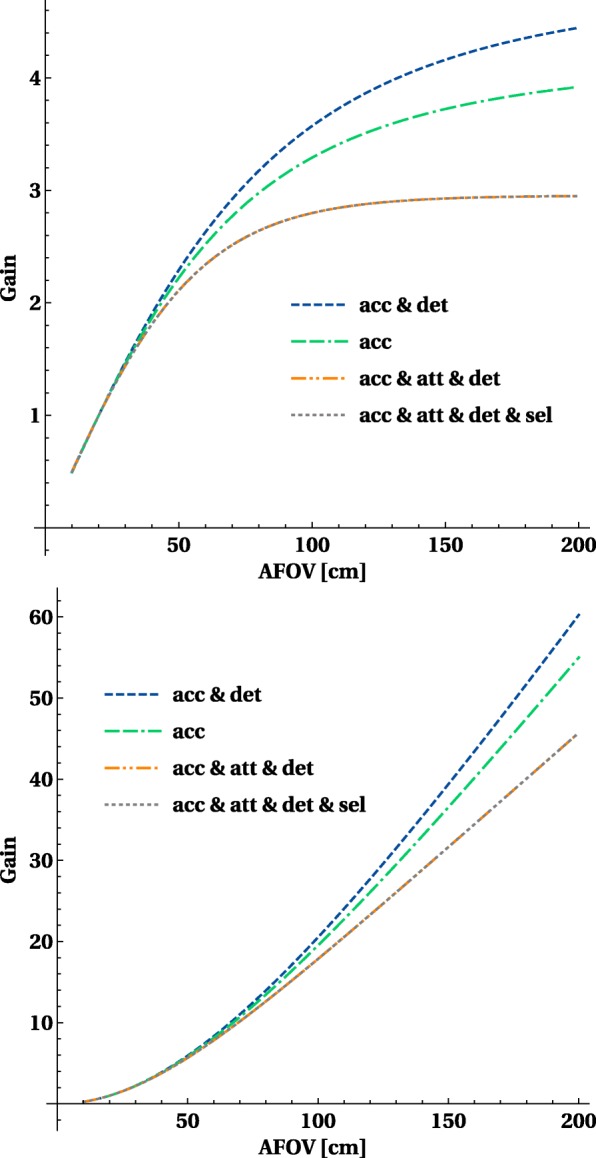
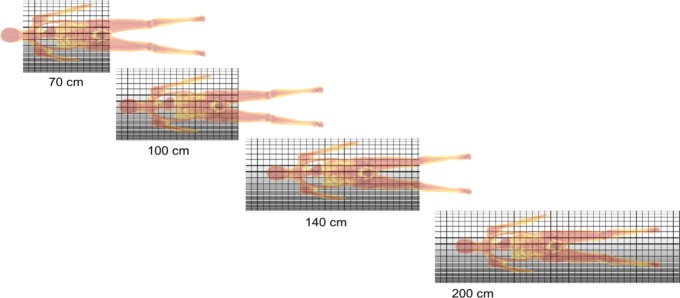
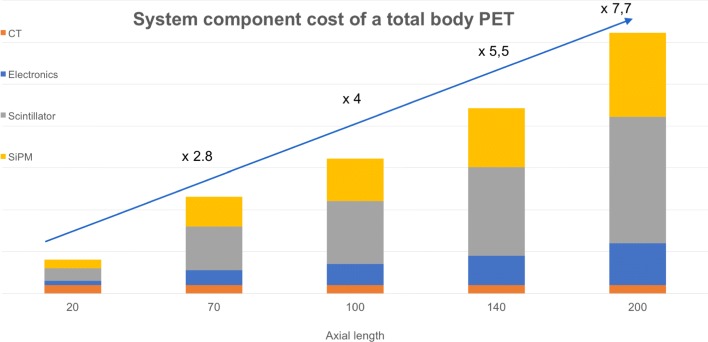
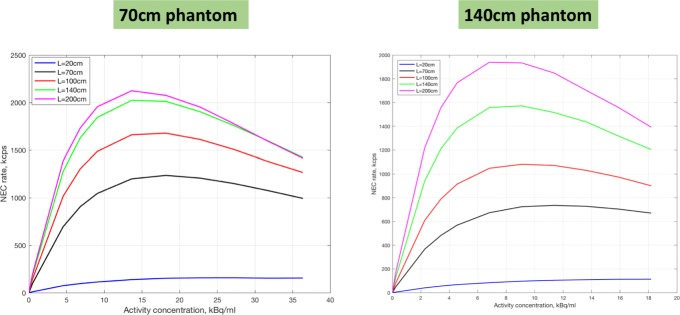
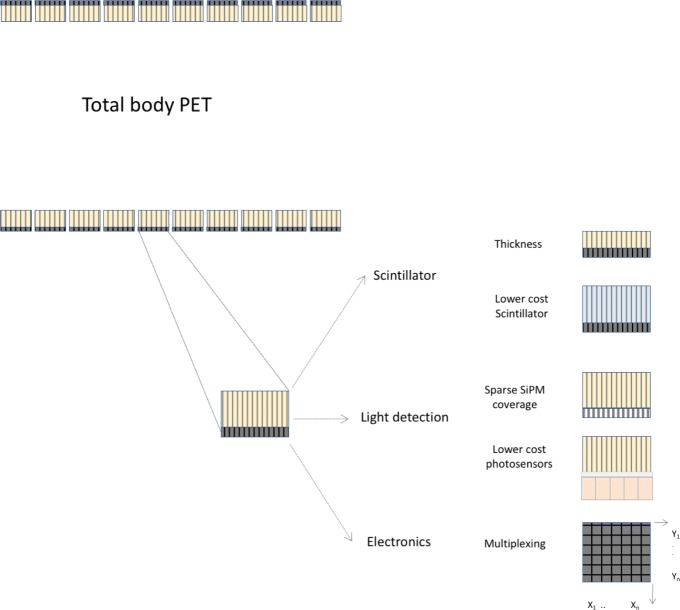
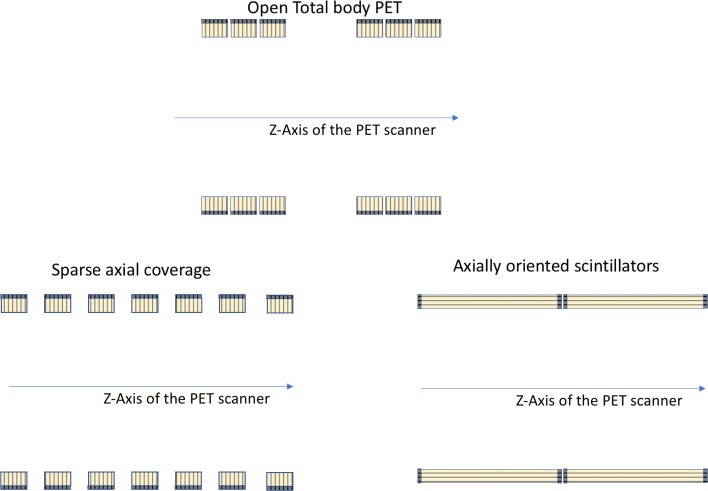
The idea of a very sensitive positron emission tomography (PET) system covering a large portion of the body of a patient already dates back to the early 1990s. In the period 2000-2010, only some prototypes with long axial field of view (FOV) have been built, which never resulted in systems used for clinical research. One of the reasons was the limitations in the available detector technology, which did not yet have sufficient energy resolution, timing resolution or countrate capabilities for fully exploiting the benefits of a long axial FOV design. PET was also not yet as widespread as it is today: the growth in oncology, which has become the major application of PET, appeared only after the introduction of PET-CT (early 2000).The detector technology used in most clinical PET systems today has a combination of good energy and timing resolution with higher countrate capabilities and has now been used since more than a decade to build time-of-flight (TOF) PET systems with fully 3D acquisitions. Based on this technology, one can construct total body PET systems and the remaining challenges (data handling, fast image reconstruction, detector cooling) are mostly related to engineering. The direct benefits of long axial FOV systems are mostly related to the higher sensitivity. For single organ imaging, the gain is close to the point source sensitivity which increases linearly with the axial length until it is limited by solid angle and attenuation of the body. The gains for single organ (compared to a fully 3D PET 20-cm axial FOV) are limited to a factor 3-4. But for long objects (like body scans), it increases quadratically with scanner length and factors of 10-40 × higher sensitivity are predicted for the long axial FOV scanner. This application of PET has seen a major increase (mostly in oncology) during the last 2 decades and is now the main type of study in a PET centre. As the technology is available and the full body concept also seems to match with existing applications, the old concept of a total body PET scanner is seeing a clear revival. Several research groups are working on this concept and after showing the potential via extensive simulations; construction of these systems has started about 2 years ago. In the first phase, two PET systems with long axial FOV suitable for large animal imaging were constructed to explore the potential in more experimental settings. Recently, the first completed total body PET systems for human use, a 70-cm-long system, called PennPET Explorer, and a 2-m-long system, called uExplorer, have become reality and first clinical studies have been shown. These results illustrate the large potential of this concept with regard to low-dose imaging, faster scanning, whole-body dynamic imaging and follow-up of tracers over longer periods. This large range of possible technical improvements seems to have the potential to change the current clinical routine and to expand the number of clinical applications of molecular imaging. The J-PET prototype is a prototype system with a long axial FOV built from axially arranged plastic scintillator strips.This paper gives an overview of the recent technical developments with regard to PET scanners with a long axial FOV covering at least the majority of the body (so called total body PET systems). After explaining the benefits and challenges of total body PET systems, the different total body PET system designs proposed for large animal and clinical imaging are described in detail. The axial length is one of the major factors determining the total cost of the system, but there are also other options in detector technology, design and processing for reducing the cost these systems. The limitations and advantages of different designs for research and clinical use are discussed taking into account potential applications and the increased cost of these systems.
早在20世纪90年代初,就已经有了关于构建一种能够覆盖患者身体大部分区域的高灵敏度正电子发射断层扫描(PET)系统的想法。在2000年至2010年期间,仅制造了一些具有长轴向视野(FOV)的原型机,但这些原型机从未发展成为用于临床研究的系统。其中一个原因是当时可用的探测器技术存在局限性,其能量分辨率、时间分辨率或计数率能力尚不足以充分利用长轴向FOV设计的优势。此外,PET在当时也不像现在这样普及:肿瘤学领域的发展,而肿瘤学如今已成为PET的主要应用领域,是在PET-CT推出后(2000年初)才出现的。如今大多数临床PET系统所使用的探测器技术,具备良好的能量和时间分辨率,同时计数率能力更高,并且在过去十多年里一直用于构建具有全三维采集功能的飞行时间(TOF)PET系统。基于这项技术,可以构建全身PET系统,而剩下的挑战(数据处理、快速图像重建、探测器冷却)大多与工程技术相关。长轴向FOV系统的直接优势主要与更高的灵敏度有关。对于单器官成像,增益接近点源灵敏度,点源灵敏度随轴向长度线性增加,直到受到立体角和身体衰减的限制。单器官成像的增益(与全三维PET中20厘米轴向FOV相比)仅限于3至4倍。但对于长物体(如全身扫描)而言,其增益随扫描仪长度呈二次方增加,预计长轴向FOV扫描仪的灵敏度会提高10至40倍。在过去20年中,PET的这种应用有了显著增长(主要在肿瘤学领域),如今已成为PET中心的主要研究类型。由于技术已经具备,并且全身概念似乎也与现有应用相匹配,全身PET扫描仪的旧概念正在明显复兴。几个研究小组正在研究这一概念,在通过广泛模拟展示了其潜力之后;大约在两年前开始构建这些系统。在第一阶段,构建了两台适用于大型动物成像的长轴向FOV的PET系统,以在更多实验环境中探索其潜力。最近,首批完成的供人类使用的全身PET系统,一个70厘米长的系统,称为宾夕法尼亚PET探索者(PennPET Explorer),以及一个2米长的系统,称为u探索者(uExplorer),已经成为现实,并且已经展示了首批临床研究成果。这些结果说明了这一概念在低剂量成像、更快扫描、全身动态成像以及更长时间追踪示踪剂方面的巨大潜力。这种大范围的可能技术改进似乎有潜力改变当前的临床常规,并扩大分子成像的临床应用数量。J-PET原型机是一个由轴向排列的塑料闪烁体条构建而成的具有长轴向FOV的原型系统。本文概述了关于具有至少覆盖身体大部分区域的长轴向FOV的PET扫描仪(即所谓的全身PET系统)的近期技术发展。在解释了全身PET系统的优势和挑战之后,详细描述了为大型动物和临床成像提出的不同全身PET系统设计。轴向长度是决定系统总成本的主要因素之一,但在探测器技术、设计和处理方面也有其他降低这些系统成本的选择。考虑到潜在应用以及这些系统成本的增加,讨论了不同设计在研究和临床应用中的局限性和优势。