
ARG-Mask RCNN:一种基于改进型Mask RCNN的红外绝缘子故障检测网络。
ARG-Mask RCNN: An Infrared Insulator Fault-Detection Network Based on Improved Mask RCNN.
作者信息
Zhou Ming, Wang Jue, Li Bo
机构信息
School of Information Science and Engineering, Dalian Polytechnic University, Dalian 116039, China.
出版信息
Sensors (Basel). 2022 Jun 22;22(13):4720. doi: 10.3390/s22134720.
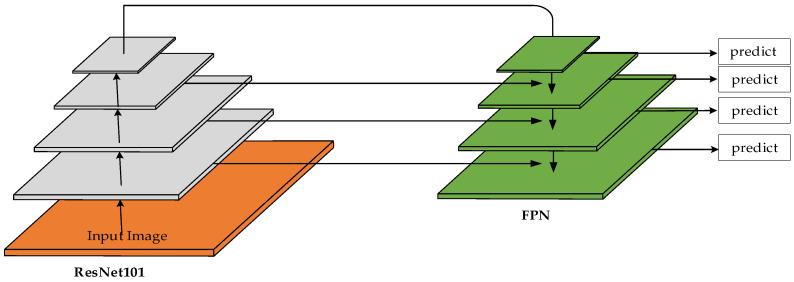
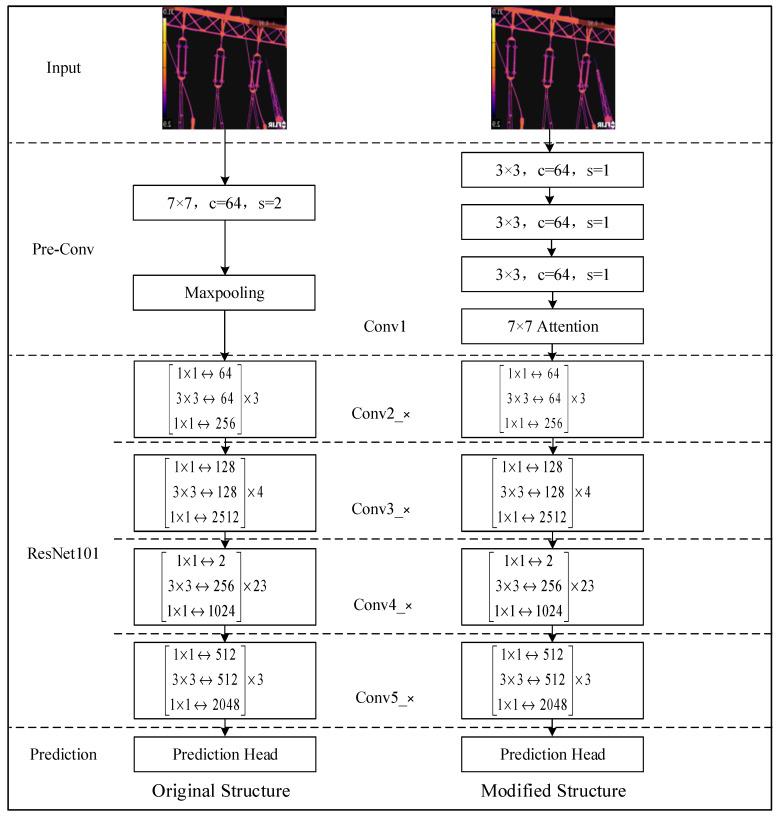
Traditional power equipment defect-detection relies on manual verification, which places a high demand on the verifier's experience, as well as a high workload and low efficiency, which can lead to false detection and missed detection. The Mask of the regions with CNN features (Mask RCNN) deep learning model is used to provide a defect-detection approach based on the Mask RCNN of Attention, Rotation, Genetic algorithm (ARG-Mask RCNN), which employs infrared imaging as the data source to assess the features of damaged insulators. For the backbone network of Mask RCNN, the structure of Residual Network 101 (ResNet101) is improved and the attention mechanism is added, which makes the model more alert to small targets and can quickly identify the location of small targets, improve the loss function, integrate the rotation mechanism into the loss function formula, and generate an anchor frame where a rotation angle is used to accurately locate the fault location. The initial hyperparameters of the network are improved, and the Genetic Algorithm Combined with Gradient Descent (GA-GD) algorithm is used to optimize the model hyperparameters, so that the model training results are as close to the global best as possible. The experimental results show that the average accuracy of the insulator fault-detection method proposed in this paper is as high as 98%, and the number of frames per second (FPS) is 5.75, which provides a guarantee of the safe, stable, and reliable operation of our country's power system.
传统的电力设备缺陷检测依靠人工核查,这对核查人员的经验要求很高,且工作量大、效率低,可能导致误检和漏检。基于卷积神经网络特征区域的掩膜(Mask RCNN)深度学习模型,提出了一种基于注意力、旋转、遗传算法的Mask RCNN(ARG-Mask RCNN)缺陷检测方法,该方法采用红外成像作为数据源来评估受损绝缘子的特征。对于Mask RCNN的骨干网络,改进了残差网络101(ResNet101)的结构并添加了注意力机制,使模型对小目标更敏感,能够快速识别小目标的位置,改进损失函数,将旋转机制集成到损失函数公式中,并生成一个使用旋转角度的锚框来精确定位故障位置。改进了网络的初始超参数,并使用遗传算法结合梯度下降(GA-GD)算法对模型超参数进行优化,使模型训练结果尽可能接近全局最优。实验结果表明,本文提出的绝缘子故障检测方法平均准确率高达98%,每秒帧数(FPS)为5.75,为我国电力系统的安全、稳定、可靠运行提供了保障。





 Zotero 插件