Department of Epidemiology and Surveillance, Centre for Infectious Diseases Control, National Institute of Public Health and the Environment (RIVM), Bilthoven, the Netherlands.
Centre for Social Research in Health, UNSW Sydney, Sydney, NSW, Australia; Institute for Prevention and Social Research, Utrecht, the Netherlands.
Vaccine. 2022 Aug 5;40(33):4889-4896. doi: 10.1016/j.vaccine.2022.06.075. Epub 2022 Jul 4.
During the COVID-19 pandemic, the number of hepatitis B virus (HBV) vaccinations among men who have sex with men (MSM) has been considerably lower than before the pandemic. Moreover, less frequent HBV testing and a reduction in numbers of sex partners have been reported. We assessed the impact of these COVID-19-related changes on HBV transmission among MSM in the Netherlands.
We estimated the changes in sexual activity, HBV testing, and HBV vaccination among MSM during the pandemic from Dutch data. We used a deterministic compartmental model and investigated scenarios with small or large declines in sexual activity, testing, and vaccination for the current phase of the pandemic (without available data). We examined the increase in HBV vaccinations needed to prevent further increase in HBV incidence.
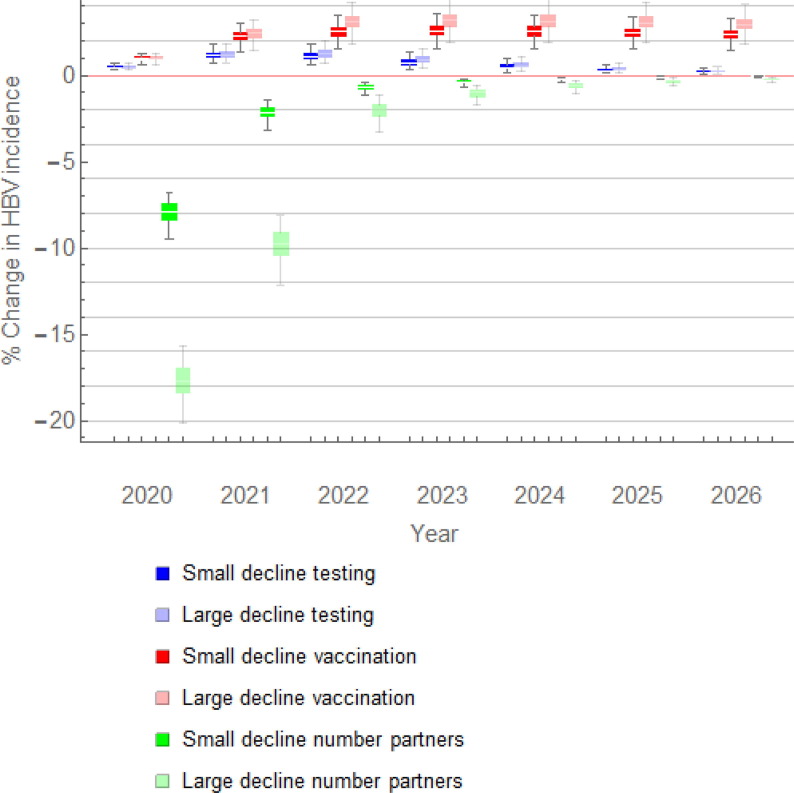
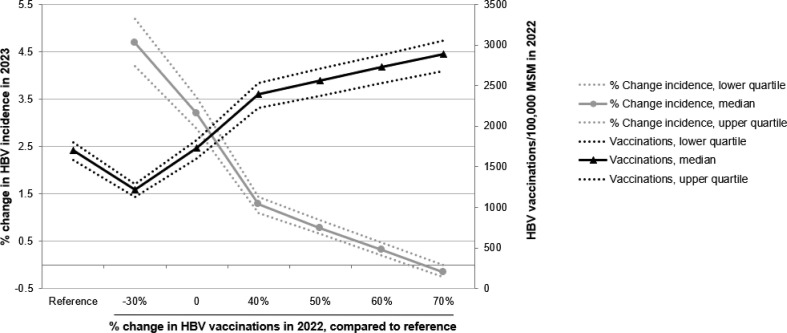
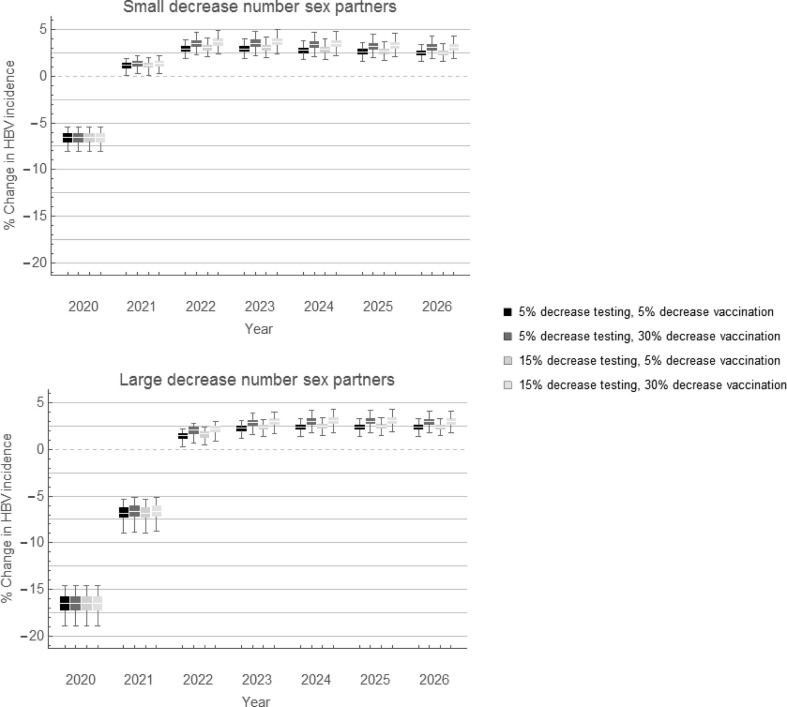
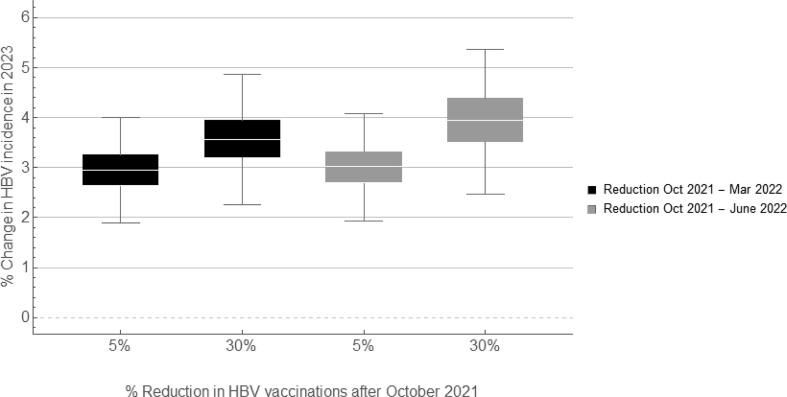
With a decrease in numbers of sex partners of 15-25% during the first lockdown and 5% during the second lockdown, we found a decline of 6.6% in HBV incidence in 2020, despite a >70% reduction in HBV testing and vaccination during the first lockdown. With numbers of sex partners rebounding close to pre-pandemic level in 2021, and a reduction of 15% in testing and 30% in vaccination in 2021, we found an increase of 1.4% in incidence in 2021 and 3.1% in 2026. With these changes, an increase of ≥60% in HBV vaccinations in 2022 would be needed to bring the HBV incidence in 2023 back to the level that it would have had if the COVID-19-related changes had not occurred.
Despite reductions in sexual activity during the COVID-19 pandemic, the decrease in HBV vaccinations may result in a small increase in HBV incidence after 2021, which may persist for years. It is important to restore the vaccination level and limit further increase in HBV transmission among MSM.
在 COVID-19 大流行期间,男男性行为者(MSM)的乙肝病毒(HBV)疫苗接种数量明显低于大流行前。此外,HBV 检测频率降低和性伴侣数量减少的情况也有报道。我们评估了这些与 COVID-19 相关的变化对荷兰 MSM 中 HBV 传播的影响。
我们从荷兰数据中评估了大流行期间 MSM 性行为、HBV 检测和 HBV 疫苗接种的变化。我们使用确定性隔室模型,研究了当前大流行阶段(无可用数据)中性行为、检测和疫苗接种数量减少的小或大情景。我们检查了预防 HBV 发病率进一步上升所需的 HBV 疫苗接种量增加。
在第一次封锁期间性伴侣数量减少 15-25%,第二次封锁期间减少 5%,我们发现 2020 年 HBV 发病率下降了 6.6%,尽管第一次封锁期间 HBV 检测和疫苗接种减少了 70%以上。随着 2021 年性伴侣数量接近大流行前水平的反弹,以及 2021 年检测减少 15%和疫苗接种减少 30%,我们发现 2021 年发病率增加 1.4%,2026 年增加 3.1%。如果这些变化发生,2022 年 HBV 疫苗接种量需要增加≥60%,才能使 2023 年的 HBV 发病率恢复到如果没有发生 COVID-19 相关变化本应达到的水平。
尽管 COVID-19 大流行期间性行为减少,但 HBV 疫苗接种量的减少可能会导致 2021 年后 HBV 发病率的小幅上升,这种情况可能会持续多年。重要的是要恢复疫苗接种水平,限制 MSM 中 HBV 传播的进一步增加。