Liang Yan, Lin Junyu, Hou Yanbing, Zhang Lingyu, Ou Ruwei, Li Chunyu, Wei Qianqian, Cao Bei, Liu Kuncheng, Jiang Zheng, Yang Tianmi, Yang Jing, Zhang Meng, Kang Simin, Xiao Yi, Jiang Qirui, Yang Jing, Song Wei, Chen Xueping, Zhao Bi, Wu Ying, Shang Huifang
Laboratory of Neurodegenerative Disorders, Department of Neurology, Rare Disease Center, West China Hospital, Sichuan University, Chengdu, China.
Front Neurol. 2022 Jun 23;13:895272. doi: 10.3389/fneur.2022.895272. eCollection 2022.
The study aimed to evaluate the health-related quality of life (HRQoL) measured by the five-level EuroQol-5 dimensions (EQ-5D-5L) in patients with cervical dystonia, and to explore the determinants of HRQoL in patients with cervical dystonia.
EQ-5D-5L health state profiles were converted into a single aggregated "health utility" score. A calibrated visual analog scale (EQ VAS) was used for self-rating of current health status. Multiple linear regression analysis was used to explore the factors associated with HRQoL in cervical dystonia.
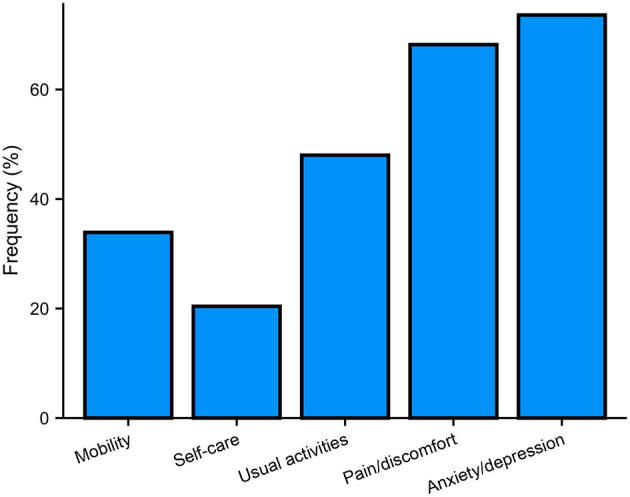
A total of 333 patients with cervical dystonia were enrolled in the analysis, with an average age of 44.3 years old. The most common impaired dimension of health was anxiety/depression (73.6%), followed by pain/discomfort (68.2%) and usual activities (48%). The median health utility score was 0.80, and the median EQ VAS score was 70.2. Multivariate linear regression analysis indicated that disease duration and the scores of the Hamilton Depression Rating Scale (HDRS), Pittsburgh sleep quality index (PSQI), Toronto Western Spasmodic Torticollis Rating Scale (TWSTRS) Part I, and TWSTRS Part III were associated with the health utility scores. After adjusting other parameters, the TWSTRS Part III score and the HDRS score were significantly associated with the EQ VAS scores ( < 0.05).
This study evaluated HRQoL in patients with cervical dystonia using the Chinese version of the EQ-5D-5L scale. We found that, besides motor symptoms, non-motor symptoms, including depression, pain, and sleep quality, could be greater determinants of HRQoL in patients with cervical dystonia. Management of non-motor symptoms, therefore, may help improve HRQoL in patients with cervical dystonia.
本研究旨在评估采用五级欧洲五维健康量表(EQ-5D-5L)测量的颈部肌张力障碍患者的健康相关生活质量(HRQoL),并探讨颈部肌张力障碍患者HRQoL的决定因素。
将EQ-5D-5L健康状态概况转换为单一汇总的“健康效用”分数。使用校准的视觉模拟量表(EQ VAS)对当前健康状况进行自我评分。采用多元线性回归分析探讨与颈部肌张力障碍患者HRQoL相关的因素。
共有333例颈部肌张力障碍患者纳入分析,平均年龄44.3岁。最常见的健康受损维度是焦虑/抑郁(73.6%),其次是疼痛/不适(68.2%)和日常活动(48%)。健康效用得分中位数为0.80,EQ VAS得分中位数为70.2。多变量线性回归分析表明,病程以及汉密尔顿抑郁量表(HDRS)、匹兹堡睡眠质量指数(PSQI)、多伦多西部痉挛性斜颈评定量表(TWSTRS)第一部分和TWSTRS第三部分的得分与健康效用得分相关。在调整其他参数后,TWSTRS第三部分得分和HDRS得分与EQ VAS得分显著相关(<0.05)。
本研究使用中文版EQ-5D-5L量表评估了颈部肌张力障碍患者的HRQoL。我们发现,除运动症状外,包括抑郁、疼痛和睡眠质量在内的非运动症状可能是颈部肌张力障碍患者HRQoL的更大决定因素。因此,管理非运动症状可能有助于改善颈部肌张力障碍患者的HRQoL。