Băjenaru Ovidiu Lucian, Nuță Cătălina Raluca, Băjenaru Lidia, Balog Alexandru, Constantinescu Alexandru, Andronic Octavian, Popescu Bogdan Ovidiu
Faculty of Medicine, "Carol Davila" University of Medicine and Pharmacy, 050474 Bucharest, Romania.
National Institute of Gerontology and Geriatrics "Ana Aslan", 011241 Bucharest, Romania.
J Clin Med. 2024 Jun 11;13(12):3403. doi: 10.3390/jcm13123403.
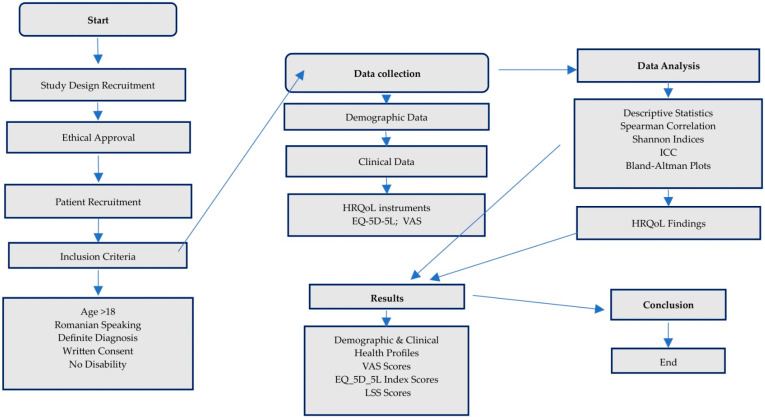
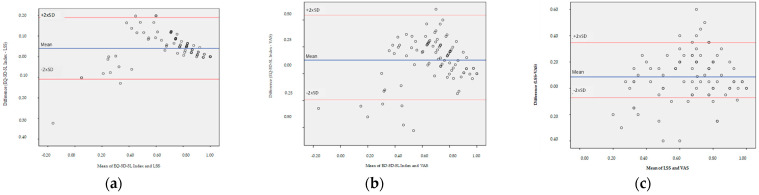
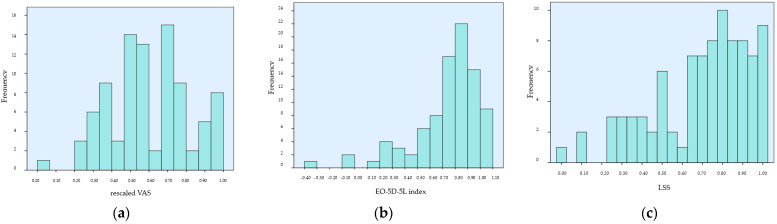
: Dystonia is a neurological movement disorder characterized by involuntary muscle contractions that lead to abnormal movements and postures; it has a major impact on patients' health-related quality of life (HRQoL). The aim of this study was to examine the HRQoL of Romanian patients with dystonia using the EQ-5D-5L instrument. : Responses to the EQ-5D-5L and the visual analogue scale (VAS) were collected alongside demographic and clinical characteristics. Health profiles were analyzed via the metrics of the EQ-5D-5L, severity levels, and age groups. Using Shannon's indexes, we calculated informativity both for patients' health profile as a whole and each individual dimension. Level sum scores (LSS) of the EQ-5D-5L were calculated and compared with scores from the EQ-5D-5L index and VAS. The HRQoL measures were analyzed through demographic and clinical characteristics. Descriptive statistics, Spearman correlation, and non-parametric tests (Mann-Whitney U or Kruskall-Wallis H) were used. The level of agreement between HRQoL measures was assessed using their intraclass correlation coefficient (ICC) and Bland-Altman plots. : A sample of 90 patients was used, around 75.6% of whom were female patients, and the mean age at the beginning of the survey was 58.7 years. The proportion of patients reporting "no problems" in all five dimensions was 10%. The highest frequency reported was "no problems" in self-care (66%), followed by "no problems" in mobility (41%). Shannon index and Shannon evenness index values showed higher informativity for pain/discomfort (2.07 and 0.89, respectively) and minimal informativity for self-care (1.59 and 0.68, respectively). The mean EQ-5D-5L index, LSS, and VAS scores were 0.74 (SD = 0.26), 0.70 (SD = 0.24), and 0.61 (SD = 0.21), respectively. The Spearman correlations between HRQoL measures were higher than 0.60. The agreement between the EQ-5D-5L index and LSS values was excellent (ICC = 0.970, 95% CI = 0.934-0.984); the agreement was poor-to-good between the EQ-5D-5L index and VAS scores (ICC = 683, 95% CI = 0.388-0.820), and moderate-to-good between the LSS and VAS scores (ICC = 0.789, 95% CI = 0.593-0.862). : Our results support the utilization of the EQ-5D-5L instrument in assessing the HRQoL of dystonia patients, and empirical results suggest that the EQ-5D-5L index and LSS measure may be used interchangeably. The findings from this study highlight that HRQoL is complex in patients with dystonia, particularly across different age groups.
肌张力障碍是一种神经运动障碍,其特征为非自主性肌肉收缩,导致异常运动和姿势;它对患者与健康相关的生活质量(HRQoL)有重大影响。本研究的目的是使用EQ-5D-5L工具来检查罗马尼亚肌张力障碍患者的HRQoL。:收集了对EQ-5D-5L和视觉模拟量表(VAS)的回答以及人口统计学和临床特征。通过EQ-5D-5L的指标、严重程度级别和年龄组对健康状况进行分析。使用香农指数,我们计算了患者整体健康状况以及每个维度的信息性。计算了EQ-5D-5L的水平总和得分(LSS),并与EQ-5D-5L指数和VAS的得分进行比较。通过人口统计学和临床特征对HRQoL测量值进行分析。使用了描述性统计、斯皮尔曼相关性和非参数检验(曼-惠特尼U检验或克鲁斯卡尔-沃利斯H检验)。使用组内相关系数(ICC)和布兰德-奥特曼图评估HRQoL测量值之间的一致性水平。:使用了90名患者的样本,其中约75.6%为女性患者,调查开始时的平均年龄为58.7岁。在所有五个维度中报告“无问题”的患者比例为10%。报告频率最高的是自我护理方面“无问题”(66%),其次是活动能力方面“无问题”(41%)。香农指数和香农均匀度指数值显示,疼痛/不适方面的信息性较高(分别为2.07和0.89),自我护理方面的信息性最低(分别为1.59和0.68)。EQ-5D-5L指数、LSS和VAS的平均得分分别为0.74(标准差=0.26)、0.70(标准差=0.24)和0.61(标准差=0.21)。HRQoL测量值之间的斯皮尔曼相关性高于0.60。EQ-5D-5L指数与LSS值之间的一致性极佳(ICC=0.970,95%置信区间=0.934-0.984);EQ-5D-5L指数与VAS得分之间的一致性为差到良好(ICC=0.683,95%置信区间=0.388-0.820),LSS与VAS得分之间的一致性为中等至良好(ICC=0.789,95%置信区间=0.593-0.862)。:我们的结果支持使用EQ-5D-5L工具评估肌张力障碍患者的HRQoL,实证结果表明EQ-5D-5L指数和LSS测量值可能可以互换使用。本研究的结果突出表明,肌张力障碍患者的HRQoL很复杂,尤其是在不同年龄组之间。