Amatruda Jonathan G, Katz Ronit, Sarnak Mark J, Gutierrez Orlando M, Greenberg Jason H, Cushman Mary, Waikar Sushrut, Parikh Chirag R, Schelling Jeffrey R, Jogalekar Manasi P, Bonventre Joseph V, Vasan Ramachandran S, Kimmel Paul L, Shlipak Michael G, Ix Joachim H
Division of Nephrology, Department of Medicine, University of California San Francisco, San Francisco, California, USA.
Kidney Health Research Collaborative, San Francisco VA Medical Center and University of California, San Francisco, San Francisco, California, USA.
Kidney Int Rep. 2022 Apr 5;7(7):1514-1523. doi: 10.1016/j.ekir.2022.03.033. eCollection 2022 Jul.
Tubulointerstitial damage in diabetes and chronic kidney disease (CKD) is poorly captured by estimated glomerular filtration rate (eGFR) and albuminuria. Urine biomarkers of kidney health may better elucidate disease progression in persons with diabetes and CKD.
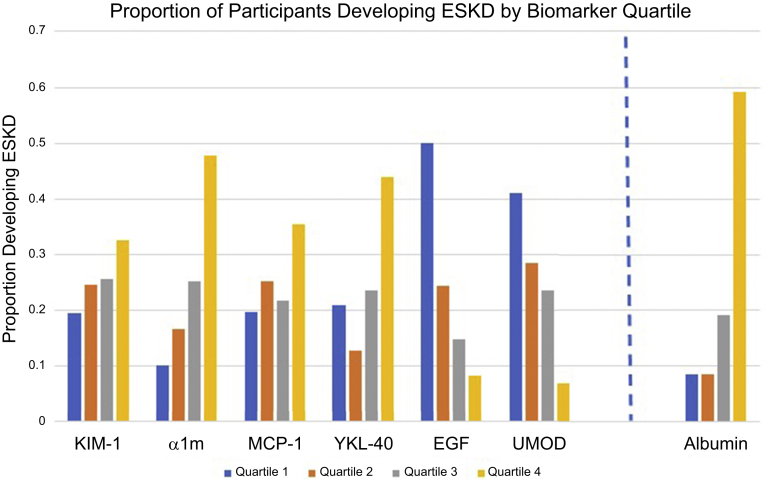
Per case-cohort design, we randomly selected a subcohort of 560 study participants of the REasons for Geographic And Racial Differences in Stroke (REGARDS) study from 1092 adults with diabetes and baseline eGFR <60 ml/min per 1.73 m and registered a total of 161 end-stage kidney disease (ESKD) cases ( = 93 from the subcohort; = 68 from outside the subcohort) during 4.3 ± 2.7 years mean follow-up. We measured urine biomarkers of kidney tubule injury (kidney injury molecule-1 [KIM-1]), inflammation and fibrosis (monocyte chemoattractant protein-1 [MCP-1]), repair (chitinase-3-like protein 1 [YKL-40]), and tubule function, including reabsorption (alpha-1-microglobulin [α1m]) and synthetic capacity (epidermal growth factor [EGF] and uromodulin [UMOD]). Weighted Cox regression models estimated ESKD risk adjusting for demographics, ESKD risk factors, and baseline eGFR and urine albumin. Least absolute shrinkage and selection operator (LASSO) regression identified a subset of biomarkers most strongly associated with ESKD.
At baseline, subcohort participants had mean age of 70 ± 9 years, mean eGFR of 40 ±13 ml/min per 1.73 m, and median urine albumin-to-creatinine ratio of 33 (interquartile range 10-213) mg/g. Adjusting for baseline eGFR and albuminuria, each 2-fold higher urine KIM-1 (hazard ratio = 1.43 [95% CI: 1.17-1.75]), α1m (hazard ratio = 1.47 [1.19-1.82]), and MCP-1 (hazard ratio = 1.27 [1.06-1.53]) were independently associated with ESKD. LASSO retained KIM-1 and α1m for associations with ESKD.
Among adults with diabetes and eGFR <60 ml/min per 1.73 m, higher urine KIM-1, α1m, and MCP-1 are independently associated with incident ESKD, providing insight into kidney disease progression in persons with diabetes and CKD.
糖尿病和慢性肾脏病(CKD)中的肾小管间质损伤难以通过估算肾小球滤过率(eGFR)和蛋白尿来准确反映。肾脏健康的尿液生物标志物可能能更好地阐明糖尿病和CKD患者的疾病进展情况。
按照病例队列设计,我们从1092名糖尿病且基线eGFR<60 ml/(min·1.73 m²)的成年人中,随机选取了560名研究参与者作为亚队列,参与卒中地理和种族差异原因(REGARDS)研究。在平均4.3±2.7年的随访期间,共记录了161例终末期肾病(ESKD)病例(亚队列中有93例;亚队列外有68例)。我们检测了肾小管损伤(肾损伤分子-1 [KIM-1])、炎症和纤维化(单核细胞趋化蛋白-1 [MCP-1])、修复(几丁质酶-3样蛋白1 [YKL-40])以及肾小管功能的尿液生物标志物,包括重吸收(α1-微球蛋白[α1m])和合成能力(表皮生长因子[EGF]和尿调节蛋白[UMOD])。加权Cox回归模型在对人口统计学、ESKD危险因素、基线eGFR和尿白蛋白进行校正后,估计ESKD风险。最小绝对收缩和选择算子(LASSO)回归确定了与ESKD关联最密切的一组生物标志物。
在基线时,亚队列参与者的平均年龄为70±9岁,平均eGFR为40±13 ml/(min·1.73 m²),尿白蛋白与肌酐比值的中位数为33(四分位间距10 - 213)mg/g。在校正基线eGFR和蛋白尿后,尿KIM-1每升高2倍(风险比=1.43 [95% CI:1.17 - 1.75])、α1m每升高2倍(风险比=1.47 [1.19 - 1.82])以及MCP-1每升高2倍(风险比=1.27 [1.06 - 1.53])均与ESKD独立相关。LASSO保留了KIM-1和α1m与ESKD的关联。
在糖尿病且eGFR<60 ml/(min·1.73 m²)的成年人中,较高的尿KIM-1、α1m和MCP-1与新发ESKD独立相关,这为了解糖尿病和CKD患者的肾脏疾病进展提供了依据。