Department of Neurology, Tianjin Medical University General Hospital, Tianjin Neurological Institute, Key Laboratory of Post-Neurotrauma, Neurorepair, and Regeneration in Central Nervous System, Ministry of Education and Tianjin City, Tianjin, China.
Front Immunol. 2022 Jun 23;13:870174. doi: 10.3389/fimmu.2022.870174. eCollection 2022.
Intracerebral hemorrhage (ICH) is the devastating subtype of stroke with cardiovascular complications, resulting in high rates of mortality and morbidity with the release of inflammatory factors. Previous studies have demonstrated that activation of α7nAChR can reduce immune and inflammation-related diseases by triggering the cholinergic anti-inflammatory pathway (CAIP). α7nAChR mediates protection from nervous system inflammation through AMPK-mTOR-p70S6K-associated autophagy. Therefore, the purpose of this study is to explore whether the activation of α7nAChR improves cerebral and cardiac dysfunction after ICH through autophagy.
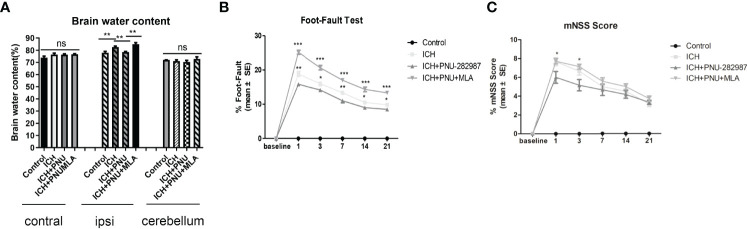
Male C57BL/6 mice were randomly divided into five groups : Control + saline , ICH+ saline , ICH + PNU-282987 , ICH+ PNU-282987 + MLA , ICH + PNU-282987 + 3-MA. The neurological function was evaluated at multiple time points. Brain water content was measured at 3 days after ICH to assess the severity of brain edema. PCR, immunofluorescence staining, and Western Blot were performed at 7 days after ICH to detect inflammation and autophagy. Picro-Sirius Red staining was measured at 30 days after ICH to evaluate myocardial fibrosis, echocardiography was performed at 3 and 30 days to measure cardiac function.
Our results indicated that the PNU-282987 reduced inflammatory factors (MCP-1, IL-1β, MMP-9, TNF-α, HMGB1, TLR2), promoted the polarization of macrophage/microglia into anti-inflammatory subtypes(CD206), repaired blood-brain barrier injury (ZO-1, Claudin-5, Occludin), alleviated acute brain edema and then recovered neurological dysfunction. Echocardiography and PSR indicated that activation of α7nAChR ameliorated cardiac dysfunction. Western Blot showed that activation of α7nAChR increased autophagy protein (LC3, Beclin) and decreased P62. It demonstrated that the activation of α7nAChR promotes autophagy and then recovers brain and heart function after ICH.
In conclusion, PNU-282987 promoted the cerebral and cardiac functional outcomes after ICH in mice through activated α7nAChR, which may be attributable to promoting autophagy and then reducing inflammatory reactions after ICH.
脑出血(ICH)是具有心血管并发症的破坏性中风亚型,由于炎症因子的释放,其死亡率和发病率很高。先前的研究表明,通过触发胆碱能抗炎途径(CAIP),激活α7nAChR 可以减少免疫和炎症相关疾病。α7nAChR 通过 AMPK-mTOR-p70S6K 相关自噬介导对神经系统炎症的保护。因此,本研究的目的是探讨激活α7nAChR 是否通过自噬改善 ICH 后的脑和心脏功能障碍。
雄性 C57BL/6 小鼠随机分为五组:对照组+生理盐水、ICH+生理盐水、ICH+PNU-282987、ICH+PNU-282987+MLA、ICH+PNU-282987+3-MA。在多个时间点评估神经功能。ICH 后 3 天测量脑水含量,以评估脑水肿的严重程度。PCR、免疫荧光染色和 Western Blot 于 ICH 后 7 天进行,以检测炎症和自噬。ICH 后 30 天进行皮尔斯-西里红染色,以评估心肌纤维化,在 3 和 30 天进行超声心动图,以测量心功能。
我们的结果表明,PNU-282987 降低了炎症因子(MCP-1、IL-1β、MMP-9、TNF-α、HMGB1、TLR2),促进了巨噬细胞/小胶质细胞向抗炎表型(CD206)极化,修复了血脑屏障损伤(ZO-1、Claudin-5、Occludin),减轻了急性脑水肿,从而恢复了神经功能障碍。超声心动图和 PSR 表明,激活α7nAChR 改善了心脏功能障碍。Western Blot 显示,激活α7nAChR 增加了自噬蛋白(LC3、Beclin)并减少了 P62。这表明激活α7nAChR 在 ICH 后促进自噬,从而恢复脑和心脏功能。
总之,PNU-282987 通过激活α7nAChR 促进了 ICH 后小鼠的大脑和心脏功能恢复,这可能归因于 ICH 后促进自噬和减少炎症反应。