Dolley Danielle, Walter Cheryl, du Randt Rosa, Pühse Uwe, Bosma Jacob, Aerts Ann, Adams Larissa, Arnaiz Patricia, Degen Jan, Gall Stefanie, Joubert Nandi, Müller Ivan, Nienaber Madeleine, Nqweniso Felicitas, Seelig Harald, Steinmann Peter, Utzinger Jürg, Gerber Markus
Department of Human Movement Science, Nelson Mandela University, Gqeberha, Eastern Cape, South Africa.
Department of Sport, Exercise and Health, University of Basel, Basel, Switzerland.
BMJ Open Sport Exerc Med. 2022 Jun 23;8(2):e001336. doi: 10.1136/bmjsem-2022-001336. eCollection 2022.
To determine the prevalence of individual cardiovascular disease (CVD) risk factors and clustered CVD risk among children attending schools in periurban areas of Gqeberha and to investigate the independent association between clustered CVD risk, moderate to vigorous physical activity (MVPA) and cardiorespiratory fitness (CRF).
Baseline data were collected in a cross-sectional analysis of 975 children aged 8-13 years. We measured the height, weight, waist circumference, blood pressure, fasting glucose, full lipid panel, 20 m shuttle run performance and accelerometry. The prevalence of individual risk factors was determined, and a clustered risk score (CRS) was constructed using principal component analysis. Children with an elevated CRS of 1 SD above the average CRS were considered 'at-risk'.
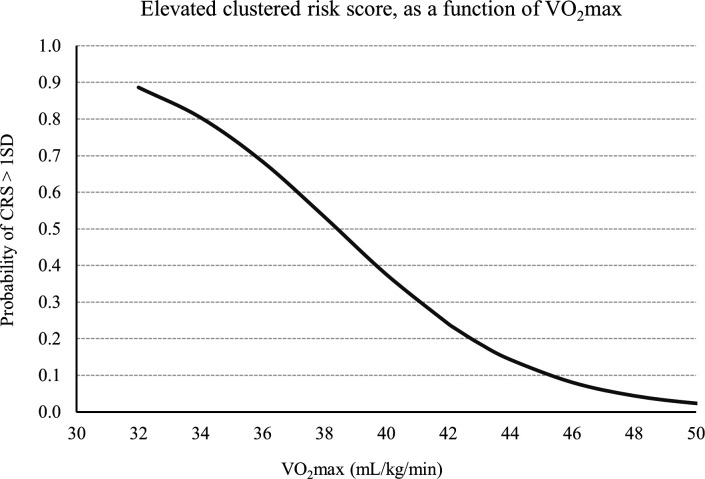
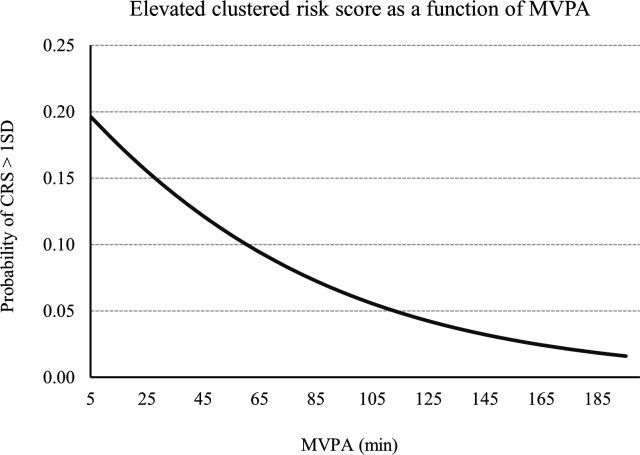
We found 424 children (43.3%) having at least one elevated CVD risk factor: 27.7% elevated triglycerides, 20.7% depressed high-density lipoprotein cholesterol and 15.9% elevated total cholesterol. An elevated clustered risk was identified in 17% (n=104) of the sample; girls exhibited a significantly higher CRS >1 SD than boys (p=0.036). The estimated odds of an elevated clustered risk are doubled every 2 mL/kg/min decrease in VOmax (95% CI 1.66 to 3.12) or every 49 min reduction in MVPA (95% CI 27 to 224).
A relatively high prevalence of elevated individual and clustered CVD risk was identified. Our results have also confirmed the independent inverse association of the clustered CVD risk with physical activity and CRF. These indicate that increased levels of CRF or MVPA may aid in the prevention and reduction of elevated clustered CVD risk.
确定伊丽莎白港周边地区学校儿童个体心血管疾病(CVD)危险因素及聚集性CVD风险的患病率,并调查聚集性CVD风险、中度至剧烈身体活动(MVPA)和心肺适能(CRF)之间的独立关联。
对975名8至13岁儿童进行横断面分析,收集基线数据。我们测量了身高、体重、腰围、血压、空腹血糖、全血脂谱、20米往返跑成绩和加速度计数据。确定个体危险因素的患病率,并使用主成分分析构建聚集风险评分(CRS)。CRS高于平均CRS 1个标准差的儿童被视为“高危”。
我们发现424名儿童(43.3%)至少有一项升高的CVD危险因素:27.7%甘油三酯升高,20.7%高密度脂蛋白胆固醇降低,15.9%总胆固醇升高。17%(n = 104)的样本中发现聚集风险升高;女孩的CRS>1个标准差显著高于男孩(p = 0.036)。每降低2 mL/kg/min的最大摄氧量(95% CI 1.66至3.12)或每减少49分钟的MVPA(95% CI 27至224),聚集风险升高的估计几率就会加倍。
确定了个体和聚集性CVD风险升高的相对较高患病率。我们的结果还证实了聚集性CVD风险与身体活动和CRF之间存在独立的负相关。这些表明,提高CRF或MVPA水平可能有助于预防和降低聚集性CVD风险升高。