Jaradeh Mark, Curran Brett, Poulikidis Kostantinos, Rodrigues Adrian, Jeske Walter, Abdelsattar Zaid M, Lubawski James, Walenga Jeanine, Vigneswaran Wickii T
Department of Thoracic and Cardiovascular Surgery, Loyola University Medical Center, Maywood, IL, USA.
J Thorac Dis. 2022 Jun;14(6):2000-2010. doi: 10.21037/jtd-21-1820.
Cytokines play a crucial role in the inflammatory response and are essential modulators of injury repair mechanisms. While minimally invasive operations have been shown to induce lower levels of cytokines compared to open thoracotomy, the inflammatory cytokine profile difference between video-assisted (VATS) and robotic-assisted thoracic surgery (RATS) techniques has yet to be elucidated.
In this prospective observational study of 45 patients undergoing RATS (n=30) or VATS (n=15) lung resection for malignancy, plasma levels of interleukin (IL)-1α, IL-1β, IL-2, IL-4, IL-6, IL-8, IL-10, vascular endothelial growth factor (VEGF), interferon (IFN)-γ, tumor necrosis factor (TNF)-α, monocyte chemo-attractant protein (MCP)-1, and endothelial growth factor (EGF) were measured before and after surgery via immunoassay.
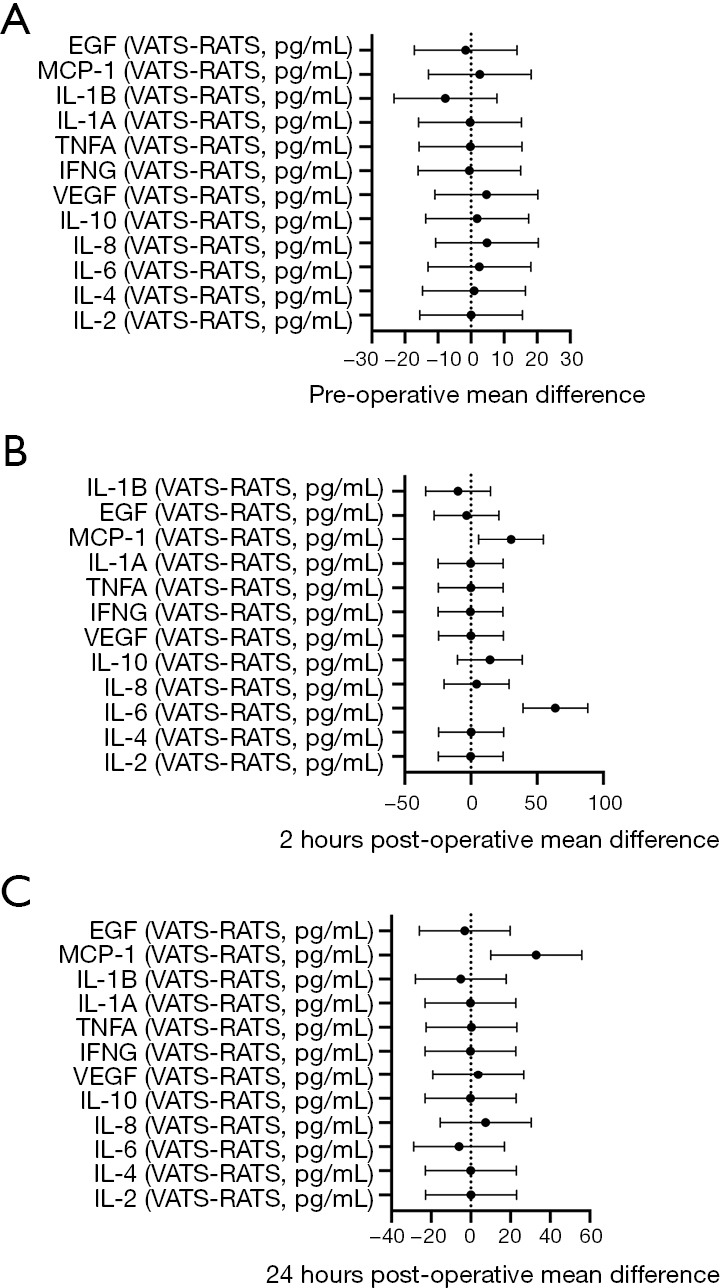
Levels of IL-6 and MCP-1 were significantly higher in patients undergoing VATS than in patients undergoing RATS (P<0.001 and P=0.005, respectively) 2 hours following surgery. MCP-1 levels were also found to be significantly higher in the VATS group (P<0.001) 24 hours following surgery. IL-1α, IL-1β, IL-2, IL-4, IL-8, IL-10, IFN-γ, TNF-α, and EGF levels were not significantly different at any time-point comparing VATS to RATS.
The VATS approach is associated with a more robust pro-inflammatory cytokine response through the upregulation of MCP-1 and IL-6 when compared to the RATS approach in patients undergoing anatomic lung resection. Further studies are necessary to validate the clinical significance of this finding.
细胞因子在炎症反应中起关键作用,是损伤修复机制的重要调节因子。虽然与开胸手术相比,微创手术已被证明可诱导较低水平的细胞因子,但电视辅助(VATS)和机器人辅助胸外科手术(RATS)技术之间的炎性细胞因子谱差异尚未阐明。
在这项对45例因恶性肿瘤接受RATS(n = 30)或VATS(n = 15)肺切除术的患者进行的前瞻性观察研究中,通过免疫测定法测量手术前后血浆中白细胞介素(IL)-1α、IL-1β、IL-2、IL-4、IL-6、IL-8、IL-10、血管内皮生长因子(VEGF)、干扰素(IFN)-γ、肿瘤坏死因子(TNF)-α、单核细胞趋化蛋白(MCP)-1和内皮生长因子(EGF)的水平。
手术后2小时,接受VATS的患者中IL-6和MCP-1水平显著高于接受RATS的患者(分别为P < 0.001和P = 0.005)。还发现手术后24小时VATS组的MCP-1水平也显著更高(P < 0.001)。在比较VATS和RATS的任何时间点,IL-1α、IL-1β、IL-2、IL-4、IL-8、IL-10、IFN-γ、TNF-α和EGF水平均无显著差异。
在接受解剖性肺切除术的患者中,与RATS方法相比,VATS方法通过上调MCP-1和IL-6与更强的促炎细胞因子反应相关。需要进一步研究来验证这一发现的临床意义。