Brummer Tobias, Muthuraman Muthuraman, Steffen Falk, Uphaus Timo, Minch Lena, Person Maren, Zipp Frauke, Groppa Sergiu, Bittner Stefan, Fleischer Vinzenz
Department of Neurology, Focus Program Translational Neuroscience (FTN) and Immunotherapy (FZI), Rhine Main Neuroscience Network (rmn2), University Medical Center of the Johannes Gutenberg University Mainz, Langenbeckstr, 1, Mainz 55131, Germany.
Brain Commun. 2022 Jul 8;4(4):fcac153. doi: 10.1093/braincomms/fcac153. eCollection 2022.
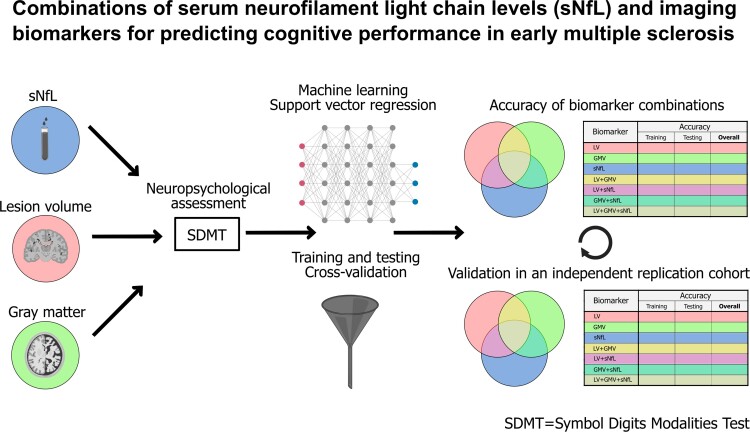
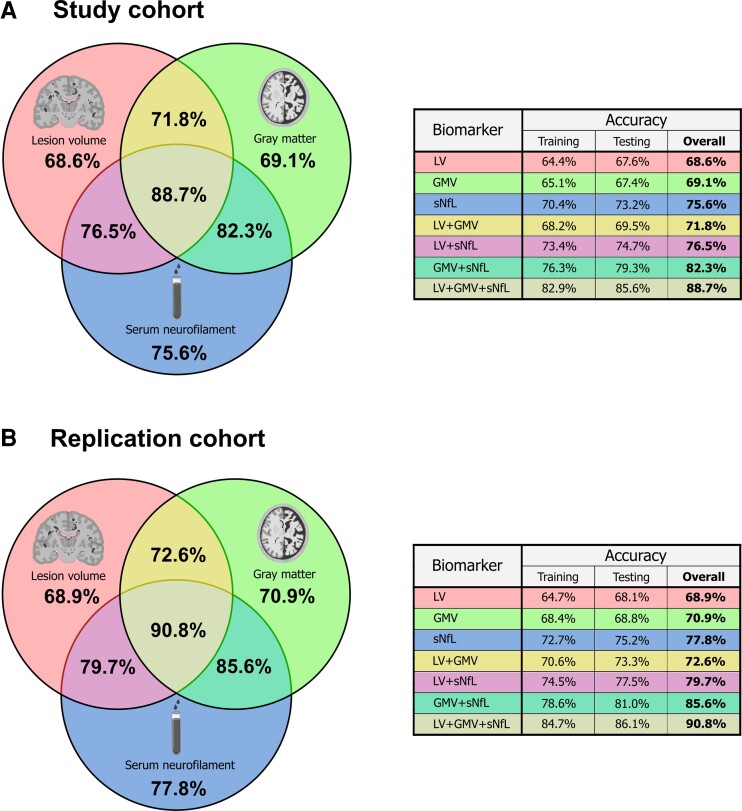
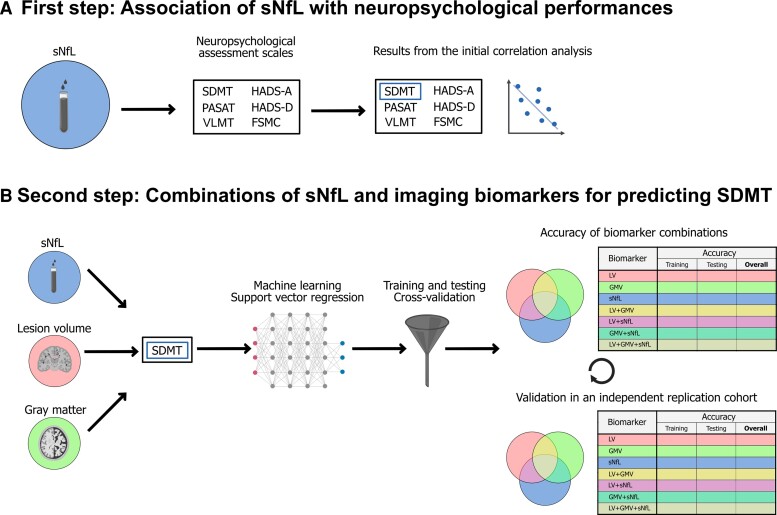
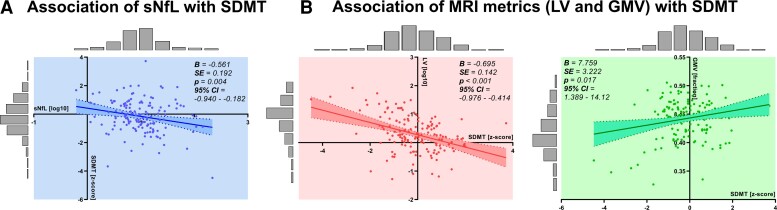
Disability in multiple sclerosis is generally classified by sensory and motor symptoms, yet cognitive impairment has been identified as a frequent manifestation already in the early disease stages. Imaging- and more recently blood-based biomarkers have become increasingly important for understanding cognitive decline associated with multiple sclerosis. Thus, we sought to determine the prognostic utility of serum neurofilament light chain levels alone and in combination with MRI markers by examining their ability to predict cognitive impairment in early multiple sclerosis. A comprehensive and detailed assessment of 152 early multiple sclerosis patients (Expanded Disability Status Scale: 1.3 ± 1.2, mean age: 33.0 ± 10.0 years) was performed, which included serum neurofilament light chain measurement, MRI markers (i.e. T-hyperintense lesion volume and grey matter volume) acquisition and completion of a set of cognitive tests (Symbol Digits Modalities Test, Paced Auditory Serial Addition Test, Verbal Learning and Memory Test) and mood questionnaires (Hospital Anxiety and Depression scale, Fatigue Scale for Motor and Cognitive Functions). Support vector regression, a branch of unsupervised machine learning, was applied to test serum neurofilament light chain and combination models of biomarkers for the prediction of neuropsychological test performance. The support vector regression results were validated in a replication cohort of 101 early multiple sclerosis patients (Expanded Disability Status Scale: 1.1 ± 1.2, mean age: 34.4 ± 10.6 years). Higher serum neurofilament light chain levels were associated with worse Symbol Digits Modalities Test scores after adjusting for age, sex Expanded Disability Status Scale, disease duration and disease-modifying therapy (B = -0.561; SE = 0.192; = 0.004; 95% CI = -0.940 to -0.182). Besides this association, serum neurofilament light chain levels were not linked to any other cognitive or mood measures (all -values > 0.05). The tripartite combination of serum neurofilament light chain levels, lesion volume and grey matter volume showed a cross-validated accuracy of 88.7% (90.8% in the replication cohort) in predicting Symbol Digits Modalities Test performance in the support vector regression approach, and outperformed each single biomarker (accuracy range: 68.6-75.6% and 68.9-77.8% in the replication cohort), as well as the dual biomarker combinations (accuracy range: 71.8-82.3% and 72.6-85.6% in the replication cohort). Taken together, early neuro-axonal loss reflects worse information processing speed, the key deficit underlying cognitive dysfunction in multiple sclerosis. Our findings demonstrate that combining blood and imaging measures improves the accuracy of predicting cognitive impairment, highlighting the clinical utility of cross-modal biomarkers in multiple sclerosis.
多发性硬化症的残疾通常根据感觉和运动症状进行分类,但认知障碍在疾病早期就已被确认为常见表现。影像学以及最近基于血液的生物标志物对于理解与多发性硬化症相关的认知衰退变得越来越重要。因此,我们试图通过检查血清神经丝轻链水平单独以及与MRI标志物联合预测早期多发性硬化症认知障碍的能力,来确定其预后效用。对152例早期多发性硬化症患者(扩展残疾状态量表:1.3±1.2,平均年龄:33.0±10.0岁)进行了全面详细的评估,包括血清神经丝轻链测量、MRI标志物(即T2高信号病变体积和灰质体积)采集以及完成一系列认知测试(符号数字模态测试、听觉连续加法测试、言语学习和记忆测试)和情绪问卷(医院焦虑和抑郁量表、运动和认知功能疲劳量表)。支持向量回归作为无监督机器学习的一个分支,被用于测试血清神经丝轻链和生物标志物组合模型对神经心理测试表现的预测能力。支持向量回归结果在101例早期多发性硬化症患者的复制队列中得到验证(扩展残疾状态量表:1.1±1.2,平均年龄:34.4±10.6岁)。在调整年龄、性别、扩展残疾状态量表、疾病持续时间和疾病修饰治疗后,较高的血清神经丝轻链水平与较差的符号数字模态测试分数相关(B = -0.561;SE = 0.192;P = = 0.004;95% CI = -0.940至-0.182)。除了这种关联外,血清神经丝轻链水平与任何其他认知或情绪指标均无关联(所有P值>0.05)。血清神经丝轻链水平、病变体积和灰质体积的三联组合在支持向量回归方法中预测符号数字模态测试表现的交叉验证准确率为88.7%(在复制队列中为90.8%),并且优于每个单一生物标志物(复制队列中的准确率范围:68.6 - 75.6%和68.9 - 77.8%)以及双生物标志物组合(复制队列中的准确率范围:71.8 - 82.3%和72.6 - 85.6%)。综上所述,早期神经轴突损失反映了更差的信息处理速度,这是多发性硬化症认知功能障碍的关键缺陷。我们的研究结果表明,结合血液和影像学测量可提高预测认知障碍的准确性,突出了跨模态生物标志物在多发性硬化症中的临床效用。