Matsumoto Yuka, Ogihara Naomichi, Hanawa Hiroki, Kokubun Takanori, Kanemura Naohiko
Graduate School of Saitama Prefectural University, Graduate Course of Health and Social Services, Saitama, Japan.
Department of Biological Sciences, The University of Tokyo, Tokyo, Japan.
Front Bioeng Biotechnol. 2022 Jun 24;10:894731. doi: 10.3389/fbioe.2022.894731. eCollection 2022.
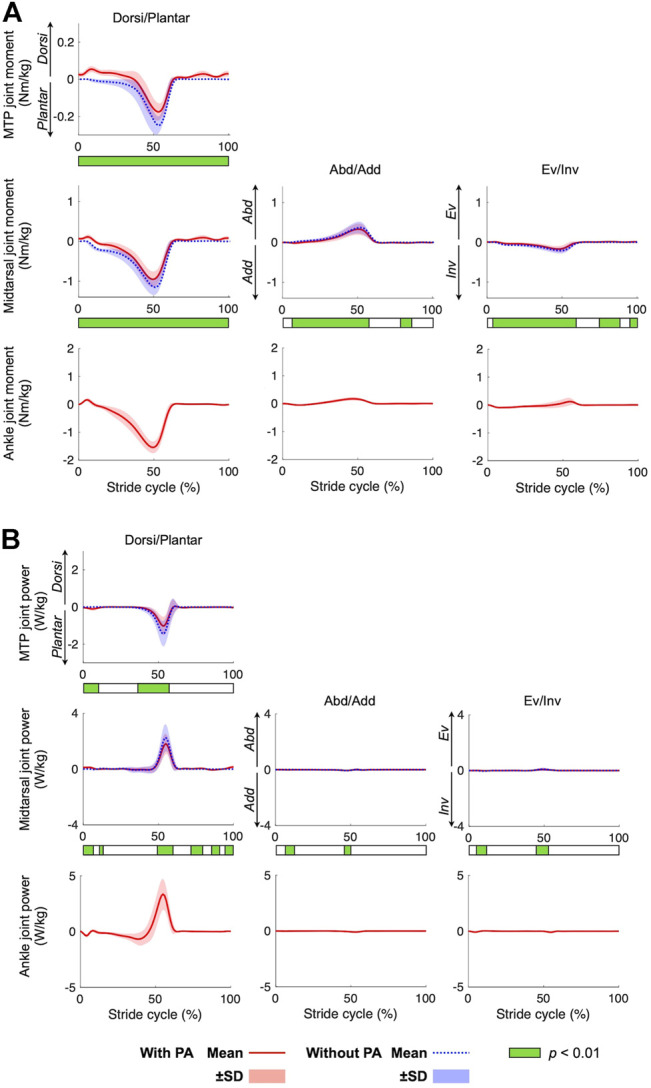
Kinetic multi-segment foot models have been proposed to evaluate the forces and moments generated in the foot during walking based on inverse dynamics calculations. However, these models did not consider the plantar aponeurosis (PA) despite its potential importance in generation of the ground reaction forces and storage and release of mechanical energy. This study aimed to develop a novel multi-segment foot model incorporating the PA to better elucidate foot kinetics. The foot model comprised three segments: the phalanx, forefoot, and hindfoot. The PA was modeled using five linear springs connecting the origins and the insertions intermediate points. To demonstrate the efficacy of the foot model, an inverse dynamic analysis of human gait was performed and how the inclusion of the PA model altered the estimated joint moments was examined. Ten healthy men walked along a walkway with two force plates placed in series close together. The attempts in which the participant placed his fore- and hindfoot on the front and rear force plates, respectively, were selected for inverse dynamic analysis. The stiffness and the natural length of each PA spring remain largely uncertain. Therefore, a sensitivity analysis was conducted to evaluate how the estimated joint moments were altered by the changes in the two parameters within a range reported by previous studies. The present model incorporating the PA predicted that 13%-45% of plantarflexion in the metatarsophalangeal (MTP) joint and 8%-29% of plantarflexion in the midtarsal joints were generated by the PA at the time of push-off during walking. The midtarsal joint generated positive work, whereas the MTP joint generated negative work in the late stance phase. The positive and negative work done by the two joints decreased, indicating that the PA contributed towards transfer of the energy absorbed at the MTP joint to generate positive work at the midtarsal joint during walking. Although validation is limited due to the difficulty associated with direct measurement of the PA force , the proposed novel foot model may serve as a useful tool to clarify the function and mechanical effects of the PA and the foot during dynamic movements.
动力学多节段足部模型已被提出,用于基于逆动力学计算来评估步行过程中足部产生的力和力矩。然而,尽管足底腱膜(PA)在产生地面反作用力以及机械能的储存和释放方面具有潜在重要性,但这些模型并未考虑到它。本研究旨在开发一种纳入PA的新型多节段足部模型,以更好地阐明足部动力学。足部模型由三个节段组成:趾骨、前足和后足。PA通过连接起点和插入中间点的五个线性弹簧进行建模。为了证明足部模型的有效性,进行了人体步态的逆动力学分析,并研究了纳入PA模型如何改变估计的关节力矩。十名健康男性沿着一条通道行走,通道上串联放置了两个测力板。选择参与者分别将前足和后足放在前后测力板上的试验进行逆动力学分析。每个PA弹簧的刚度和自然长度在很大程度上仍不确定。因此,进行了敏感性分析,以评估在先前研究报告的范围内,这两个参数的变化如何改变估计的关节力矩。纳入PA的当前模型预测,在步行蹬离阶段,跖趾(MTP)关节13% - 45%的跖屈以及中跗关节8% - 29%的跖屈是由PA产生的。在站立后期,中跗关节产生正功,而MTP关节产生负功。两个关节所做的正功和负功均减少,这表明PA有助于在步行过程中将在MTP关节吸收的能量转移,从而在中跗关节产生正功。尽管由于直接测量PA力存在困难,验证受到限制,但所提出的新型足部模型可能是阐明PA和足部在动态运动中的功能及力学效应的有用工具。