Valson Anna T, George Reena R, Lalwani Manish, Balusamy Dhivakar, Albert Divina S, Abraham Anissa, Richie Blesswin, Samuel Naevis P, Eapen Jeethu J, Thomas Athul, John Elenjickal E, Yusuf Sabina, Chidambaram Annamalai V, Alexander Suceena, David Vinoi G, Varughese Santosh, Jesudoss Ilavarasi, Ravindran Vinitha
Department of Nephrology, Christian Medical College, Vellore, Tamil Nadu, India.
College of Nursing, Christian Medical College, Vellore, Tamil Nadu, India.
Indian J Nephrol. 2022 May-Jun;32(3):256-261. doi: 10.4103/ijn.IJN_561_20. Epub 2022 Jan 5.
The mass quarantine measures adopted to control the COVID-19 pandemic greatly impacted the lives of patients on haemodialysis in India. We used a mixed methods approach to study its effect on dialysis outcomes and the lived experience of haemodialysis patients during the lockdown.
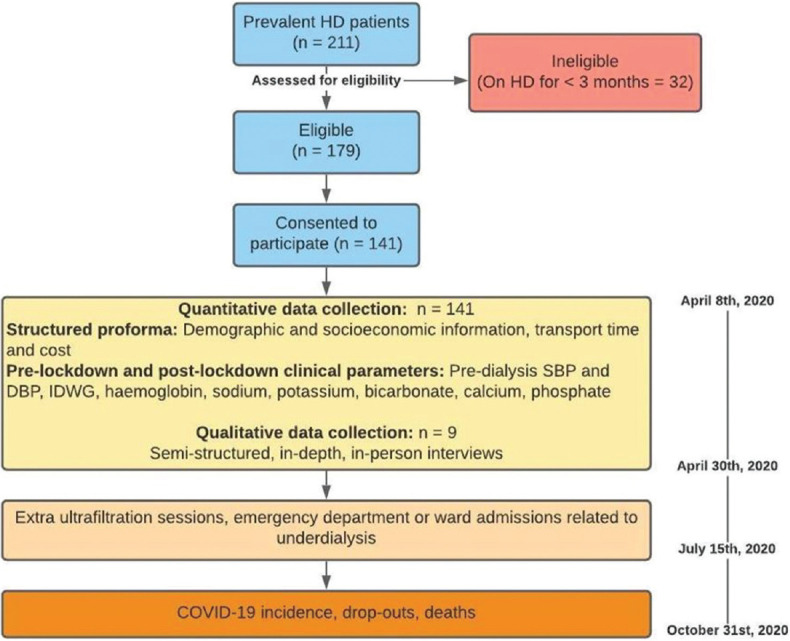
Quantitative data was collected from 141 subjects using a structured proforma to determine the impact of the lockdown on dialysis outcomes and travel expenses. Qualitative data collected through in-depth interviews with 9 patients by purposive sampling were recorded and transcribed to explore the lived experience of haemodialysis patients during lockdown. The cohort was followed up till October 31 2020 for incidence of COVID-19, deaths, and dropouts.
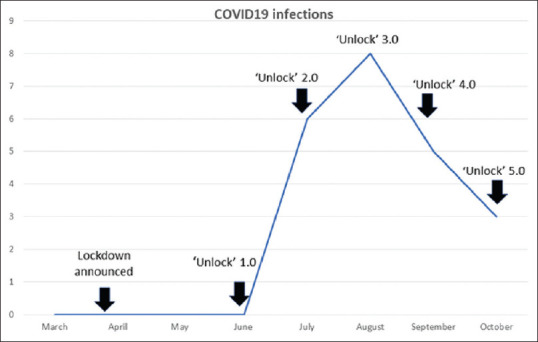
The median increase in per day travel expense was 25%. Due to decrease in dialysis frequency, patients previously on thrice weekly haemodialysis experienced significant increase in pre-dialysis systolic blood pressure ( = 0.005) compared to those on twice weekly haemodialysis. Between March 25 and July 15 2020, 12 patients (8.5%) required emergency dialysis sessions, and 4 patients (2.8%) required admissions for hypertensive emergencies. Four main themes emerged from thematic analysis of transcribed interviews: Travel inconveniences, uncertainty resulting in anxiety, financial burden and frequency change in dialysis leading to worsening of symptoms. Twenty-two patients (15.6%) were diagnosed with COVID-19, the first case diagnosed 33 days after the first 'unlock' phase.
The lockdown was successful in delaying infection transmission but had unintended physical and psychosocial effects on haemodialysis patients.
为控制新冠疫情而采取的大规模隔离措施对印度接受血液透析的患者生活产生了重大影响。我们采用混合方法研究其对透析结果以及封锁期间血液透析患者实际生活体验的影响。
使用结构化表格从141名受试者收集定量数据,以确定封锁对透析结果和交通费用的影响。通过目的性抽样对9名患者进行深入访谈收集的定性数据进行了记录和转录,以探讨封锁期间血液透析患者的实际生活体验。对该队列进行随访至2020年10月31日,记录新冠病毒感染、死亡和退出情况。
每日交通费用的中位数增加了25%。由于透析频率降低,之前每周进行三次血液透析的患者与每周进行两次血液透析的患者相比,透析前收缩压显著升高(P = 0.005)。在2020年3月25日至7月15日期间,12名患者(8.5%)需要进行紧急透析治疗,4名患者(2.8%)因高血压急症需要住院治疗。对转录访谈进行主题分析得出四个主要主题:出行不便、不确定性导致焦虑、经济负担以及透析频率改变导致症状恶化。22名患者(15.6%)被诊断感染新冠病毒,首例确诊病例在首个“解封”阶段33天后出现。
封锁成功延缓了感染传播,但对血液透析患者产生了意想不到的身体和心理社会影响。