Rincón Abraham, Moreso Francesc, López-Herradón Ana, Fernández-Robres M Amparo, Cidraque Ignacio, Nin Jordi, Méndez Orleans, López Marisol, Pájaro Carlota, Satorra Àngels, Stuard Stefano, Ramos Rosa
Medical Department, Fresenius Medical Care Spain, Madrid, Spain.
Hospitalet Dialysis Center, Fresenius Medical Care Spain, Hospitalet de Llobregat, Barcelona, Spain.
Clin Kidney J. 2020 Jul 13;13(4):542-549. doi: 10.1093/ckj/sfaa119. eCollection 2020 Aug.
The high rate of severe acute respiratory syndrome coronavirus 2 (SARS-CoV-2) spreading represents a challenge to haemodialysis (HD) units. While fast isolation of suspected cases plays an essential role to avoid disease outbreaks, significant rates of asymptomatic cases have recently been described. After detecting an outbreak in one of our HD clinics, wide SARS-CoV-2 screening and segregation of confirmed cases were performed.
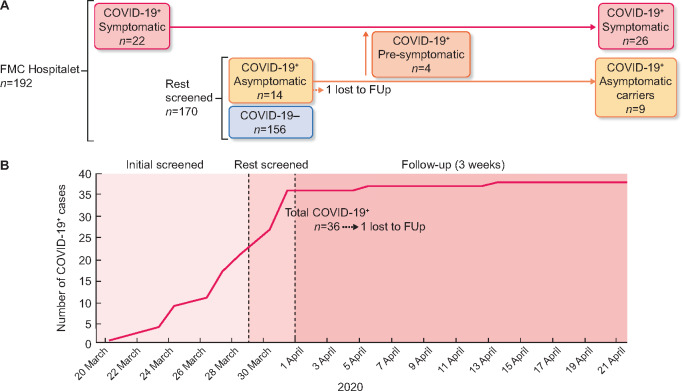
The entire clinic population, 192 patients, underwent testing for SARS-CoV-2 detection by real-time reverse-transcriptase polymerase chain reaction . We used univariate and multivariate logistic regression to define variables involved in SARS-CoV-2 infection in our dialysis unit. Later, we analysed differences between symptomatic and asymptomatic SARS-CoV-2-positive patients.
In total, 22 symptomatic and 14 of the 170 asymptomatic patients had a SARS-CoV-2-positive result. Living in a nursing home/homeless [odds ratio (OR) 3.54; P = 0.026], having been admitted to the reference hospital within the previous 2 weeks (OR 5.19; P = 0.002) and sharing health-care transportation with future symptomatic (OR 3.33; P = 0.013) and asymptomatic (OR 4.73; P = 0.002) positive patients were independent risk factors for a positive test. Nine positive patients (25.7%) remained asymptomatic after a 3-week follow-up. We found no significant differences between symptomatic and asymptomatic SARS-CoV-2-positive patients.
Detection of asymptomatic SARS-CoV-2-positive patients is probably one of the key points to controlling an outbreak in an HD unit. Sharing health-care transportation to the dialysis unit, living in a nursing home and having been admitted to the reference hospital within the previous 2 weeks, are major risk factors for SARS-CoV-2 infection.
严重急性呼吸综合征冠状病毒2(SARS-CoV-2)的高传播率对血液透析(HD)单位构成了挑战。虽然快速隔离疑似病例对避免疾病爆发起着至关重要的作用,但最近已报道了相当比例的无症状病例。在我们的一家血液透析诊所检测到疫情爆发后,我们对SARS-CoV-2进行了广泛筛查,并对确诊病例进行了隔离。
对该诊所的全部192名患者进行实时逆转录聚合酶链反应检测SARS-CoV-2。我们使用单变量和多变量逻辑回归来确定我们透析单位中与SARS-CoV-2感染相关的变量。随后,我们分析了有症状和无症状的SARS-CoV-2阳性患者之间的差异。
总共22名有症状患者以及170名无症状患者中的14名SARS-CoV-2检测呈阳性。居住在养老院/无家可归者[比值比(OR)3.54;P = 0.026]、在过去2周内入住参考医院(OR 5.19;P = 0.002)以及与未来有症状(OR 3.33;P = 0.013)和无症状(OR 4.73;P = 0.002)的阳性患者共用医疗运输工具是检测呈阳性的独立危险因素。9名阳性患者(25.7%)在3周随访后仍无症状。我们发现有症状和无症状的SARS-CoV-2阳性患者之间没有显著差异。
检测无症状的SARS-CoV-2阳性患者可能是控制血液透析单位疫情爆发的关键点之一。共用前往透析单位的医疗运输工具、居住在养老院以及在过去2周内入住参考医院是SARS-CoV-2感染的主要危险因素。