Wang Dan, Cang Wei, Zhu Shan, Jia Congwei, Cao Dongyan, Yang Jiaxin, Xiang Yang
Department of Obstetrics and Gynecology, Peking Union Medical College Hospital, National Clinical Research Center for Obstetric and Gynecologic Diseases, Chinese Academy of Medical Sciences and Peking Union Medical College, Beijing, China.
Department of Pathology, Peking Union Medical College Hospital, Chinese Academy of Medical Science and Peking Union Medical College, Beijing, China.
Front Oncol. 2022 Jun 22;12:822341. doi: 10.3389/fonc.2022.822341. eCollection 2022.
To evaluate the oncological and reproductive outcomes in patients with advanced-stage ovarian immature teratoma (IMT).
We retrospectively reviewed the medical records of patients with advanced-stage IMT who were treated with surgery between January 1985 and December 2020. Fertility-sparing surgery (FSS) was defined as preservation of the uterus and at least one adnexa. Oncological outcomes were compared between patients who underwent FSS and radical surgery. Patients who underwent FSS were also contacted to gather information about their menstrual history and reproductive outcomes.
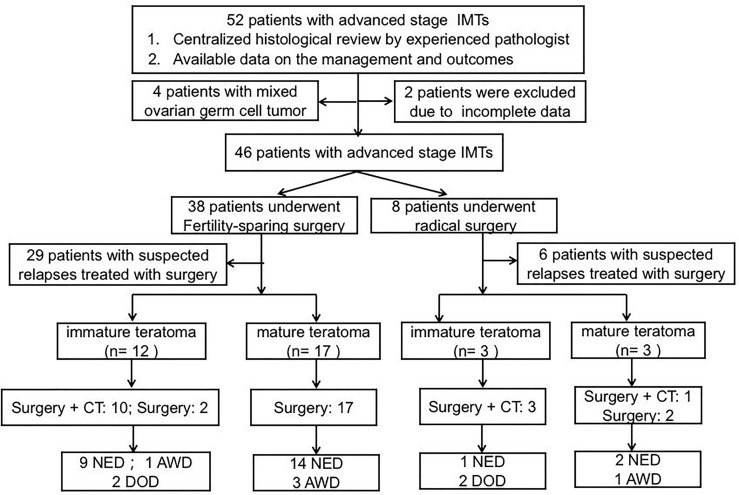
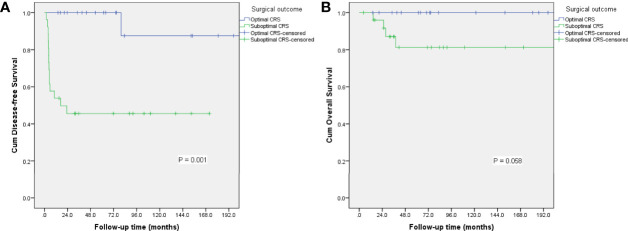
Forty-six patients fulfilled the inclusion criteria, of whom 38 underwent FSS and eight were treated with radical surgery. Fifteen patients suffered recurrence after a median follow-up time of 74.2 months (range: 4.1-434.1 months). The 5-year disease-free survival (DFS) and overall survival (OS) rates were 69.1% and 89.9%, respectively. Multivariate analysis identified suboptimal cytoreductive surgery as the only independent risk factor for recurrence. There was no significant difference in DFS or OS between patients with different surgical procedures. Ten of the 15 relapsed patients had optimal salvage surgery and all remained alive with no evidence disease. Among the 32 patients who underwent FSS, 29 resumed menstruation after surgery, and five of seven patients who designed pregnancy achieved a total of five successful pregnancies.
Ovarian IMT has a favorable prognosis, even when diagnosed at an advanced stage. FSS is feasible in patients with advanced-stage IMT who wish to preserve their fertility. Patients may benefit from optimal cytoreductive surgery during initial and salvage surgery.
评估晚期卵巢未成熟畸胎瘤(IMT)患者的肿瘤学及生殖结局。
我们回顾性分析了1985年1月至2020年12月期间接受手术治疗的晚期IMT患者的病历。保留生育功能手术(FSS)定义为保留子宫及至少一侧附件。比较接受FSS和根治性手术患者的肿瘤学结局。还联系了接受FSS的患者以收集其月经史及生殖结局的信息。
46例患者符合纳入标准,其中38例行FSS,8例行根治性手术。中位随访时间74.2个月(范围:4.1 - 434.1个月)后,15例患者复发。5年无病生存率(DFS)和总生存率(OS)分别为69.1%和89.9%。多因素分析确定减瘤手术不彻底是复发的唯一独立危险因素。不同手术方式患者的DFS或OS无显著差异。15例复发患者中有10例接受了最佳挽救性手术,均存活且无疾病证据。在32例行FSS的患者中,29例术后恢复月经,7例计划妊娠的患者中有5例共成功妊娠5次。
卵巢IMT预后良好,即使在晚期诊断时也是如此。对于希望保留生育功能的晚期IMT患者,FSS是可行的。患者可能从初次手术及挽救性手术中的最佳减瘤手术中获益。