Chen Zhen, Tian Ya, Wang Yu, Zhao Hongxin, Chen Chen, Zhang Fujie
Savaid Medical School, University of Chinese Academy of Sciences, Beijing, China.
Affiliated Beijing Ditan Hospital, Capital Medical University, Beijing, China.
Front Microbiol. 2022 Jun 23;13:888996. doi: 10.3389/fmicb.2022.888996. eCollection 2022.
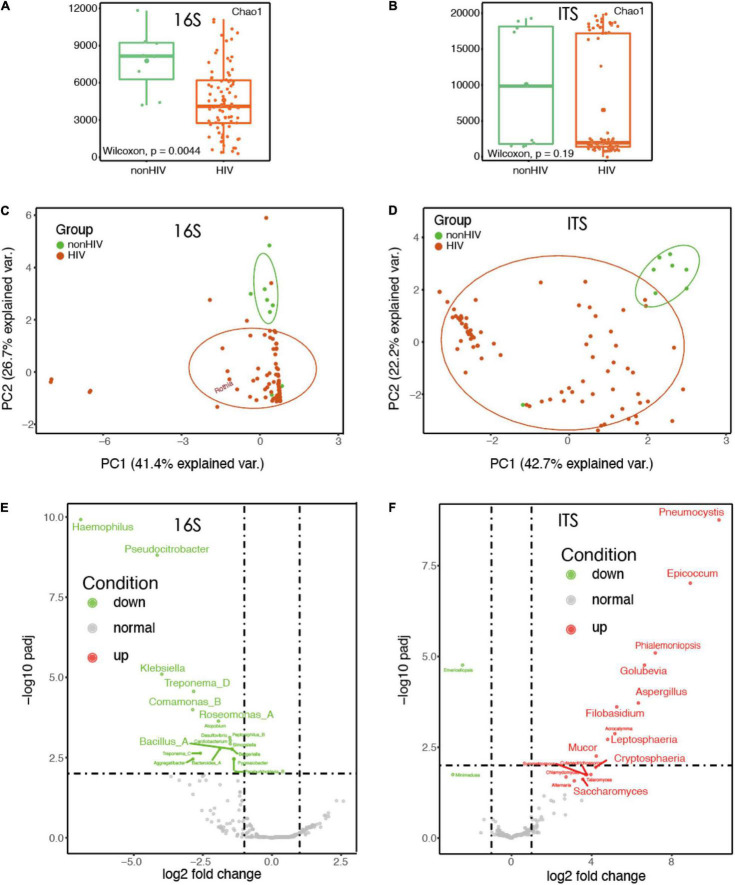
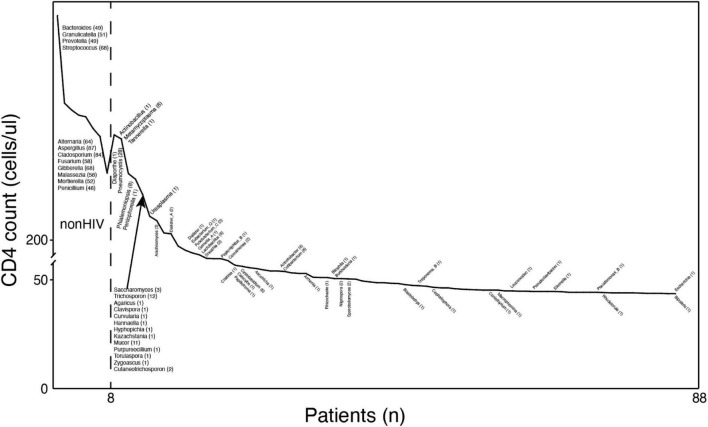
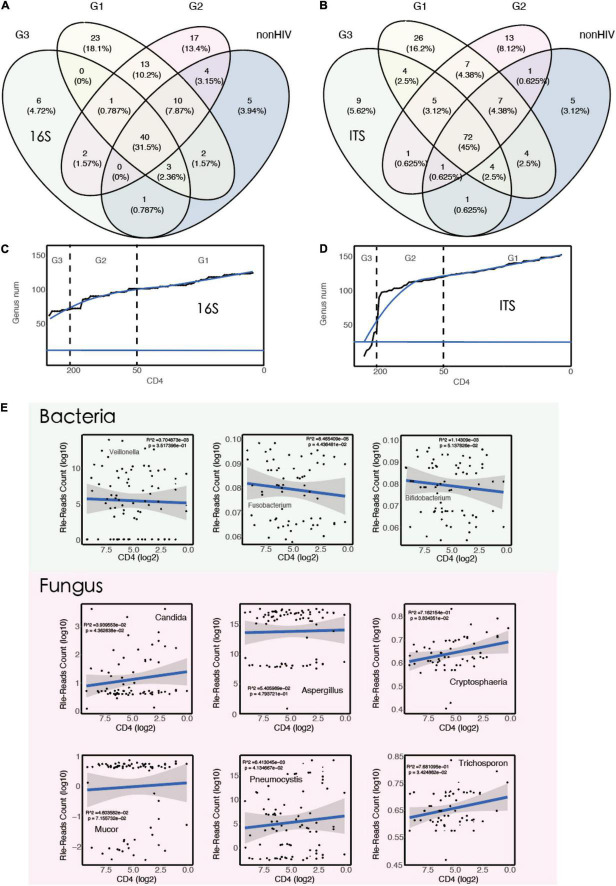
Once an human immunodeficiency virus (HIV)-infected individual enters the onset period, a variety of opportunistic infections may occur, affecting various systems and organs throughout the body, due to the considerable reduction in the body's immune function. The objectives of this study were to explore the relationship between immune status and microbial communities in the lungs of individuals with HIV infection. A total of 88 patients with lung disease [80 (91%) HIV-positive and 8 (9%) HIV-negative] were enrolled in our study between January and July 2018, and 88 bronchoalveolar lavage fluid (BALF) samples were obtained during bronchoscopy. In this cross-sectional study, we investigated differences in the pulmonary microbiome of patients with HIV who had different immune statuses. The diversity of bacteria in the lungs of HIV-positive individuals was lower than that in HIV-negative individuals ( < 0.05). There was a significant difference in the composition and distribution of bacteria and fungi between the HIV-positive and HIV-negative groups ( < 0.01). The number of fungal species in the BALF of HIV-positive patients was higher than in HIV-negative patients. The diversity of bacteria and fungi in the BALF of HIV-positive patients increased with decreasing CD4 T-cell counts. Linear regression analysis showed that Pneumocystis ( = 6.4e-03, < 0.05), Cryptosphaeria ( = 7.2e-01, < 0.05), Candida ( = 3.9e-02, < 0.05), and Trichosporon ( = 7.7e-01, < 0.05) were negatively correlated with CD4 counts (-test, < 0.05). The samples collected from HIV-positive patients exhibited a different pattern relative to those from the HIV-negative group. Differences in host immune status cause differences in the diversity and structure of lower respiratory tract microorganisms.
一旦人类免疫缺陷病毒(HIV)感染者进入发病期,由于机体免疫功能大幅下降,可能会发生多种机会性感染,影响全身各个系统和器官。本研究的目的是探讨HIV感染者肺部免疫状态与微生物群落之间的关系。2018年1月至7月,我们共纳入了88例肺部疾病患者[80例(91%)HIV阳性和8例(9%)HIV阴性],并在支气管镜检查期间获取了88份支气管肺泡灌洗液(BALF)样本。在这项横断面研究中,我们调查了不同免疫状态的HIV患者肺部微生物组的差异。HIV阳性个体肺部细菌的多样性低于HIV阴性个体(<0.05)。HIV阳性组和HIV阴性组之间细菌和真菌的组成及分布存在显著差异(<0.01)。HIV阳性患者BALF中的真菌种类数量高于HIV阴性患者。HIV阳性患者BALF中细菌和真菌的多样性随着CD4 T细胞计数的降低而增加。线性回归分析表明,肺孢子菌(=6.4e-03,<0.05)、隐球壳属(=7.2e-01,<0.05)、念珠菌属(=3.9e-02,<0.05)和毛孢子菌属(=7.7e-01,<0.05)与CD4计数呈负相关(-检验,<0.05)。与HIV阴性组相比,从HIV阳性患者采集的样本呈现出不同的模式。宿主免疫状态的差异导致下呼吸道微生物的多样性和结构存在差异。