Department of Pathology, Amsterdam University Medical Center (UMC), Vrije Universiteit Amsterdam, Cancer Center Amsterdam, Amsterdam, The Netherlands.
Department of Hematology, Radboudumc Nijmegen, Nijmegen, The Netherlands.
Blood Adv. 2022 Sep 27;6(18):5482-5493. doi: 10.1182/bloodadvances.2022008355.
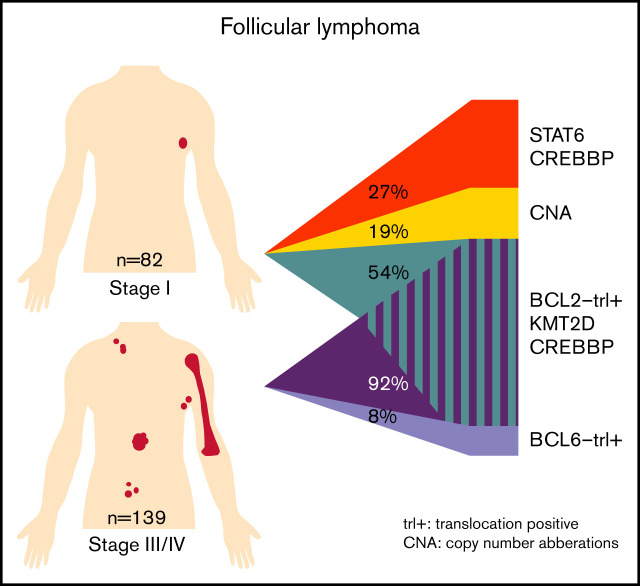
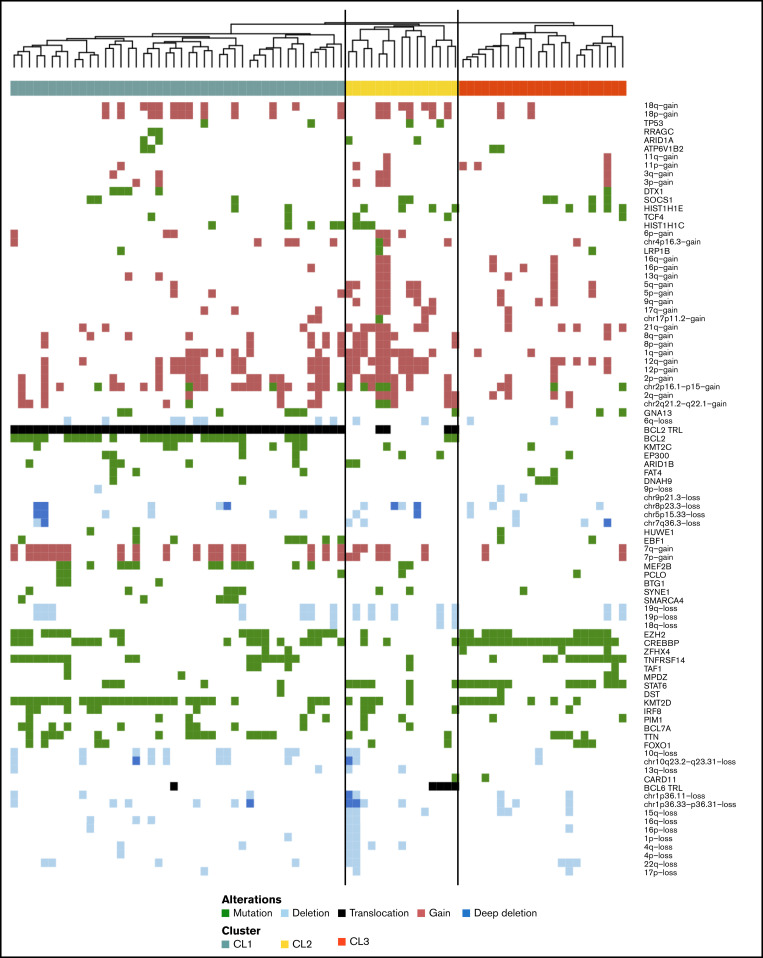
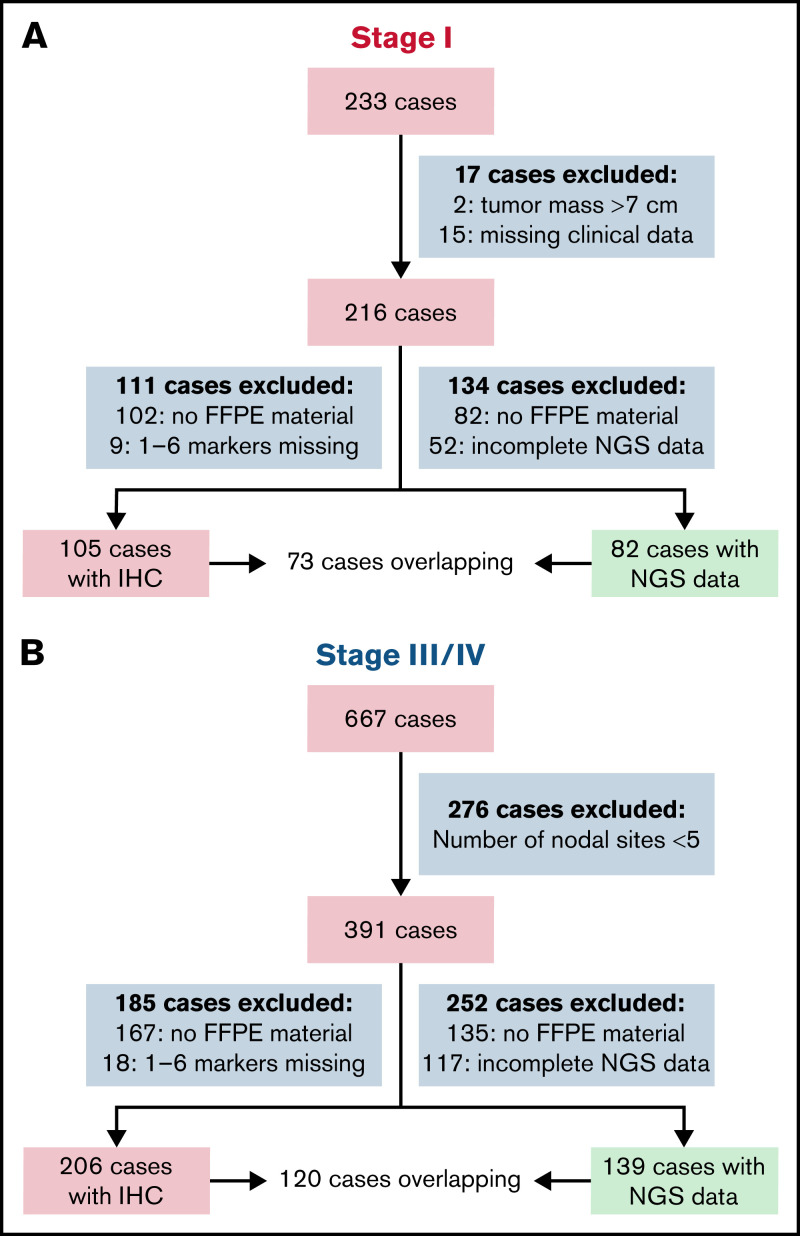
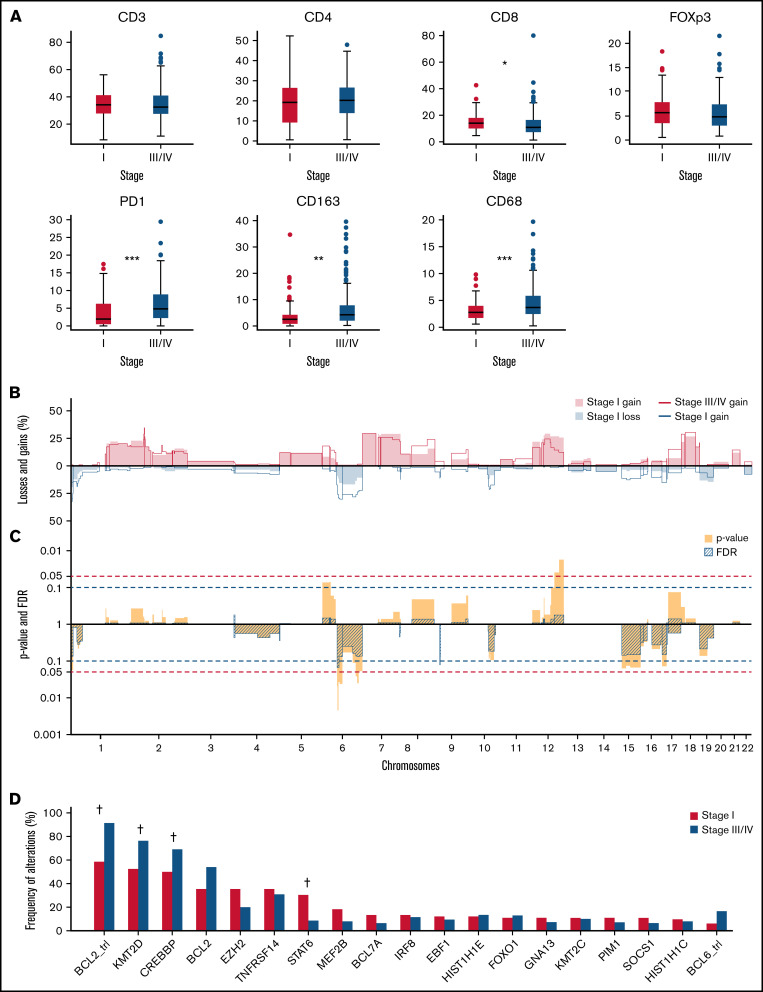
Although the genomic and immune microenvironmental landscape of follicular lymphoma (FL) has been extensively investigated, little is known about the potential biological differences between stage I and stage III/IV disease. Using next-generation sequencing and immunohistochemistry, 82 FL nodal stage I cases were analyzed and compared with 139 FL stage III/IV nodal cases. Many similarities in mutations, chromosomal copy number aberrations, and microenvironmental cell populations were detected. However, there were also significant differences in microenvironmental and genomic features. CD8+ T cells (P = .02) and STAT6 mutations (false discovery rate [FDR] <0.001) were more frequent in stage I FL. In contrast, programmed cell death protein 1-positive T cells, CD68+/CD163+ macrophages (P < .001), BCL2 translocation (BCL2trl+) (P < .0001), and KMT2D (FDR = 0.003) and CREBBP (FDR = 0.04) mutations were found more frequently in stage III/IV FL. Using clustering, we identified 3 clusters within stage I, and 2 clusters within stage III/IV. The BLC2trl+ stage I cluster was comparable to the BCL2trl+ cluster in stage III/IV. The two BCL2trl- stage I clusters were unique for stage I. One was enriched for CREBBP (95%) and STAT6 (64%) mutations, without BLC6 translocation (BCL6trl), whereas the BCL2trl- stage III/IV cluster contained BCL6trl (64%) with fewer CREBBP (45%) and STAT6 (9%) mutations. The other BCL2trl- stage I cluster was relatively heterogeneous with more copy number aberrations and linker histone mutations. This exploratory study shows that stage I FL is genetically heterogeneous with different underlying oncogenic pathways. Stage I FL BCL2trl- is likely STAT6 driven, whereas BCL2trl- stage III/IV appears to be more BCL6trl driven.
尽管滤泡性淋巴瘤(FL)的基因组和免疫微环境景观已得到广泛研究,但对于 I 期和 III/IV 期疾病之间潜在的生物学差异知之甚少。本研究使用下一代测序和免疫组织化学分析了 82 例 FL 淋巴结 I 期病例,并与 139 例 FL 淋巴结 III/IV 期病例进行了比较。研究发现,在突变、染色体拷贝数异常和微环境细胞群体方面有许多相似之处。然而,在微环境和基因组特征方面也存在显著差异。在 I 期 FL 中,CD8+T 细胞(P=0.02)和 STAT6 突变(假发现率[FDR]<0.001)更为常见。相比之下,程序性死亡蛋白 1 阳性 T 细胞、CD68+/CD163+巨噬细胞(P<0.001)、BCL2 易位(BCL2trl+)(P<0.0001)、KMT2D(FDR=0.003)和 CREBBP(FDR=0.04)突变在 III/IV 期 FL 中更为常见。通过聚类分析,我们在 I 期内确定了 3 个簇,在 III/IV 期内确定了 2 个簇。BCL2trl+I 期簇与 III/IV 期的 BCL2trl+簇相当。两个 BCL2trl-I 期簇在 I 期内是独特的。一个簇富含 CREBBP(95%)和 STAT6(64%)突变,没有 BCL6 易位(BCL6trl),而 BCL2trl-I 期 III/IV 簇含有 BCL6trl(64%),但 CREBBP(45%)和 STAT6(9%)突变较少。另一个 BCL2trl-I 期簇相对异质性较大,有更多的拷贝数异常和连接组蛋白突变。这项探索性研究表明,I 期 FL 具有遗传异质性,存在不同的致癌途径。I 期 FL BCL2trl-可能是 STAT6 驱动的,而 BCL2trl-III/IV 期似乎更多地是 BCL6trl 驱动的。