Center of Respiratory Medicine, Xiangya Hospital, 12570Central South University, Changsha, Hunan, China.
Department of Nephrology, Xiangya Hospital, 12570Central South University, Changsha, Hunan, China.
Int J Immunopathol Pharmacol. 2022 Jan-Dec;36:3946320221114194. doi: 10.1177/03946320221114194.
We hope to identify key molecules that can be used as markers of asthma severity and investigate their correlation with immune cell infiltration in severe asthma.
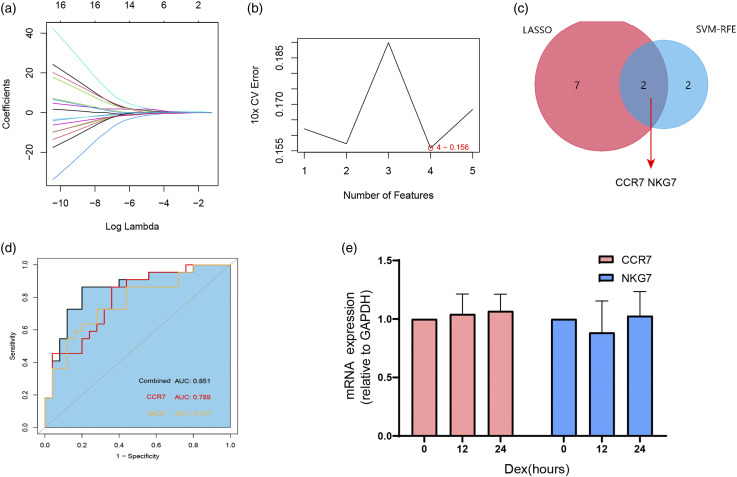
An asthma dataset was downloaded from the Gene Expression Omnibus database and then processed by R software to obtain differentially expressed genes (DEGs). First, multiple enrichment platforms were applied to analyze crucial biological processes and pathways and protein-protein interaction networks related to the DEGs. We next combined least absolute shrinkage and selection operator logistic regression and the support vector machine-recursive feature elimination algorithms to screen diagnostic markers of severe asthma. Then, a local cohort consisting of 40 asthmatic subjects (24 with moderate asthma and 16 with severe asthma) was used for biomarker validation. Finally, infiltration of immune cells in asthma bronchoalveolar lavage fluid and their correlation with the screened markers was evaluated by CIBERSORT.
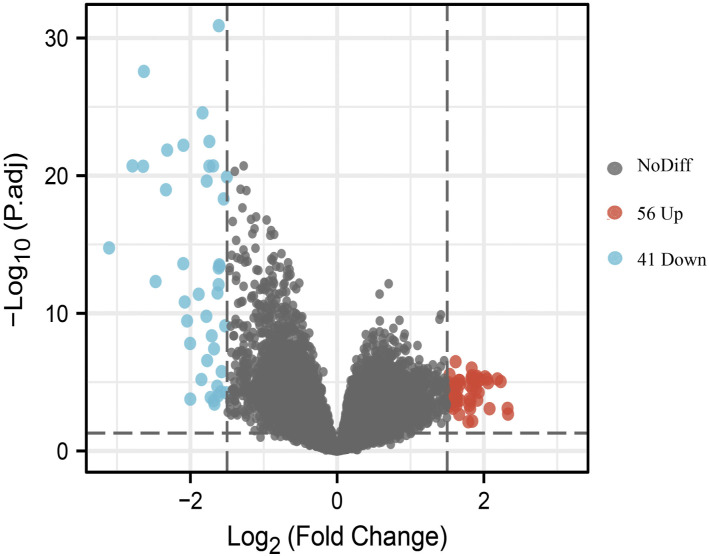
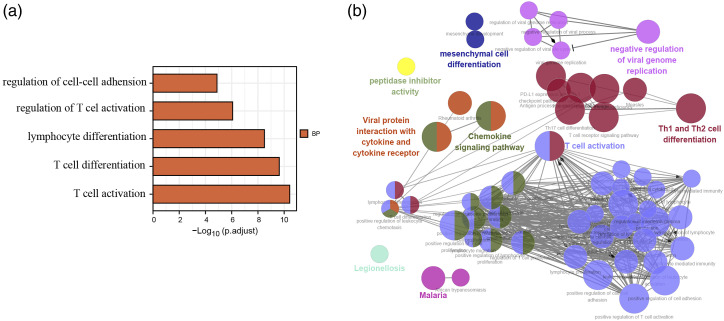
A total of 97 DEGs were identified in this study. Most of these genes are enriched in T cell activation and immune response in the asthma biological process. CC-chemokine receptor 7 (CCR7) and natural killer cell protein 7(NKG7) were identified as markers of severe asthma. The highest area under the ROC curve (AUC) was from a new indicator combining CCR7 and NKG7 (AUC = 0.851, adj. < 0.05). Resting and activated memory CD4 T cells, activated NK cells, and CD8 T cells were found to be significantly higher in the severe asthma group (adj. < 0.01). CCR7 and NKG7 were significantly correlated with these infiltrated cells that showed differences between the two groups. In addition, CCR7 was found to be significantly positively correlated with eosinophils (r = 0.38, adj. < 0.05) infiltrated in bronchoalveolar lavage fluid.
CCR7 and NKG7 might be used as potential markers for asthma severity, and their expression may be associated with differences in immune cell infiltration in the moderate and severe asthma groups.
我们希望确定可作为哮喘严重程度标志物的关键分子,并研究其与重度哮喘中免疫细胞浸润的相关性。
从基因表达综合数据库(GEO)下载哮喘数据集,然后使用 R 软件进行处理,以获得差异表达基因(DEG)。首先,应用多个富集平台分析与 DEG 相关的关键生物学过程和途径以及蛋白质-蛋白质相互作用网络。接下来,我们结合最小绝对收缩和选择算子逻辑回归以及支持向量机递归特征消除算法,筛选重度哮喘的诊断标志物。然后,使用由 40 例哮喘患者(24 例中度哮喘和 16 例重度哮喘)组成的本地队列进行生物标志物验证。最后,通过 CIBERSORT 评估哮喘支气管肺泡灌洗液中免疫细胞的浸润及其与筛选标志物的相关性。
本研究共鉴定出 97 个 DEG。这些基因主要富集在哮喘的 T 细胞激活和免疫反应等生物学过程中。CC-趋化因子受体 7(CCR7)和自然杀伤细胞蛋白 7(NKG7)被鉴定为重度哮喘的标志物。来自结合 CCR7 和 NKG7 的新指标的 ROC 曲线下面积(AUC)最高(AUC = 0.851,adj. < 0.05)。在重度哮喘组中,静息和激活的记忆 CD4 T 细胞、激活的 NK 细胞和 CD8 T 细胞明显更高(adj. < 0.01)。CCR7 和 NKG7 与两组间差异明显的浸润细胞显著相关。此外,发现 CCR7 与支气管肺泡灌洗液中浸润的嗜酸性粒细胞(r = 0.38,adj. < 0.05)呈显著正相关。
CCR7 和 NKG7 可能作为哮喘严重程度的潜在标志物,其表达可能与中度和重度哮喘组免疫细胞浸润的差异有关。