Spanish National Research Council (CSIC), Instituto de Ciencia y Tenología de Alimentos y Nutrición (ICTAN-CSIC), Jose Antonio Novais 10, Ciudad Universitaria, 28040 Madrid, Spain.
Centro de Espectroscopía de RMN (CERMN), Universidad de Alcalá (UAH), Campus Universitario Ctra. Madrid-Barcelona km 33.6, 28805 Alcalá de Henares, Madrid, Spain.
J Agric Food Chem. 2022 Jul 27;70(29):9143-9153. doi: 10.1021/acs.jafc.2c03187. Epub 2022 Jul 12.
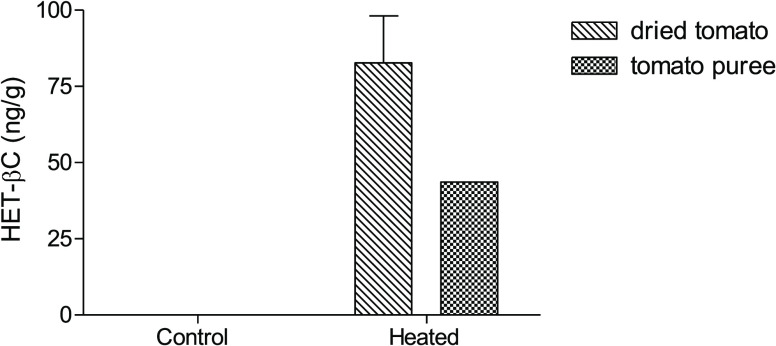
β-Carbolines (βCs) are naturally occurring bioactive alkaloids, whereas α-dicarbonyl compounds are reactive substances generated in foods and . In this work, l-tryptophan reacted with α-dicarbonyl compounds affording new β-carbolines. Glyoxal afforded 1-hydroxymethyl-β-carboline (HME-βC) and its 3-carboxylic acid, and methylglyoxal afforded 1-(1-hydroxyethyl)-β-carboline (HET-βC) and its 3-carboxylic acid. 3-Deoxyglucosone afforded 1-(1,3,4,5-tetrahydroxypent-1-yl)-β-carboline isomers (), 1-(1,4,5-trihydroxypent-1-yl)-β-carboline (), and 1-(1,5-dihydroxypent-3-en-1-yl)-β-carboline (). The formation of these βCs increased under acidic conditions and with increasing temperature. A mechanism is proposed explaining the conversion of a carbonyl into a hydroxy group based on tautomerism and cyclization to the dihydro-βC-3-COOH intermediates, which were isolated and gave the βCs. These α-dicarbonyl-derived βCs occurred in model reactions of l-tryptophan with fructose or glucose incubated under heating and can be considered as advanced glycation end products (AGEs). They were also present in foods and formed during heating processes. HET-βC appeared in processed foods, reaching up to 309 ng/g, with the highest amount found in dried tomato, fried onion, toasted bread, and Manuka honey. HME-βC was only detected in some foods with lower amounts than HET-βC. HET-βC appeared in foods as a racemic mixture of enantiomers suggesting the same mechanism of formation as the synthetized product. α-Dicarbonyl-derived βCs (HET-βC, HME-βC, and ) occur in foods and food processing and, therefore, they are ingested during diet.
β-咔啉(βCs)是天然存在的生物活性生物碱,而α-二羰基化合物是食物中产生的反应性物质。在这项工作中,l-色氨酸与α-二羰基化合物反应生成新的β-咔啉。乙二醛生成 1-羟甲基-β-咔啉(HME-βC)和 3-羧酸,甲基乙二醛生成 1-(1-羟乙基)-β-咔啉(HET-βC)和 3-羧酸。3-脱氧葡萄糖酮生成 1-(1,3,4,5-四羟基戊-1-基)-β-咔啉异构体()、1-(1,4,5-三羟基戊-1-基)-β-咔啉()和 1-(1,5-二羟基戊-3-烯-1-基)-β-咔啉()。这些βCs 的形成在酸性条件下和温度升高时增加。提出了一种基于互变异构和环化到二氢-βC-3-COOH 中间体的机制来解释羰基转化为羟基,这些中间体被分离并得到了βCs。这些由α-二羰基衍生的βCs 发生在 l-色氨酸与果糖或葡萄糖在加热下孵育的模型反应中,可以被认为是晚期糖基化终产物(AGEs)。它们也存在于食物中,并在加热过程中形成。HET-βC 出现在加工食品中,高达 309ng/g,在干番茄、油炸洋葱、烤面包和麦卢卡蜂蜜中含量最高。HME-βC 仅在一些食物中检测到,含量低于 HET-βC。HET-βC 作为对映异构体的外消旋混合物出现在食物中,表明其形成机制与合成产物相同。由α-二羰基衍生的βCs(HET-βC、HME-βC 和)存在于食物和食品加工中,因此在饮食中被摄入。