Department of Anaesthesia, Critical Care and Pain Medicine, University of Edinburgh, UK.
Usher Institute, University of Edinburgh, UK.
Anaesthesia. 2022 Sep;77(9):971-980. doi: 10.1111/anae.15798. Epub 2022 Jul 12.
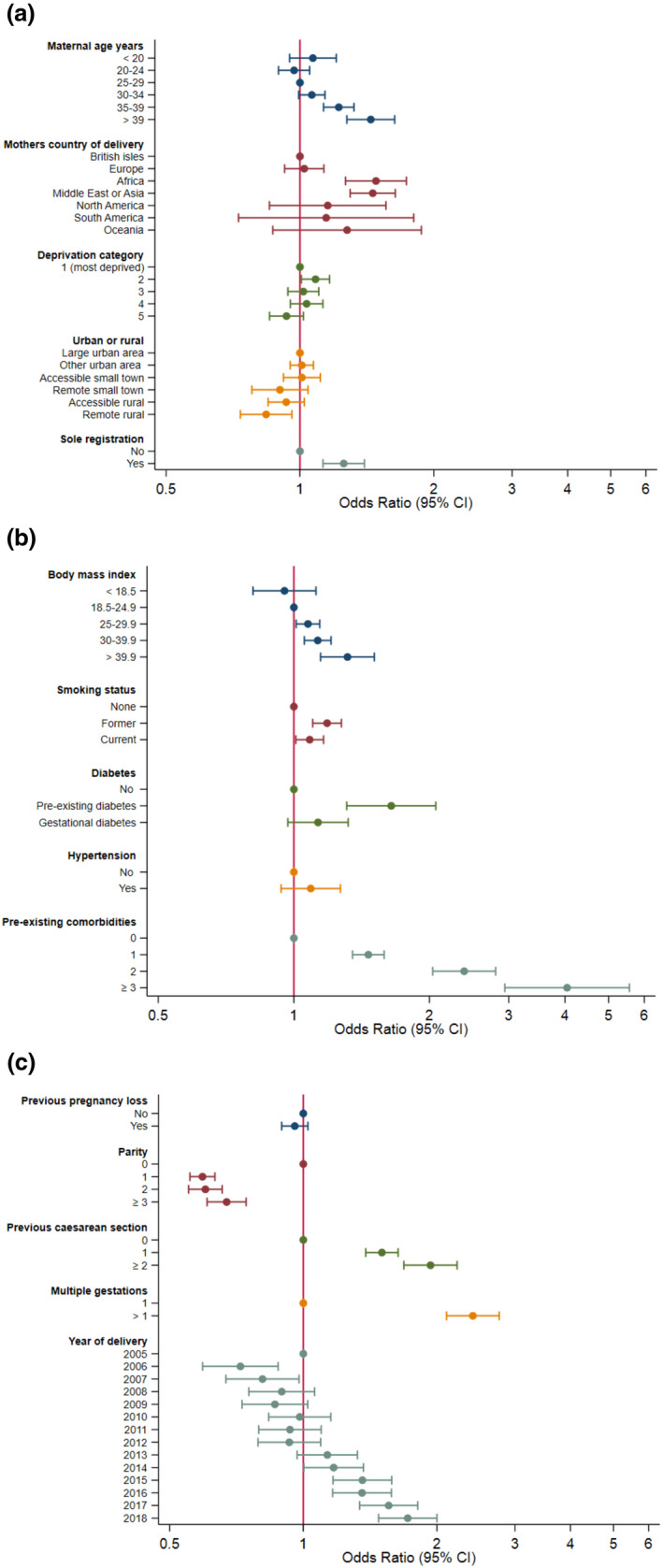
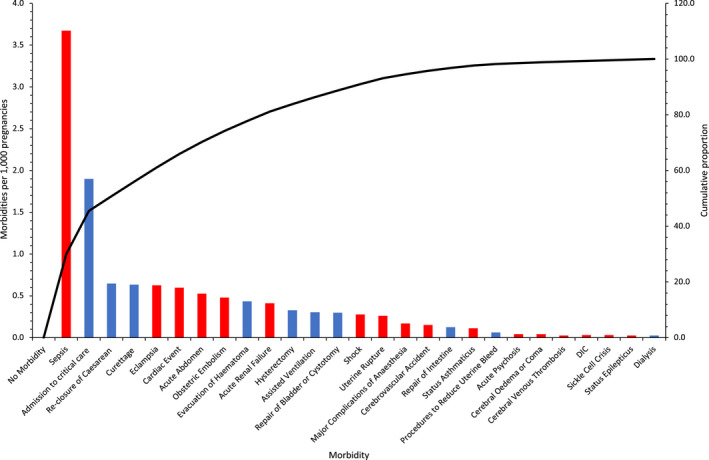
Using a cohort study design, we analysed 17 diagnoses and 9 interventions (including critical care admission) as a composite measure of severe maternal morbidity for pregnancies recorded over 14 years in Scotland. There were 762,918 pregnancies, of which 7947 (10 in 1000 pregnancies) recorded 9345 severe maternal morbidity events, 2802 episodes of puerperal sepsis being the most common (30%). Severe maternal morbidity incidence increased from 9 in 1000 pregnancies in 2012 to 17 in 1000 pregnancies in 2018, due in part to puerperal sepsis recording. The odds ratio (95%CI) for severe maternal morbidity was higher for: older women, for instance 1.22 (1.13-1.33) for women aged 35-39 years and 1.44 (1.27-1.63) for women aged > 40 years compared with those aged 25-29 years; obese women, for instance 1.13 (1.06-1.21) for BMI 30-40 kg.m and 1.32 (1.15-1.51) for BMI > 40 kg.m compared with BMI 18.5-24.9 kg.m ; multiple pregnancy, 2.39 (2.09-2.74); and previous caesarean delivery, 1.52 (1.40-1.65). The median (IQR [range]) hospital stay was 3 (2-5 [1-8]) days with severe maternal morbidity and 2 (1-3 [1-5]) days without. Forty-one women died during pregnancy or up to 42 days after delivery, representing mortality rates per 100,000 pregnancies of about 365 with severe maternal morbidity and 1.6 without. There were 1449 women admitted to critical care, 807 (58%) for mechanical ventilation or support of at least two organs. We recorded an incidence of severe maternal morbidity higher than previously published, possibly because sepsis was coded inaccurately in our databases. Further research may determine the value of this composite measure of severe maternal morbidity.
采用队列研究设计,我们分析了 17 种诊断和 9 种干预措施(包括重症监护入院),作为苏格兰 14 多年来记录的妊娠严重产妇发病率的综合指标。共有 762918 例妊娠,其中 7947 例(每 1000 例妊娠中有 10 例)记录了 9345 例严重产妇发病率事件,最常见的是产褥期脓毒症 2802 例(30%)。由于产褥期脓毒症的记录,严重产妇发病率从 2012 年的每 1000 例妊娠中的 9 例增加到 2018 年的每 1000 例妊娠中的 17 例。对于年龄较大的妇女,例如年龄在 35-39 岁的妇女为 1.22(1.13-1.33),年龄大于 40 岁的妇女为 1.44(1.27-1.63),与 25-29 岁的妇女相比,严重产妇发病率的比值比(95%CI)更高;肥胖妇女,例如 BMI 为 30-40kg.m 的 1.13(1.06-1.21)和 BMI 大于 40kg.m 的 1.32(1.15-1.51),与 BMI 为 18.5-24.9kg.m 的妇女相比,严重产妇发病率的比值比(95%CI)更高;多胎妊娠,2.39(2.09-2.74);以及既往剖宫产,1.52(1.40-1.65)。严重产妇发病率的中位数(IQR [范围])住院时间为 3 天(2-5 [1-8]),无严重产妇发病率的中位数(IQR [范围])住院时间为 2 天(1-3 [1-5])。41 名妇女在妊娠期间或分娩后 42 天内死亡,每 100000 例妊娠的死亡率约为 365 例伴有严重产妇发病率和 1.6 例无严重产妇发病率。有 1449 名妇女入住重症监护病房,807 名(58%)因机械通气或至少两个器官的支持而入住。我们记录的严重产妇发病率高于之前发表的发病率,可能是因为我们的数据库中对脓毒症的编码不准确。进一步的研究可能会确定这种严重产妇发病率综合指标的价值。