ICAP at Columbia, Columbia University Mailman School of Public Health, New York, New York, USA
Department of Epidemiology, Mailman School of Public Health, New York, New York, USA.
BMJ Open. 2022 Jul 12;12(7):e058704. doi: 10.1136/bmjopen-2021-058704.
To assess the potential bidirectional relationship between food insecurity and HIV infection in sub-Saharan Africa.
Nationally representative HIV impact assessment household-based surveys.
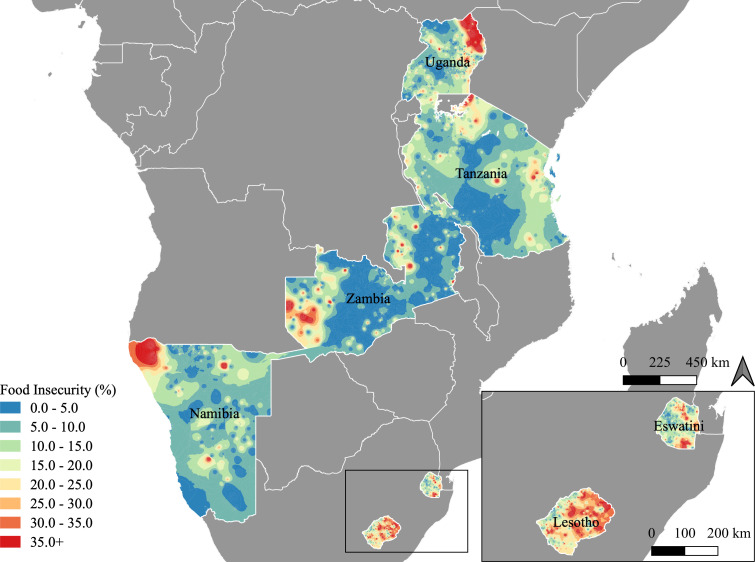
Zambia, Eswatini, Lesotho, Uganda and Tanzania and Namibia.
112 955 survey participants aged 15-59 years with HIV and recency test results.
Recent HIV infection (within 6 months) classified using the HIV-1 limited antigen avidity assay, in participants with an unsuppressed viral load (>1000 copies/mL) and no detectable antiretrovirals; severe food insecurity (SFI) defined as having no food in the house ≥three times in the past month.
Overall, 10.3% of participants lived in households reporting SFI. SFI was most common in urban, woman-headed households, and in people with chronic HIV infection. Among women, SFI was associated with a twofold increase in risk of recent HIV infection (adjusted relative risk (aRR) 2.08, 95% CI 1.09 to 3.97). SFI was also associated with transactional sex (aRR 1.28, 95% CI 1.17 to 1.41), a history of forced sex (aRR 1.36, 95% CI 1.11 to 1.66) and condom-less sex with a partner of unknown or positive HIV status (aRR 1.08, 95% CI 1.02 to 1.14) in all women, and intergenerational sex (partner ≥10 years older) in women aged 15-24 years (aRR 1.23, 95% CI 1.03 to 1.46). Recent receipt of food support was protective against HIV acquisition (aRR 0.36, 95% CI 0.14 to 0.88).
SFI increased risk for HIV acquisition in women by twofold. Heightened food insecurity during climactic extremes could imperil HIV epidemic control, and food support to women with SFI during these events could reduce HIV transmission.
评估撒哈拉以南非洲地区食物不安全与 HIV 感染之间的潜在双向关系。
基于全国代表性的 HIV 影响评估家庭调查。
赞比亚、斯威士兰、莱索托、乌干达和坦桑尼亚以及纳米比亚。
112955 名年龄在 15-59 岁之间、有 HIV 且最近有检测结果的调查参与者。
使用 HIV-1 有限抗原亲和力测定法,对未抑制病毒载量 (>1000 拷贝/ml)且未检测到抗逆转录病毒药物的参与者进行近期 HIV 感染(6 个月内)分类;严重食物不安全 (SFI) 定义为过去一个月家中有三次或以上没有食物。
总体而言,参与者中有 10.3%的人生活在报告 SFI 的家庭中。SFI 在城市、女性户主家庭和慢性 HIV 感染人群中最为常见。对于女性来说,SFI 与近期 HIV 感染风险增加两倍相关(调整后的相对风险 (aRR) 2.08,95%CI 1.09 至 3.97)。SFI 还与易性交易(aRR 1.28,95%CI 1.17 至 1.41)、强迫性行为史(aRR 1.36,95%CI 1.11 至 1.66)和与伴侣为未知或阳性 HIV 状态的无保护性行为(aRR 1.08,95%CI 1.02 至 1.14)相关,对于所有女性而言,还与代际性行为(伴侣年龄大 10 岁以上)有关,对于 15-24 岁的女性而言,这种相关性更为明显(aRR 1.23,95%CI 1.03 至 1.46)。最近获得食物支持可降低 HIV 感染风险(aRR 0.36,95%CI 0.14 至 0.88)。
SFI 使女性 HIV 感染风险增加两倍。在气候极端时期,食物不安全程度加剧可能危及 HIV 疫情控制,在这些事件期间向 SFI 女性提供食物支持可能会减少 HIV 传播。