Department of Medical Statistics, School of Public Health, Sun Yat-sen University, Guangzhou, China.
Environ Health. 2022 Jul 11;21(1):66. doi: 10.1186/s12940-022-00876-6.
Although the oldest-old (those aged over 80 years) are vulnerable to environmental factors and have the highest prevalence of hypertension, studies focusing on greenness exposure and the development of hypertension among them are insufficient. The aim of this study was to explore the association between residential greenness and hypertension in the oldest-old population.
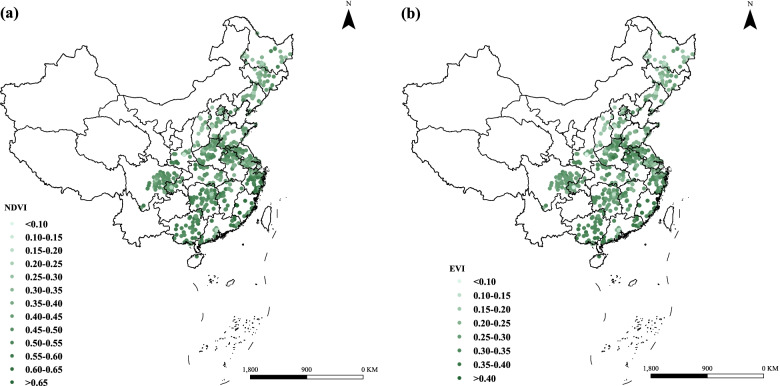
This cohort study included data from the Chinese Longitudinal Healthy Longevity Survey (CLHLS). The oldest-old were free of hypertension at baseline (2008), and hypertension events were assessed by follow-up surveys in 2011, 2014, and 2018. The one-year averages of the normalized difference vegetation index (NDVI) and enhanced vegetation index (EVI) at 500-m buffer before the interview year of incident hypertension or last censoring interview were collected at the level of 652 residential units (district or county). The linear or nonlinear association between greenness and hypertension incidence was analyzed using the Cox proportional hazards model with penalized splines. The linear links between greenness and hypertension incidence were determined using the Cox proportional hazards model included a random effect term.
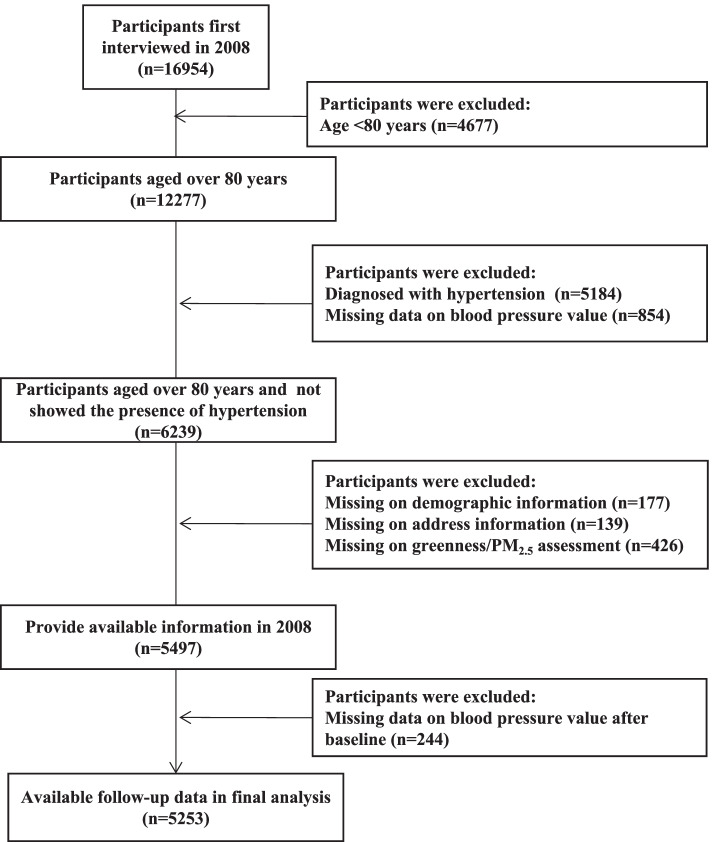
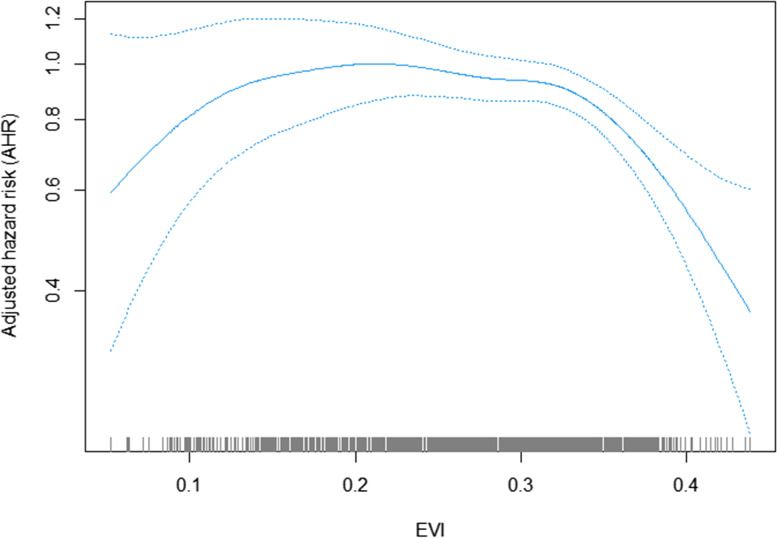
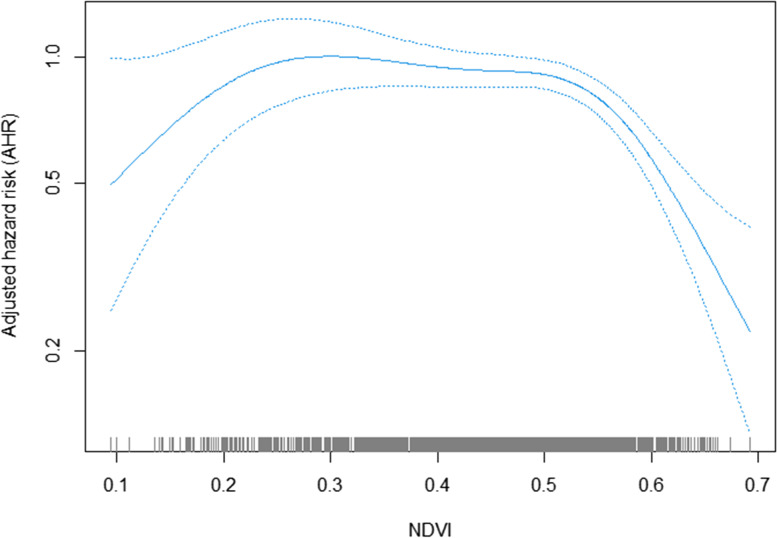
Among 5253 participants, the incidence rate of hypertension was 7.25 (95% confidence interval [CI]: 6.83-7.67) per 100 person-years. We found a nonlinear association between greenness exposure and hypertension risk, and the exposure-response curve showed that 1 change point existed. We examined the linear effect of greenness on hypertension by categorizing the NDVI/EVI into low and high-level exposure areas according to the change point. We found more notable protective effects of each 0.1-unit increase in greenness on hypertension incidence for participants living in the high-level greenness areas (hazard ratio (HR) = 0.60; 95% CI: 0.53-0.70 for NDVI; HR = 0.46; 95% CI: 0.37-0.57 for EVI). In contrast, no significant influence of greenness exposure on hypertension risk was found for participants living in the low-level greenness areas (HR = 0.77; 95% CI: 0.38-1.55 for NDVI; HR = 0.73; 95% CI: 0.33-1.63 for EVI).
Greenness exposure is nonlinearly associated with hypertension risk among the oldest-old, presenting its relationship in an inverse "U-shaped" curve. Greenness is a protective factor that decreases the risk of hypertension.
尽管最年长的老年人(80 岁以上的老年人)易受环境因素影响,且高血压患病率最高,但针对他们的绿色环境暴露与高血压发展的研究还不够充分。本研究旨在探讨最年长老年人的居住绿化与高血压之间的关系。
本队列研究纳入了中国长寿队列研究(CLHLS)的数据。最年长老年人在基线时(2008 年)无高血压,通过 2011 年、2014 年和 2018 年的随访调查评估高血压事件。在发生高血压的前一年或最后一次删失访谈的采访年份之前,在 500m 缓冲区收集归一化差异植被指数(NDVI)和增强植被指数(EVI)的一年平均值,共 652 个居住单元(区或县)。使用 Cox 比例风险模型和惩罚样条分析绿化与高血压发病率之间的线性或非线性关联。Cox 比例风险模型包括一个随机效应项,用于确定绿化与高血压发病率之间的线性关系。
在 5253 名参与者中,高血压的发病率为每 100 人年 7.25(95%置信区间[CI]:6.83-7.67)。我们发现绿化暴露与高血压风险之间存在非线性关系,暴露反应曲线显示存在 1 个转折点。我们根据转折点将 NDVI/EVI 分为低水平和高水平暴露区,以检查绿化对高血压的线性影响。我们发现,对于居住在高水平绿化区的参与者,绿化每增加 0.1 个单位,对高血压发病率的保护作用更为显著(NDVI:危险比[HR] = 0.60;95%CI:0.53-0.70;EVI:HR = 0.46;95%CI:0.37-0.57)。相比之下,居住在低水平绿化区的参与者的绿化暴露对高血压风险没有显著影响(NDVI:HR = 0.77;95%CI:0.38-1.55;EVI:HR = 0.73;95%CI:0.33-1.63)。
绿化暴露与最年长老年人的高血压风险呈非线性相关,呈现出反“U 形”曲线关系。绿化是降低高血压风险的保护因素。