Department of Pediatrics, University of California, San Francisco, California, USA.
Clinical Trials Center, University of Washington, Seattle, Washington, USA.
Matern Child Nutr. 2022 Oct;18(4):e13396. doi: 10.1111/mcn.13396. Epub 2022 Jul 12.
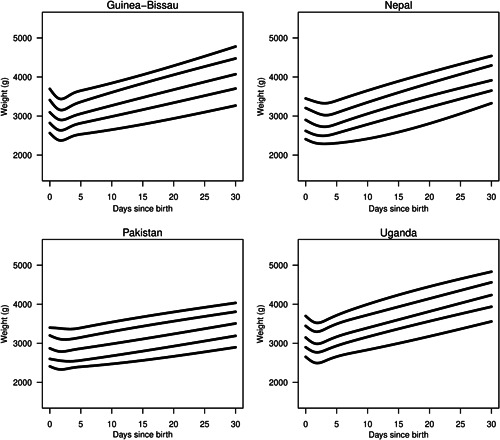
In low- and middle-income countries (LMIC), growth impairment is common; however, the trajectory of growth over the course of the first month has not been well characterised. To describe newborn growth trajectory and predictors of growth impairment, we assessed growth frequently over the first 30 days among infants born ≥2000 g in Guinea-Bissau, Nepal, Pakistan and Uganda. In this cohort of 741 infants, the mean birth weight was 3036 ± 424 g. For 721 (98%) infants, weight loss occurred for a median of 2 days (interquartile range, 1-4) following birth until weight nadir was reached 5.9 ± 4.3% below birth weight. At 30 days of age, the mean weight was 3934 ± 592 g. The prevalence of being underweight at 30 days ranged from 5% in Uganda to 31% in Pakistan. Of those underweight at 30 days of age, 56 (59%) had not been low birth weight (LBW), and 48 (50%) had reached weight nadir subsequent to 4 days of age. Male sex (relative risk [RR] 2.73 [1.58, 3.57]), LBW (RR 6.41 [4.67, 8.81]), maternal primiparity (1.74 [1.20, 2.51]) and reaching weight nadir subsequent to 4 days of age (RR 5.03 [3.46, 7.31]) were highly predictive of being underweight at 30 days of age. In this LMIC cohort, country of birth, male sex, LBW and maternal primiparity increased the risk of impaired growth, as did the modifiable factor of delayed initiation of growth. Interventions tailored to infants with modifiable risk factors could reduce the burden of growth impairment in LMIC.
在中低收入国家(LMIC),生长受损很常见;然而,在第一个月的生长轨迹尚未得到很好的描述。为了描述新生儿的生长轨迹和生长受损的预测因素,我们在几内亚比绍、尼泊尔、巴基斯坦和乌干达对出生体重≥2000 克的婴儿进行了频繁的生长评估。在这个 741 名婴儿的队列中,平均出生体重为 3036±424 克。对于 721 名(98%)婴儿,出生后中位数 2 天(四分位距,1-4)体重开始下降,直到体重达到最低点,比出生体重低 5.9±4.3%。在 30 天时,平均体重为 3934±592 克。30 天时体重不足的患病率从乌干达的 5%到巴基斯坦的 31%不等。在 30 天时体重不足的婴儿中,有 56 名(59%)婴儿不是低出生体重(LBW),有 48 名(50%)婴儿在 4 天后体重达到最低点。男性(相对风险 [RR] 2.73 [1.58, 3.57])、LBW(RR 6.41 [4.67, 8.81])、母亲初产(1.74 [1.20, 2.51])和在 4 天后体重达到最低点(RR 5.03 [3.46, 7.31])都高度预测 30 天时体重不足。在这个 LMIC 队列中,出生国家、男性、LBW 和母亲初产增加了生长受损的风险,可改变的因素是生长开始延迟。针对有可改变风险因素的婴儿采取的干预措施可以减少 LMIC 中生长受损的负担。