Huang August Yue, Lee Eunjung Alice
Division of Genetics and Genomics, Manton Center for Orphan Diseases, Boston Children's Hospital, Boston, MA, United States, Department of Pediatrics, Harvard Medical School, Boston, MA, United States.
Front Aging. 2022 Jan 3;2:800380. doi: 10.3389/fragi.2021.800380. eCollection 2021.
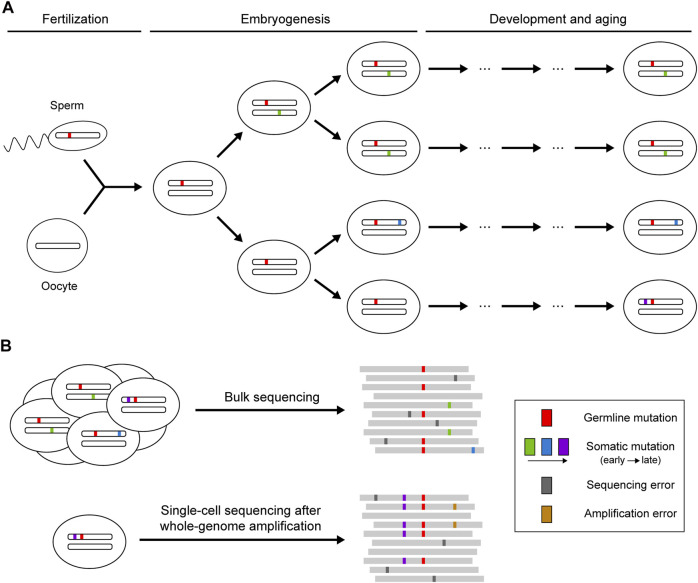
Somatic mutations are DNA variants that occur after the fertilization of zygotes and accumulate during the developmental and aging processes in the human lifespan. Somatic mutations have long been known to cause cancer, and more recently have been implicated in a variety of non-cancer diseases. The patterns of somatic mutations, or mutational signatures, also shed light on the underlying mechanisms of the mutational process. Advances in next-generation sequencing over the decades have enabled genome-wide profiling of DNA variants in a high-throughput manner; however, unlike germline mutations, somatic mutations are carried only by a subset of the cell population. Thus, sensitive bioinformatic methods are required to distinguish mutant alleles from sequencing and base calling errors in bulk tissue samples. An alternative way to study somatic mutations, especially those present in an extremely small number of cells or even in a single cell, is to sequence single-cell genomes after whole-genome amplification (WGA); however, it is critical and technically challenging to exclude numerous technical artifacts arising during error-prone and uneven genome amplification in current WGA methods. To address these challenges, multiple bioinformatic tools have been developed. In this review, we summarize the latest progress in methods for identification of somatic mutations and the challenges that remain to be addressed in the future.
体细胞突变是受精卵受精后发生的DNA变异,并在人类寿命的发育和衰老过程中积累。长期以来,人们已知体细胞突变会导致癌症,最近又发现其与多种非癌症疾病有关。体细胞突变的模式,即突变特征,也有助于揭示突变过程的潜在机制。几十年来,下一代测序技术的进步使得以高通量方式对DNA变异进行全基因组分析成为可能;然而,与种系突变不同,体细胞突变仅由一部分细胞群体携带。因此,需要灵敏的生物信息学方法来区分大量组织样本测序和碱基识别错误中的突变等位基因。研究体细胞突变的另一种方法,特别是那些存在于极少数细胞甚至单个细胞中的突变,是在全基因组扩增(WGA)后对单细胞基因组进行测序;然而,在当前的WGA方法中,排除在容易出错且不均匀的基因组扩增过程中产生的大量技术假象至关重要且在技术上具有挑战性。为应对这些挑战,已开发了多种生物信息学工具。在本综述中,我们总结了体细胞突变鉴定方法的最新进展以及未来仍有待解决的挑战。