Dipartimento di Biologia, Complesso Universitario di Monte Sant'Angelo, Università degli Studi di Napoli "Federico II", Napoli, Italia.
Dipartimento di Scienze, Università degli Studi Roma Tre, Roma, Italia.
Redox Rep. 2022 Dec;27(1):150-157. doi: 10.1080/13510002.2022.2094109.
Although the protooncogenes small GTPases Ras are redox-sensitive proteins, how they are regulated by redox signaling in the central nervous system (CNS) is still poorly understood. Alteration in redox-sensitive targets by redox signaling may have myriad effects on Ras stability, activity and localization. Redox-mediated changes in astrocytic RAS may contribute to the control of redox homeostasis in the CNS that is connected to the pathogenesis of many diseases.
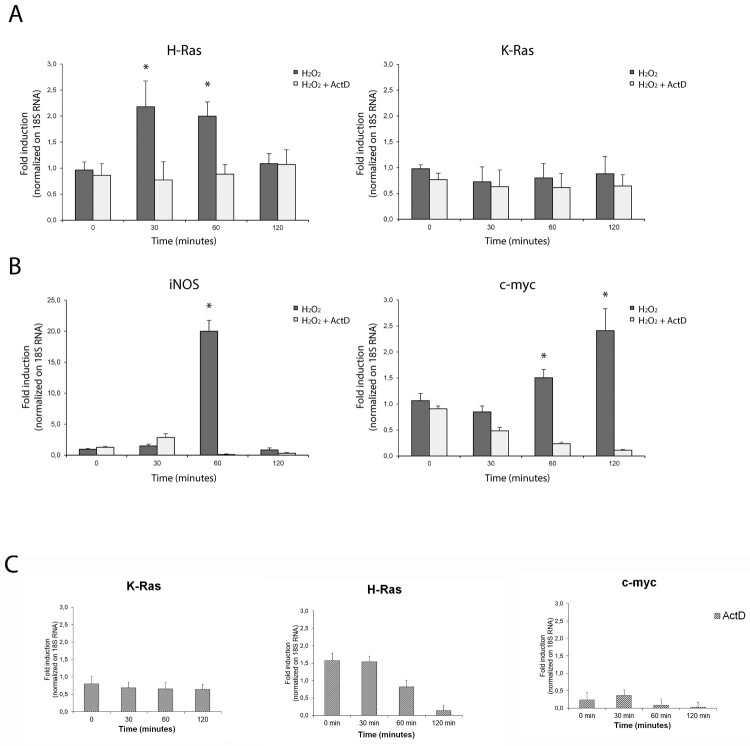
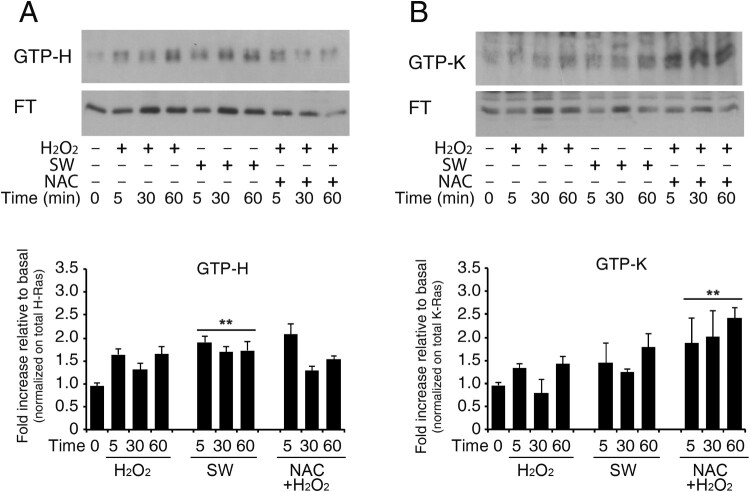
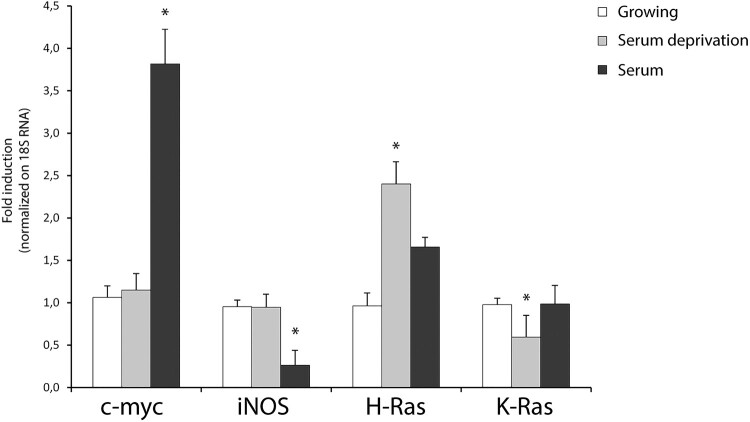
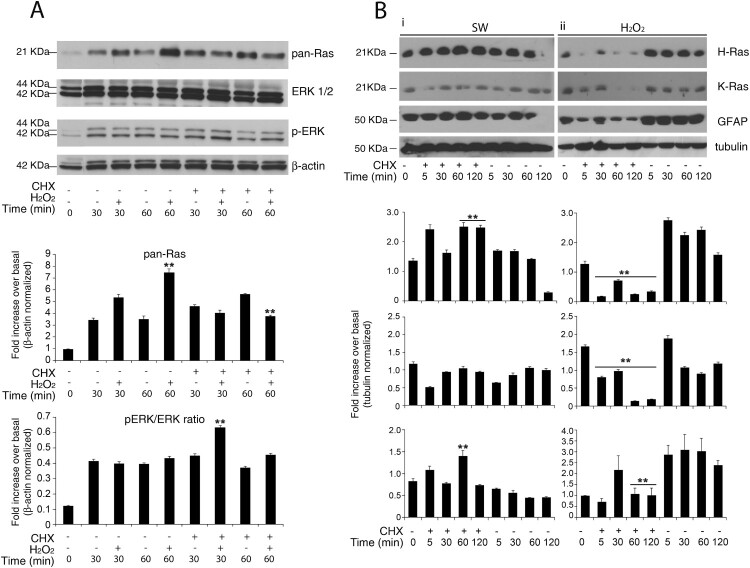
Here, we investigated the transient physiological induction, at both transcriptional and translational levels, of small GTPases Ras in response to redox stimulation. Cultured astrocytes were treated with hydrogen peroxide as in bolus addition and relative mRNA levels of murine and genes were detected by qRT-PCR. We found that transcription of hras mRNA in reactive astrocytes is redox-sensitive and mimics the prototypical redox-sensitive gene iNOS. Protein abundance in combination with protein turnover measurements by cycloheximide-chase experiments revealed distinct translation efficiency, GTP-bound enrichment, and protein turnover rates between the two isoforms H-Ras and K-Ras.
Reports from recent years support a significant role of H-Ras in driving redox processes. Beyond its canonical functions, Ras may impact on the core astrocytic cellular machinery that operates during redox stimulation.
尽管原癌基因小 GTP 酶 Ras 是氧化还原敏感蛋白,但它们在中枢神经系统 (CNS) 中如何被氧化还原信号调节仍知之甚少。氧化还原信号对氧化还原敏感靶标的改变可能对 Ras 的稳定性、活性和定位产生多种影响。氧化还原介导的星形胶质细胞 Ras 变化可能有助于控制与许多疾病发病机制相关的中枢神经系统氧化还原稳态。
在这里,我们研究了小 GTP 酶 Ras 在响应氧化还原刺激时在转录和翻译水平上的短暂生理诱导。用过氧化氢作为脉冲添加物处理培养的星形胶质细胞,并通过 qRT-PCR 检测鼠 和 基因的相对 mRNA 水平。我们发现反应性星形胶质细胞中 hras mRNA 的 转录是氧化还原敏感的,模拟了典型的氧化还原敏感基因 iNOS。结合环已酰亚胺 chase 实验的蛋白丰度和蛋白周转测量表明,两种同工型 H-Ras 和 K-Ras 之间存在明显的翻译效率、GTP 结合富集和蛋白周转速率。
近年来的报告支持 H-Ras 在驱动氧化还原过程中发挥重要作用。除了其典型功能外,Ras 还可能影响在氧化还原刺激期间运行的核心星形胶质细胞细胞机制。