Cave Veterinary Specialists, part of Linnaeus Veterinary Limited.
Dick White Referrals, Cambridge, UK.
Vet Surg. 2022 Oct;51(7):1078-1086. doi: 10.1111/vsu.13852. Epub 2022 Jul 13.
To describe the frequency of incomplete histological margins following planned narrow excision (PNE) of mast cell tumors (MCTs) and soft tissue sarcomas (STSs), and to assess the residual tumor classification (R) scheme for reporting histological margins in clinical cases.
Retrospective clinical study.
Forty-four client-owned dogs with 47 masses.
Medical records of dogs undergoing planned narrow excision of STSs and MCTs were reviewed (2016-2019). Histologic specimens were reviewed by a single pathologist and assigned R scoring (histologically incomplete/R1 margins defined as "tumor on ink").
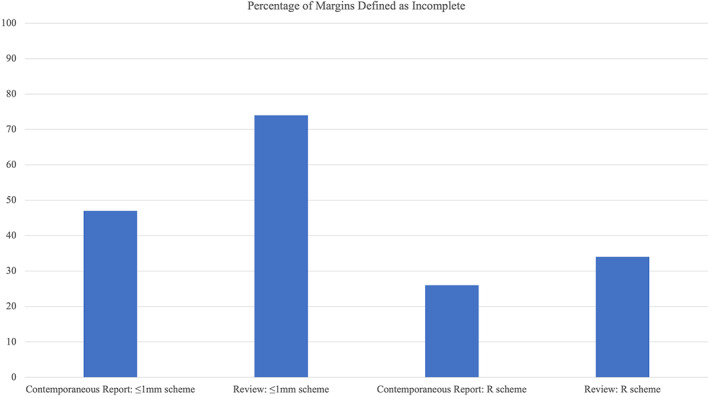
Six out of 23 (26%) MCT PNEs and 10/42 (42%) of STS PNEs resulted in R1 margins. R1 margins were more likely when performing PNE with 6-10 mm lateral measured surgical margins (LMSMs) versus 0-5 mm LMSM for MCTs (1/14 vs 5/9), but not STSs (3/7 vs 7/17) (P = .049). The R scheme resulted in higher retrospective percentage agreement in histological reporting than defining incomplete histological margin as tumor cells within ≤1 mm of the margin (83% vs 68% agreement). Complications occurred in 12/47 surgeries, with none requiring additional surgery. Tumors recurred in 3/18 (17%) STSs and 2/18 (11%) MCTs.
Fewer R1 margins were obtained when PNE with LMSM of 6-10 mm was performed for mast cell tumors. The use of the R scheme increased agreement in histopathological margin assessment.
Planned narrow excision is a viable technique for histopathological diagnosis of appendicular soft tissue sarcomas and mast cell tumors for limb salvage.
描述计划性窄切(PNE)切除后,皮肤软组织肉瘤(STS)和肥大细胞瘤(MCT)组织学切缘不完整的频率,并评估用于报告临床病例组织学切缘的残余肿瘤分类(R)方案。
回顾性临床研究。
44 只患有 47 个肿块的患犬。
回顾性分析 2016 年至 2019 年期间接受 STS 和 MCT 计划性窄切的患犬的病历。由同一位病理学家对组织学标本进行复查,并进行 R 评分(组织学不完整/R1 切缘定义为“墨水上有肿瘤”)。
23 例 MCT PNE 中有 6 例(26%)和 42 例 STS PNE 中有 10 例(42%)为 R1 切缘。对于 MCT,与 0-5mm 侧距测量手术切缘(LMSM)相比,采用 6-10mm LMSM 行 PNE 时,R1 切缘更常见(1/14 与 5/9),但对于 STS 并非如此(3/7 与 7/17)(P=0.049)。与将组织学切缘不完整定义为切缘 1mm 内有肿瘤细胞(83%与 68%的一致性)相比,R 方案在组织学报告中具有更高的回顾性百分比一致性。47 例手术中有 12 例发生并发症,无 1 例需要再次手术。在 3 例 STS(17%)和 2 例 MCT(11%)中复发。
对于 MCT,当采用 6-10mm LMSM 行 PNE 时,获得的 R1 切缘较少。R 方案的使用提高了组织病理学切缘评估的一致性。
计划性窄切是一种可行的技术,可用于保留肢体的四肢软组织肉瘤和肥大细胞瘤的组织病理学诊断。