Office of Cancer Screening, National Cancer Center, National Clinical Research Center for Cancer, Cancer Hospital, Chinese Academy of Medical Sciences and Peking Union Medical College, Beijing 100021, China.
Key Laboratory of Cancer Data Science, Chinese Academy of Medical Sciences, Beijing 100021, China.
Chin Med J (Engl). 2022 Jun 5;135(11):1331-1339. doi: 10.1097/CM9.0000000000002161.
Non-smokers account for a large proportion of lung cancer patients, especially in Asia, but the attention paid to them is limited compared with smokers. In non-smokers, males display a risk for lung cancer incidence distinct from the females-even after excluding the influence of smoking; but the knowledge regarding the factors causing the difference is sparse. Based on a large multicenter prospective cancer screening cohort in China, we aimed to elucidate the interpretable sex differences caused by known factors and provide clues for primary and secondary prevention.
Risk factors including demographic characteristics, lifestyle factors, family history of cancer, and baseline comorbidity were obtained from 796,283 Chinese non-smoking participants by the baseline risk assessment completed in 2013 to 2018. Cox regression analysis was performed to assess the sex difference in the risk of lung cancer, and the hazard ratios (HRs) that were adjusted for different known factors were calculated and compared to determine the proportion of excess risk and to explain the existing risk factors.
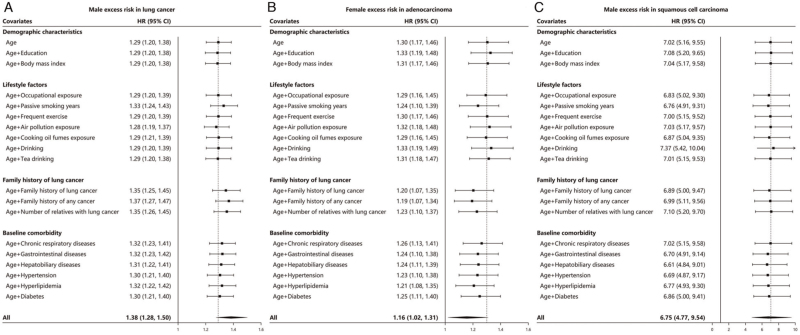
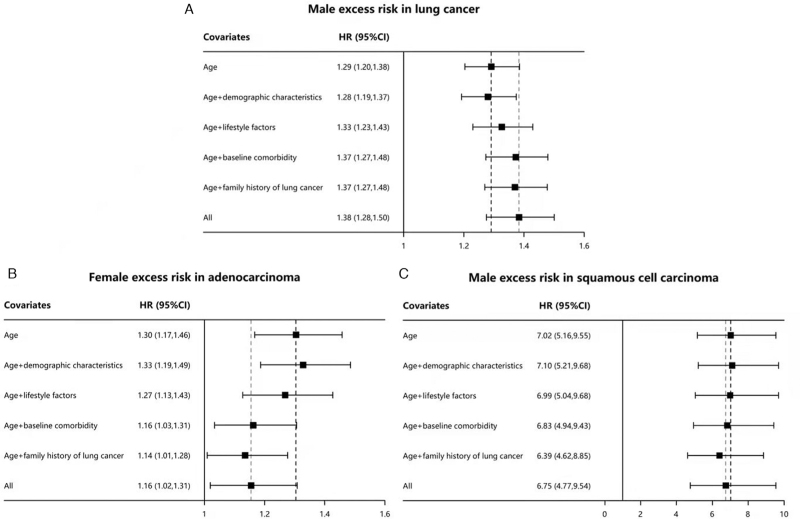
With a median follow-up of 4.80 years, 3351 subjects who were diagnosed with lung cancer were selected in the analysis. The lung cancer risk of males was significantly higher than that of females; the HRs in all male non-smokers were 1.29 (95% confidence interval [CI]: 1.20-1.38) after adjusting for the age and 1.38 (95% CI: 1.28-1.50) after adjusting for all factors, which suggested that known factors could not explain the sex difference in the risk of lung cancer in non-smokers. Known factors were 7% (|1.29-1.38|/1.29) more harmful in women than in men. For adenocarcinoma, women showed excess risk higher than men, contrary to squamous cell carcinoma; after adjusting for all factors, 47% ([1.30-1.16]/[1.30-1]) and 4% ([7.02-6.75]/[7.02-1])) of the excess risk was explainable in adenocarcinoma and squamous cell carcinoma. The main causes of gender differences in lung cancer risk were lifestyle factors, baseline comorbidity, and family history.
Significant gender differences in the risk of lung cancer were discovered in China non-smokers. Existing risk factors did not explain the excess lung cancer risk of all non-smoking men, and the internal causes for the excess risk still need to be explored; most known risk factors were more harmful to non-smoking women; further exploring the causes of the sex difference would help to improve the prevention and screening programs and protect the non-smoking males from lung cancers.
非吸烟者在肺癌患者中占很大比例,尤其是在亚洲,但与吸烟者相比,对他们的关注有限。在非吸烟者中,男性患肺癌的风险与女性不同——即使排除了吸烟的影响;但关于导致这种差异的因素的知识还很匮乏。基于中国一项大型多中心前瞻性癌症筛查队列研究,我们旨在阐明已知因素引起的可解释的性别差异,并为一级和二级预防提供线索。
通过 2013 年至 2018 年完成的基线风险评估,从 796283 名中国不吸烟参与者中获得包括人口统计学特征、生活方式因素、癌症家族史和基线合并症在内的风险因素。使用 Cox 回归分析评估肺癌风险的性别差异,并计算和比较经不同已知因素调整后的危险比(HR),以确定超额风险的比例并解释现有风险因素。
中位随访 4.80 年后,分析中选择了 3351 名被诊断为肺癌的患者。男性的肺癌风险明显高于女性;所有男性非吸烟者的 HRs 在调整年龄后为 1.29(95%置信区间[CI]:1.20-1.38),在调整所有因素后为 1.38(95% CI:1.28-1.50),这表明已知因素不能解释非吸烟者肺癌风险的性别差异。在女性中,已知因素比男性更具危害性,比例为 7%(|1.29-1.38|/1.29)。腺癌患者的风险高于男性,而鳞状细胞癌患者则相反;在调整所有因素后,腺癌和鳞状细胞癌的超额风险中,47%([1.30-1.16]/[1.30-1])和 4%([7.02-6.75]/[7.02-1])可归因于已知因素。导致肺癌风险性别差异的主要原因是生活方式因素、基线合并症和家族史。
在中国非吸烟者中发现了肺癌风险的显著性别差异。现有风险因素并不能解释所有非吸烟男性的肺癌风险,超额风险的内在原因仍需进一步探讨;大多数已知的风险因素对非吸烟女性的危害性更大;进一步探索性别差异的原因有助于改善预防和筛查计划,保护非吸烟男性免受肺癌侵害。