Wang Luwei, Chen Jiasheng, Lin Lihui, Huang Xiaowei
Department of Pharmacy, Women and Children's Hospital, School of Medicine, Xiamen University, Xiamen, 361003, China.
Clinical Trial Institution, Scientific Research and lnnovation Center, Women and Children's Hospital, School of Medicine, Xiamen University, Xiamen, 361003, China.
Health Econ Rev. 2025 Jul 12;15(1):60. doi: 10.1186/s13561-025-00656-1.
Squamous NSCLC (sqNSCLC), a subtype with few targetable mutations, is often diagnosed at advanced stages. Platinum-based chemo-therapy, the first-line treatment, yields median overall survival (OS) of less than or equal to one year, underscoring the need for better therapies. Penpulimab, a novel PD-1 inhibitor developed in China, is a humanized IgG1 antibody with a modified Fc region. Phase III trial data (AK105-302) showed penpulimab + carboplatin-paclitaxel (PEN-CP) significantly improved progression-free survival (PFS) and OS in metastatic sqNSCLC vs. placebo (CP), with a favorable safety profile. However, its high cost and lack of cost-effectiveness analyses warrant further study. This research evaluates PEN-CP's cost-effectiveness vs. CP from the Chinese healthcare perspective.
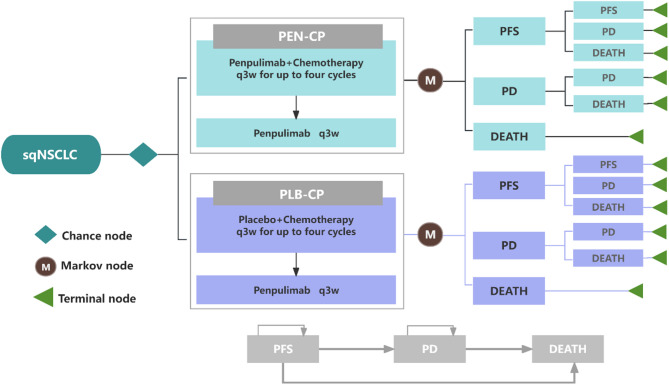
A three-state Markov model was developed to evaluate the cost-effectiveness of PEN-CP as a first-line treatment for metastatic sqNSCLC. Clinical efficacy data were sourced from the AK105-302 trial, while drug costs were derived from national tender prices. Additional costs and health utilities were obtained from published literature. The primary outcomes included total costs, quality-adjusted life years (QALYs), and incremental cost-effectiveness ratios (ICERs). To assess the robustness of the findings, both one-way and probabilistic sensitivity analyses were conducted.
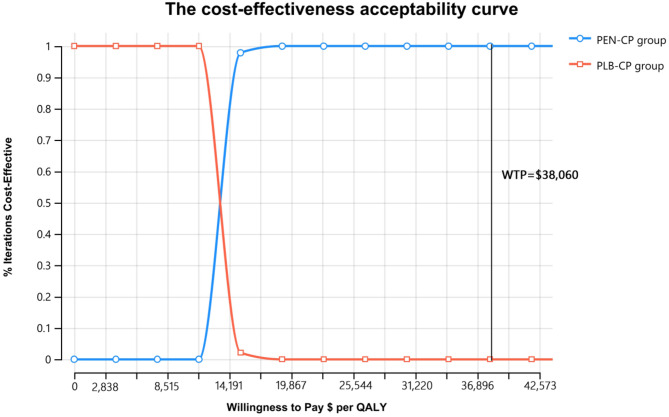
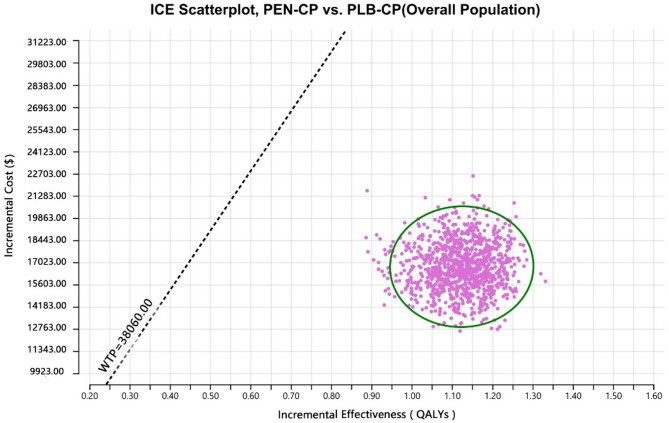
Compared to CP, the ICER for PEN-CP was $14,918.81 per QALY. The ICER values were below the willingness-to-pay (WTP) threshold of $38,060.00 per QALY. The key drivers of the model outcomes were the price of penpulimab, the PFS stage utility value, and the cost of optimal supportive care.
From the perspective of the Chinese healthcare system, penpulimab combined with first-line chemotherapy demonstrates is cost-effective at a willingness-to-pay threshold of $38,060.00 per QALY for patients with metastatic sqNSCLC and represents a promising first-line treatment option.
鳞状非小细胞肺癌(sqNSCLC)是一种可靶向突变较少的亚型,通常在晚期被诊断出来。铂类化疗作为一线治疗,其总生存期(OS)中位数小于或等于一年,这凸显了对更好治疗方法的需求。派安普利单抗是一种在中国研发的新型PD - 1抑制剂,是一种具有修饰Fc区域的人源化IgG1抗体。III期试验数据(AK105 - 302)显示,与安慰剂(CP)相比,派安普利单抗联合卡铂 - 紫杉醇(PEN - CP)显著改善了转移性sqNSCLC的无进展生存期(PFS)和OS,且安全性良好。然而,其高昂的成本以及缺乏成本效益分析值得进一步研究。本研究从中国医疗保健角度评估PEN - CP与CP相比的成本效益。
建立了一个三状态马尔可夫模型,以评估PEN - CP作为转移性sqNSCLC一线治疗的成本效益。临床疗效数据来自AK105 - 302试验,而药物成本来自国家招标价格。额外成本和健康效用值来自已发表的文献。主要结果包括总成本、质量调整生命年(QALY)和增量成本效益比(ICER)。为评估结果的稳健性,进行了单因素和概率敏感性分析。
与CP相比,PEN - CP的ICER为每QALY 14,918.81美元。ICER值低于每QALY 38,060.00美元的支付意愿(WTP)阈值。模型结果的关键驱动因素是派安普利单抗的价格、PFS阶段效用值和最佳支持治疗的成本。
从中国医疗保健系统的角度来看,对于转移性sqNSCLC患者,在每QALY支付意愿阈值为38,060.00美元的情况下,派安普利单抗联合一线化疗显示出成本效益,是一种有前景的一线治疗选择。