Kentucky Spinal Cord Injury Research Center, Department of Neurological Surgery, University of Louisville, Louisville, Kentucky.
Center for Integrative Brain Research, Seattle Children's Research Institute, Seattle, Washington.
J Neurophysiol. 2022 Aug 1;128(2):405-417. doi: 10.1152/jn.00469.2021. Epub 2022 Jul 13.
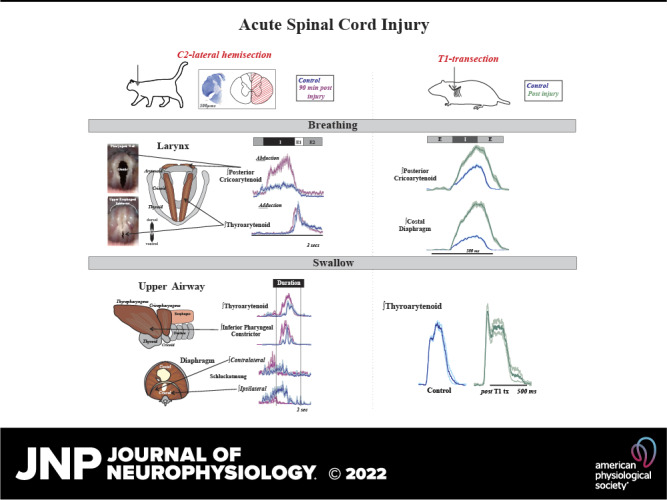
Laryngeal function is vital to airway protection. Although swallow is mediated by the brainstem, the mechanism underlying the increased risk of dysphagia after cervical spinal cord injury (SCI) is unknown. We hypothesized that: ) loss of descending phrenic drive affects swallow and breathing differently, and ) loss of ascending spinal afferent information alters swallow regulation. We recorded electromyograms (EMGs) from upper airway and chest wall muscles in freely breathing pentobarbital-anesthetized cats and rats. Laryngeal abductor activity during inspiration increased about twofold following C2 lateral hemisection. Ipsilateral to the injury, the crural diaphragm EMG amplitude was reduced during breathing (62 ± 25% change postinjury), but no animal had complete termination of activity; 75% of animals had increased contralateral diaphragm recruitment, but this did not reach significance. During swallow, laryngeal adductor and pharyngeal constrictor muscles increased activity, and diaphragm activity was bilaterally suppressed. This was unexpected because of the ipsilateral-specific response during breathing. Swallow-breathing coordination was disrupted by injury, and more swallows occurred during early expiration. Finally, to determine if the chest wall is a major source of feedback for laryngeal regulation, we performed T1 total transections in rats. As in the C2 lateral hemisection, inspiratory laryngeal recruitment was the first feature noted after injury. In contrast to the C2 lateral hemisection, diaphragmatic drive increased after T1 transection. Overall, we found that SCI alters laryngeal drive during swallow and breathing, and alters swallow-related diaphragm activity. Our results show behavior-specific effects, suggesting that swallow is affected more than breathing is by SCI, and emphasizing the need for additional studies on the effect of ascending afferents from the spinal cord on laryngeal function. This is the first manuscript to determine the impact of cSCI on laryngeal and swallow function, and to describe a possible mechanism for dysphagia and altered airway protection after injury.
喉功能对于气道保护至关重要。尽管吞咽是由脑干介导的,但颈脊髓损伤 (SCI) 后吞咽困难风险增加的机制尚不清楚。我们假设:) 膈神经下行冲动的丧失对吞咽和呼吸的影响不同,和 ) 上升的脊髓传入信息的丧失改变吞咽的调节。我们在自由呼吸的戊巴比妥麻醉猫和大鼠中记录了上气道和胸壁肌肉的肌电图 (EMG)。C2 侧半切后,吸气时喉外展肌的活动增加了约两倍。在损伤的同侧,膈神经 EMG 幅度在呼吸时降低(损伤后 62±25%变化),但没有动物的活动完全终止;75%的动物出现对侧膈神经募集增加,但无统计学意义。在吞咽时,喉内收肌和咽缩肌的活动增加,而膈神经的活动在双侧被抑制。这是出乎意料的,因为在呼吸时存在同侧特异性反应。吞咽和呼吸的协调性因损伤而受到破坏,更多的吞咽发生在早期呼气时。最后,为了确定胸壁是否是喉调节的主要反馈源,我们在大鼠中进行了 T1 全横断。与 C2 侧半切一样,损伤后首先注意到吸气时的喉募集。与 C2 侧半切不同,膈神经驱动在 T1 横断后增加。总之,我们发现 SCI 改变了吞咽和呼吸时的喉驱动,并改变了与吞咽相关的膈神经活动。我们的结果显示了行为特异性的影响,这表明 SCI 对吞咽的影响比对呼吸的影响更大,并强调了需要进一步研究来自脊髓的上升传入对喉功能的影响。这是第一篇确定 cSCI 对喉和吞咽功能影响的手稿,并描述了损伤后吞咽困难和气道保护改变的可能机制。