Section of Endocrinology, Diabetes and Metabolism, Department of Medicine, University of Verona, Piazzale A. Stefani, 1, 37126, Verona, Italy.
Pediatric Diabetes and Metabolic Disorders Unit, Department of Surgical Sciences, Dentistry, Pediatrics, and Gynaecology, University of Verona, Verona, Italy.
Hormones (Athens). 2022 Sep;21(3):477-486. doi: 10.1007/s42000-022-00387-6. Epub 2022 Jul 13.
Little is known about the association between plasma adiponectin levels and nonalcoholic fatty liver disease (NAFLD) in patients with type 2 diabetes mellitus (T2DM). We examined whether there is an association between lower plasma adiponectin levels and the presence/severity of NAFLD in people with T2DM.
We cross-sectionally recruited 79 men with non-insulin-treated T2DM and no known liver diseases, who had consecutively attended our diabetes outpatient service over a 6-month period and who underwent both ultrasonography and Fibroscan-measured liver stiffness (LSM). Nine single nucleotide polymorphisms (PNPLA3 rs738409 and other genetic variants) associated with NAFLD were investigated.
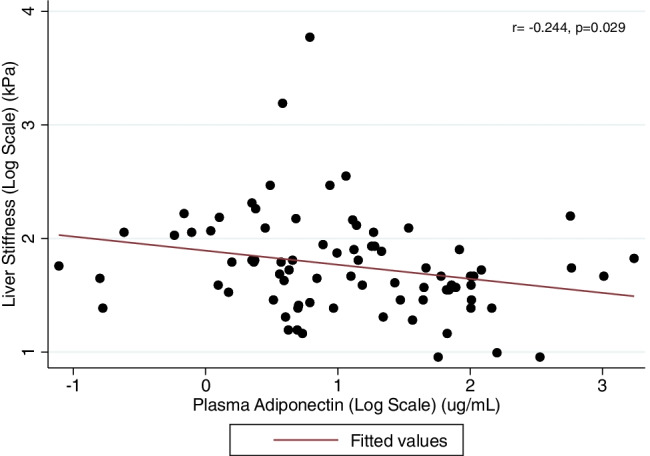
Among the 79 participants included (mean age 67 ± 10 years, BMI 27.7 ± 4 kg/m), 28 did not have NAFLD, 32 had steatosis alone, and 19 had NAFLD with coexisting significant fibrosis (LSM ≥ 7.0 kPa by Fibroscan®). Compared to those without NAFLD, patients with hepatic steatosis alone and those with hepatic steatosis and coexisting significant fibrosis had lower high-molecular-weight adiponectin levels (5.5 [IQR 2.3-7.6] vs. 2.4 [1.8-3.7] vs. 1.6 [1.0-2.9] µg/mL; p < 0.001). After adjustment for age, body mass index, insulin resistance, and the PNPLA3 rs738409 variant, lower plasma adiponectin levels were found to be associated with increased odds of both steatosis alone (adjusted-odds ratio [OR] 2.44, 95% CI 1.04-5.56, p = 0.042) and NAFLD with coexisting significant fibrosis (adjusted-OR 3.84, 95% CI 1.23-10.0, p = 0.020). Similar findings were observed after adjustment for the other eight genotyped NAFLD-related polymorphisms.
Lower plasma adiponectin levels are closely associated with the presence and severity of NAFLD in men with T2DM, pointing to a role of adiponectin in NAFLD development and progression.
在 2 型糖尿病(T2DM)患者中,血浆脂联素水平与非酒精性脂肪性肝病(NAFLD)之间的关联知之甚少。我们研究了 T2DM 患者中较低的血浆脂联素水平与 NAFLD 的存在/严重程度之间是否存在关联。
我们在 6 个月的时间里,连续招募了 79 名未接受胰岛素治疗的 T2DM 男性患者,他们没有已知的肝脏疾病,并在我院糖尿病门诊就诊,这些患者均接受了超声检查和 Fibroscan 测量的肝硬度(LSM)。研究了与 NAFLD 相关的 9 种单核苷酸多态性(PNPLA3 rs738409 和其他遗传变异)。
在纳入的 79 名参与者中(平均年龄 67 ± 10 岁,BMI 27.7 ± 4 kg/m),28 名参与者没有 NAFLD,32 名参与者仅有脂肪变性,19 名参与者有合并明显纤维化的 NAFLD(通过 Fibroscan®,LSM≥7.0 kPa)。与无 NAFLD 的患者相比,仅有肝脂肪变性的患者和有肝脂肪变性合并明显纤维化的患者的高分子量脂联素水平较低(5.5 [IQR 2.3-7.6] vs. 2.4 [1.8-3.7] vs. 1.6 [1.0-2.9] µg/mL;p<0.001)。在校正年龄、体重指数、胰岛素抵抗和 PNPLA3 rs738409 变异后,较低的血浆脂联素水平与单纯脂肪变性(校正比值比 [OR] 2.44,95%CI 1.04-5.56,p=0.042)和合并明显纤维化的 NAFLD(校正 OR 3.84,95%CI 1.23-10.0,p=0.020)的发生几率增加相关。在调整了其他 8 种与 NAFLD 相关的基因多态性后,也观察到了类似的发现。
在 T2DM 男性中,较低的血浆脂联素水平与 NAFLD 的存在和严重程度密切相关,提示脂联素在 NAFLD 的发生和发展中起作用。