The Key Laboratory of Animal Disease and Human Health of Sichuan Province, College of Veterinary Medicine, Sichuan Agricultural University, Chengdu 611130, Sichuan, People's Republic of China.
The Key Laboratory of Animal Disease and Human Health of Sichuan Province, College of Veterinary Medicine, Sichuan Agricultural University, Chengdu 611130, Sichuan, People's Republic of China - Laboratory of Molecular and Cellular Parasitology, Healthy Longevity Translational Research Programme and Department of Microbiology and Immunology, Yong Loo Lin School of Medicine, National University of Singapore, Singapore 117545, Singapore.
Parasite. 2022;29:34. doi: 10.1051/parasite/2022037. Epub 2022 Jul 14.
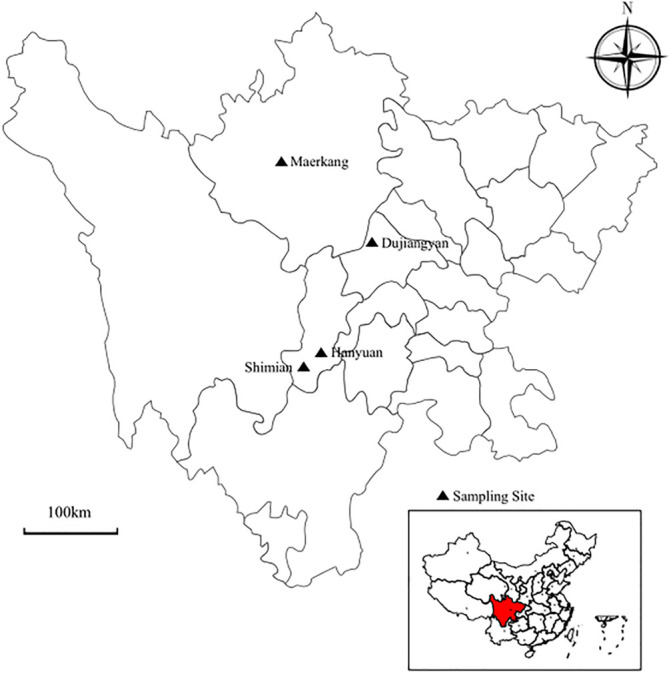
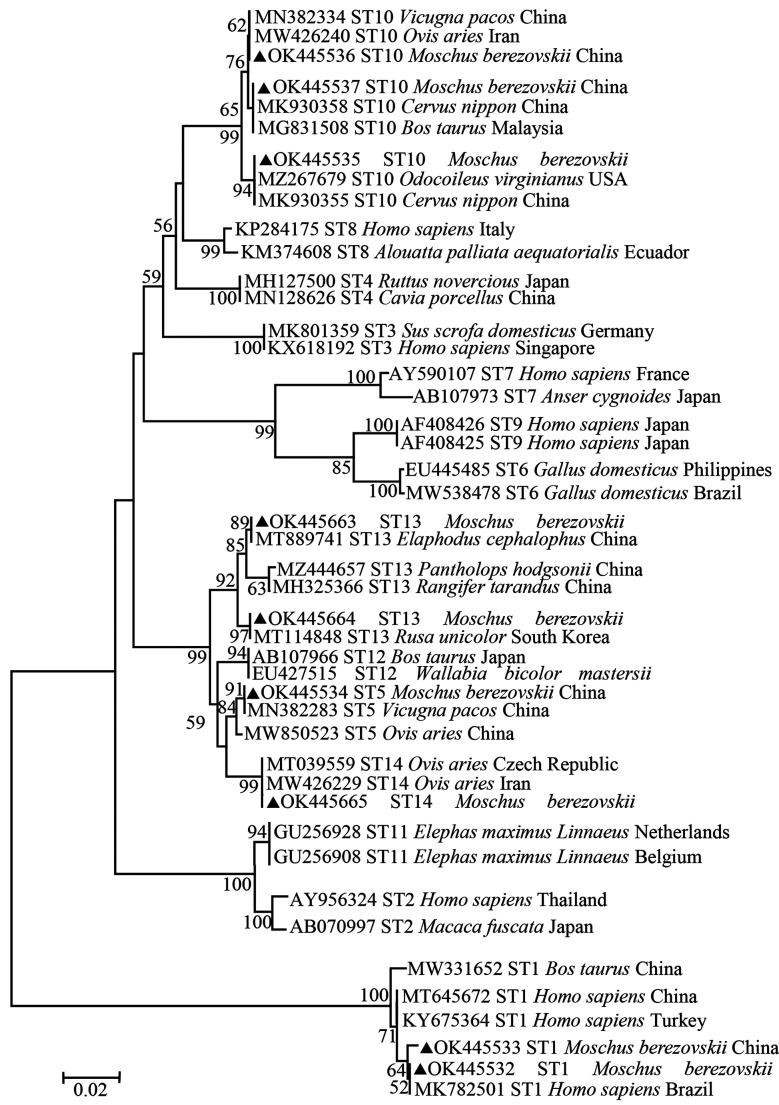
Blastocystis sp. is a common anaerobic protist with controversial pathogenicity that can infect various animals and humans. However, there are no reports of Blastocystis sp. infections in forest musk deer (Moschus berezovskii). The present study was designed to examine the occurrence, subtype distribution and genetic characterization of Blastocystis sp. in forest musk deer in southwestern China, and to assess the potential for zoonotic transmission. A total of 504 fresh stool samples were collected from captive forest musk deer in four distinct areas of southwestern China. Overall, 14.7% of the forest musk deer (74/504) were found to be infected with Blastocystis sp. The highest occurrence of Blastocystis sp. was observed in Dujiangyan (27.5%), followed by Maerkang (23.3%). The occurrence of Blastocystis sp. was 7.9% and 4.1% in Shimian and Hanyuan, respectively. Significant differences in the occurrence of Blastocystis sp. among different areas were observed (p < 0.05), while we did not observe significant differences among animals of different age and sex (p > 0.05). Two known zoonotic subtypes (ST1 and ST5) and three animal-predominant subtypes (ST10, ST13, and ST14) were identified, of which ST10 was the most common (36/74, 48.6%). Our findings highlight that forest musk deer may be potential reservoirs of zoonotic human Blastocystis sp. infections.
芽囊原虫是一种常见的具有争议性的致病性厌氧原生动物,可感染各种动物和人类。然而,在林麝(Moschus berezovskii)中尚未有芽囊原虫感染的报道。本研究旨在调查中国西南部林麝中芽囊原虫的感染情况、亚型分布和遗传特征,并评估其潜在的人畜共患传播风险。本研究共采集了来自中国西南部四个不同地区的 504 份新鲜粪便样本。结果显示,14.7%(74/504)的林麝感染了芽囊原虫。其中,都江堰地区的感染率最高(27.5%),其次是马尔康(23.3%),而在石棉和汉源的感染率分别为 7.9%和 4.1%。不同地区的芽囊原虫感染率存在显著差异(p<0.05),但不同年龄和性别的动物之间的感染率无显著差异(p>0.05)。本研究共鉴定出两种已知的人畜共患亚型(ST1 和 ST5)和三种动物优势亚型(ST10、ST13 和 ST14),其中 ST10 最为常见(36/74,48.6%)。本研究结果表明,林麝可能是潜在的人畜共患芽囊原虫感染源。