Center for Structural Biology, Center for Cancer Research, National Cancer Institute, Frederick, Maryland, USA.
J Biol Chem. 2022 Aug;298(8):102253. doi: 10.1016/j.jbc.2022.102253. Epub 2022 Jul 12.
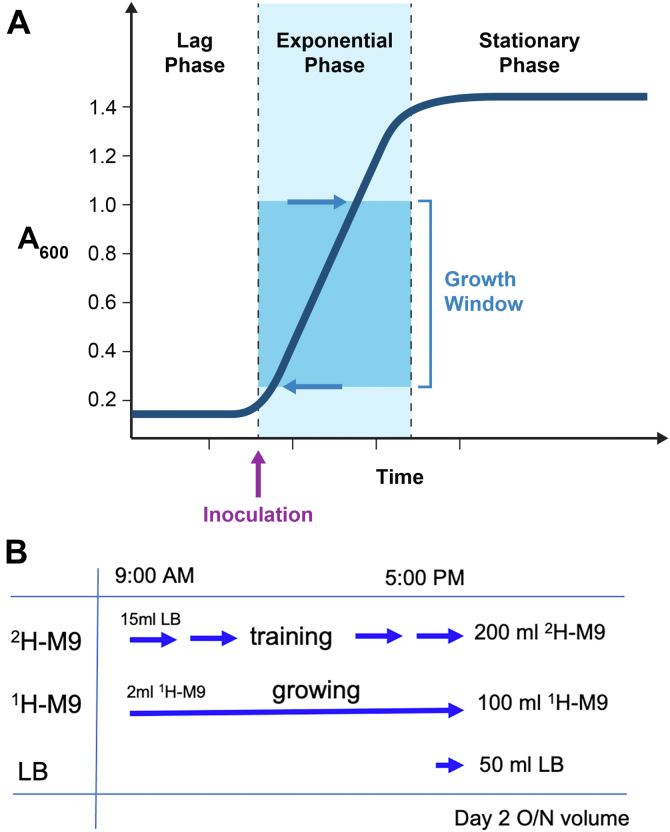
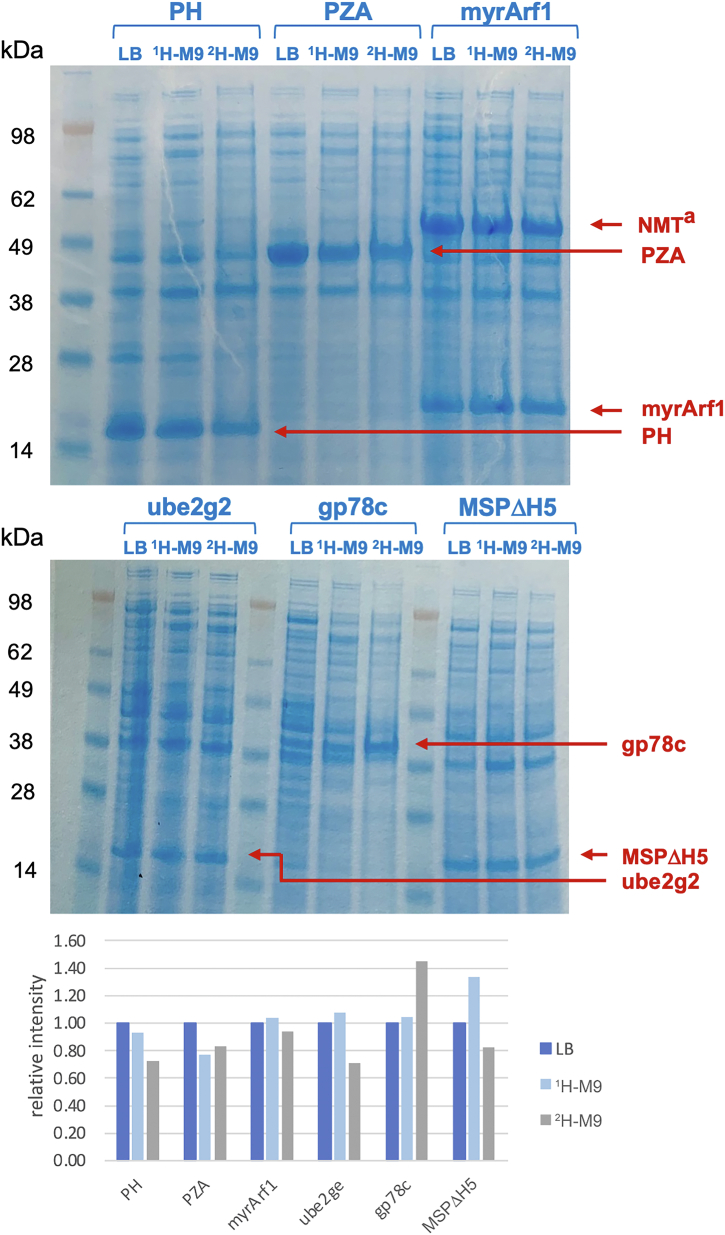
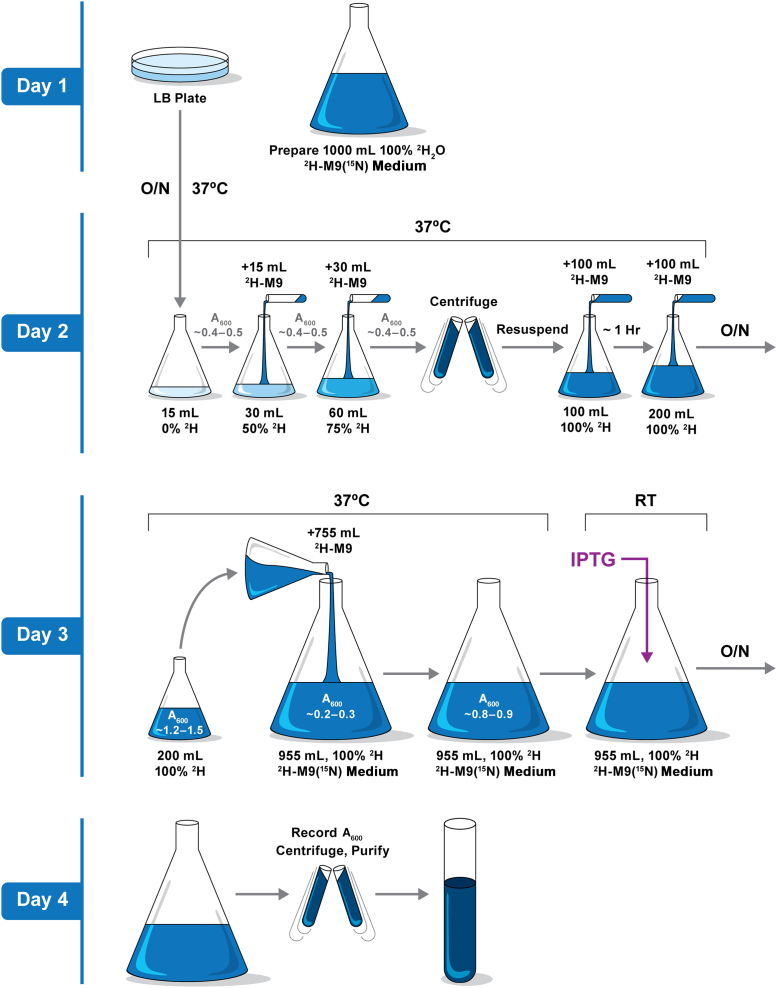
Highly deuterated protein samples expand the biophysics and biological tool kit by providing, among other qualities, contrast matching in neutron diffraction experiments and reduction of dipolar spin interactions from normally protonated proteins in magnetic resonance studies, impacting both electron paramagnetic resonance and NMR spectroscopy. In NMR applications, deuteration is often combined with other isotopic labeling patterns to expand the range of conventional NMR spectroscopy research in both solution and solid-state conditions. However, preparation of deuterated proteins is challenging. We present here a simple, effective, and user-friendly protocol to produce highly deuterated proteins in Escherichia coli cells. The protocol utilizes the common shaker flask growth method and the well-known pET system (which provides expression control via the T7 promotor) for large-scale recombinant protein expression. One liter expression typically yields 5 to 50 mg of highly deuterated protein. Our data demonstrate that the optimized procedure produces a comparable quantity of protein in deuterium (HO) oxide M9 medium compared with that in HO M9 medium. The protocol will enable a broader utilization of deuterated proteins in a number of biophysical techniques.
高度氘代的蛋白质样品通过提供在中子衍射实验中的对比匹配以及减少磁共振研究中通常质子化的蛋白质中的偶极自旋相互作用等特性,扩展了生物物理和生物工具包,这对电子顺磁共振和 NMR 光谱学都有影响。在 NMR 应用中,氘代通常与其他同位素标记模式结合使用,以扩展在溶液和固态条件下的常规 NMR 光谱学研究范围。然而,制备氘代蛋白质具有挑战性。我们在这里提出了一种简单、有效且用户友好的方案,用于在大肠杆菌细胞中生产高度氘代的蛋白质。该方案利用常见的摇瓶生长方法和众所周知的 pET 系统(通过 T7 启动子提供表达控制)进行大规模重组蛋白表达。一升表达通常可产生 5 至 50 毫克的高度氘代蛋白质。我们的数据表明,与在 H218O M9 培养基中相比,优化后的程序在 D2O M9 培养基中产生了相当数量的蛋白质。该方案将使氘代蛋白质在许多生物物理技术中的更广泛应用成为可能。