Université Paris-Saclay, CNRS, Institut Galien Paris-Saclay, 92296, Châtenay-Malabry, France.
Institut Curie, PSL Research University, Translational Research Department, Experimental Radiotherapy Platform, UMR 1288, F-91405, Orsay, France.
Nat Commun. 2022 Jul 14;13(1):4102. doi: 10.1038/s41467-022-30917-0.
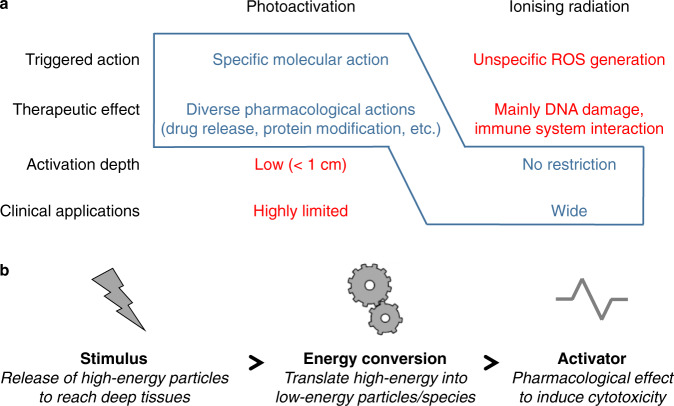
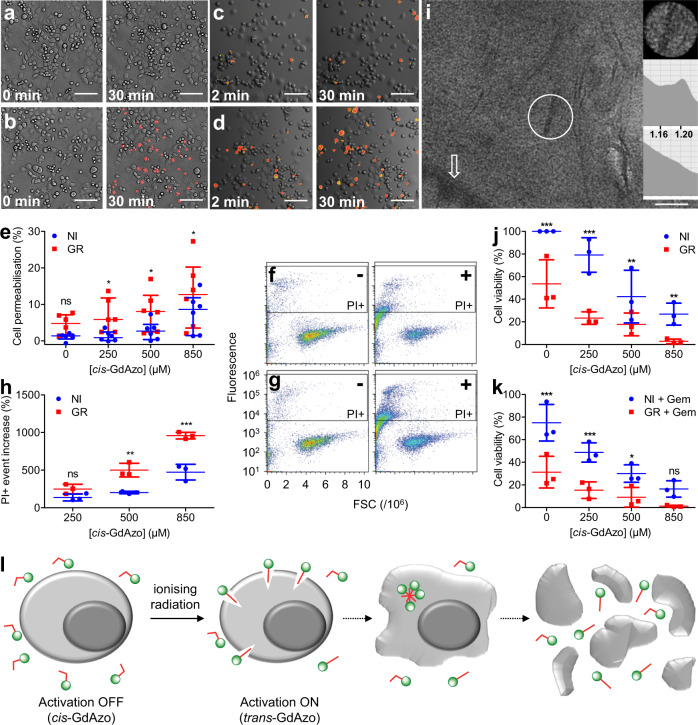
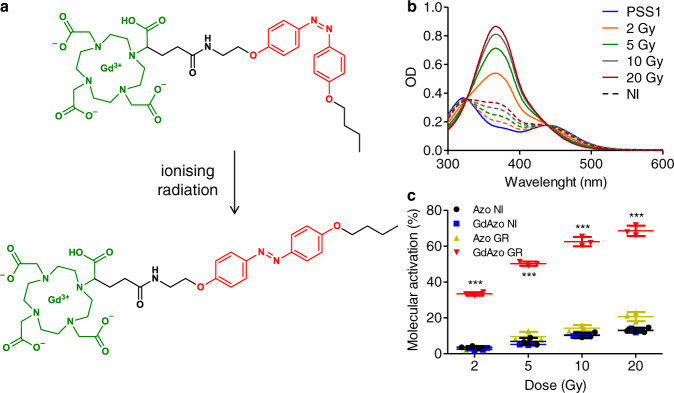
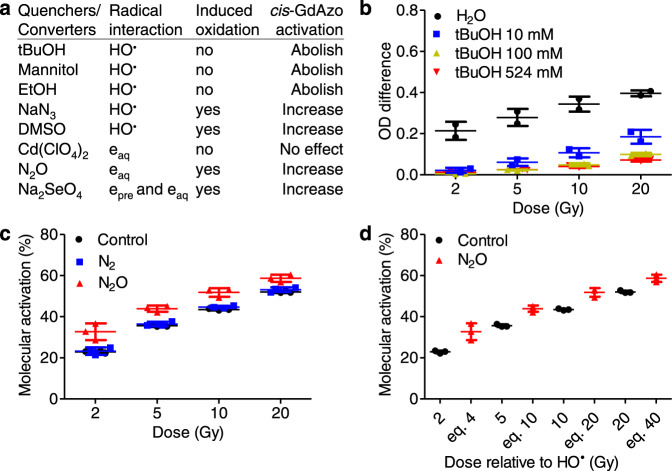
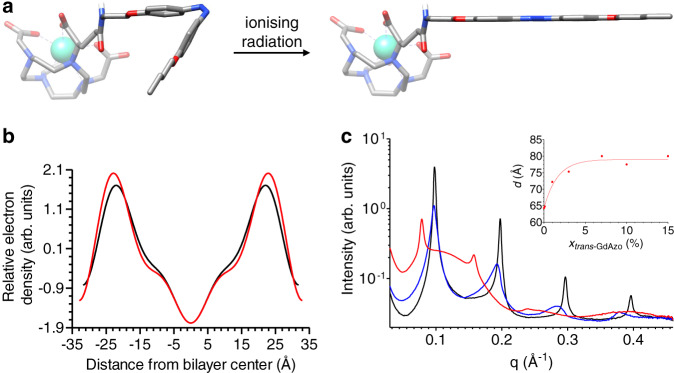
Electromagnetic radiation-triggered therapeutic effect has attracted a great interest over the last 50 years. However, translation to clinical applications of photoactive molecular systems developed to date is dramatically limited, mainly because their activation requires excitation by low-energy photons from the ultraviolet to near infra-red range, preventing any activation deeper than few millimetres under the skin. Herein we conceive a strategy for photosensitive-system activation potentially adapted to biological tissues without any restriction in depth. High-energy stimuli, such as those employed for radiotherapy, are used to carry energy while molecular activation is provided by local energy conversion. This concept is applied to azobenzene, one of the most established photoswitches, to build a radioswitch. The radiation-responsive molecular system developed is used to trigger cytotoxic effect on cancer cells upon gamma-ray irradiation. This breakthrough activation concept is expected to expand the scope of applications of photosensitive systems and paves the way towards the development of original therapeutic approaches.
在过去的 50 年中,电磁辐射触发的治疗效果引起了极大的关注。然而,迄今为止开发的光活性分子系统的临床应用转化受到了极大的限制,主要是因为它们的激活需要来自紫外线到近红外范围的低能量光子激发,这阻止了任何在皮肤下几毫米深的激活。在此,我们设想了一种潜在适用于生物组织的光敏系统激活策略,而不受任何深度限制。高能量刺激,如放射治疗中使用的刺激,用于携带能量,而分子激活则由局部能量转换提供。该概念应用于偶氮苯,最成熟的光开关之一,构建了一种放射开关。所开发的辐射响应分子系统用于在伽马射线照射下触发癌细胞的细胞毒性作用。这种突破性的激活概念有望扩大光敏感系统的应用范围,并为开发原创治疗方法铺平道路。