Interdisciplinary Laboratory of Clinical Analysis of the University of Murcia (Interlab-UMU), Department of Animal Medicine and Surgery, Veterinary School, Regional Campus of International Excellence Campus Mare Nostrum, University of Murcia, Campus de Espinardo, 30100, Espinardo, Murcia, Spain.
Department of Animal Medicine and Surgery, Veterinary School, Regional Campus of International Excellence Campus Mare Nostrum, University of Murcia, Campus de Espinardo, 30100, Espinardo, Murcia, Spain.
BMC Vet Res. 2022 Jul 14;18(1):275. doi: 10.1186/s12917-022-03371-9.
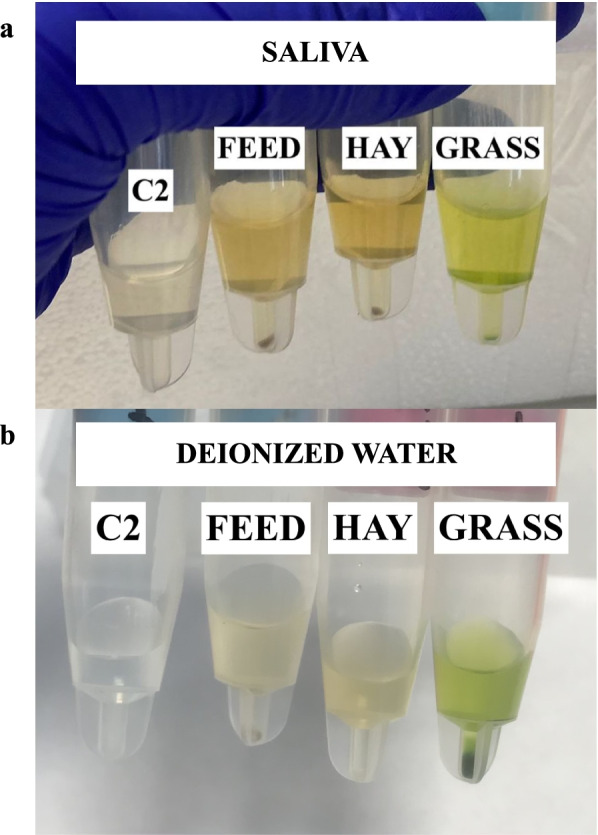
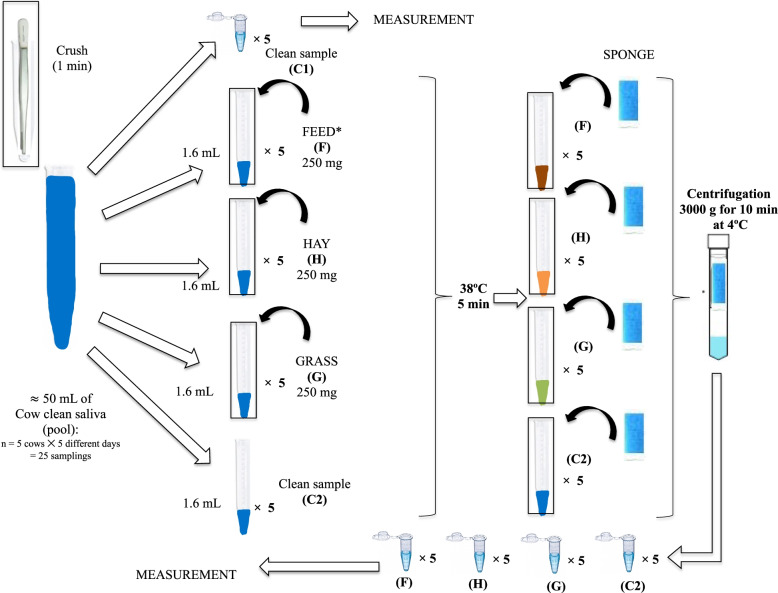
The effect in a sialochemistry profile of the presence of usually available feed in dairy cows was evaluated by an in vitro experiment. For this purpose, a pooled clean saliva from five healthy dairy cows was incubated five times with a standard feed based on a total mixed ration (F), wheat hay (H), and grass (G). The salivary panel was integrated by biomarkers of stress (cortisol -sCor-, salivary alpha-amylase -sAA-, butyrylcholinesterase -BChE-, total esterase -TEA-, and lipase -Lip-), immunity (adenosine deaminase -ADA-), oxidative status (Trolox equivalent antioxidant capacity -TEAC-, the ferric reducing ability of saliva -FRAS-, the cupric reducing antioxidant capacity -CUPRAC-, uric acid, and advanced oxidation protein products -AOPP-), and enzymes, proteins, and minerals of general metabolism and markers of liver, muscle, and renal damage (aspartate aminotransferase -AST-, alanine aminotransferase -ALP-, γ-glutamyl transferase -gGT-, lactate dehydrogenase -LDH-, creatine kinase -CK-, creatinine, urea, triglycerides, glucose, lactate, total protein, phosphorus, and total calcium).
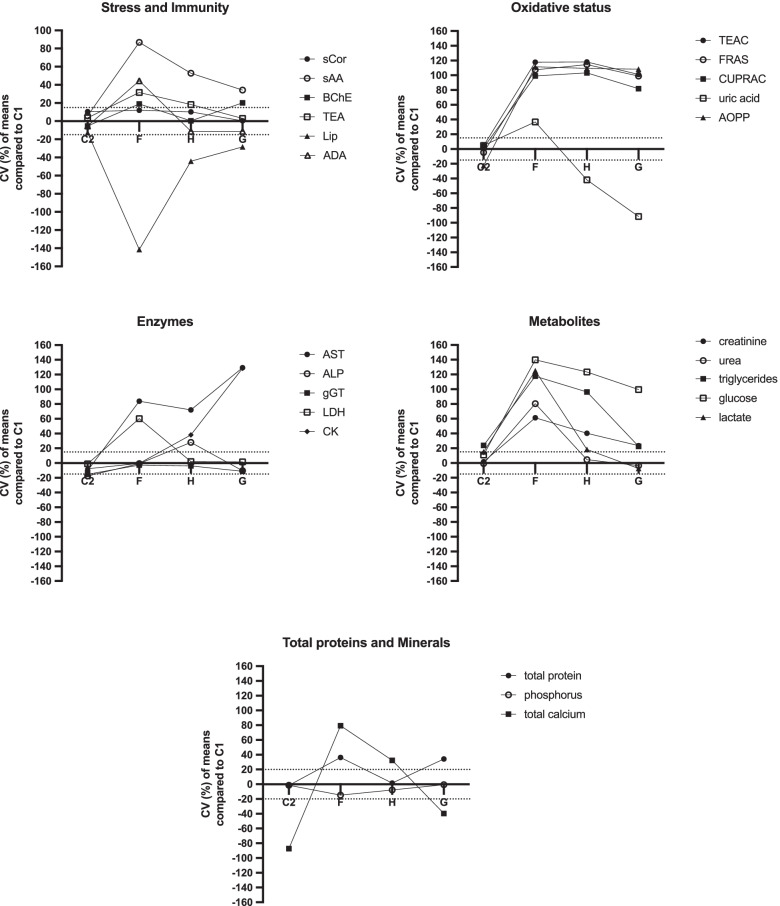
Most of the evaluated analytes showed a coefficient of variations (CV) higher than 15% and/or significant changes compared with the clean saliva when feed was present. Some analytes, such as the oxidative status biomarkers (CV > 80%), AST (CV > 60%), or glucose (CV > 100%), showed significant changes with all the feed types tested. Others showed significant differences only with certain types of feed, such as LDH with F (CV > 60%) or triglycerides with F (CV > 100%) and H (CV > 95%). However, sCor or gGT remained unchanged (CV < 15%, P > 0.05) in all the treatments.
The presence of feed can produce changes in most of the analytes measured in cows' saliva, being of high importance to consider this factor when saliva is used as a sample to avoid errors in the interpretation of the results.
通过体外实验评估了在奶牛唾液化学特征中存在通常可用饲料的影响。为此,将来自五头健康奶牛的混合唾液样本与基于全混合日粮(F)、小麦干草(H)和草(G)的标准饲料五次孵育。唾液分析物由应激生物标志物(皮质醇-sCor-、唾液α-淀粉酶-sAA-、丁酰胆碱酯酶-BChE-、总酯酶-TEA-和脂肪酶-Lip-)、免疫(腺苷脱氨酶-ADA-)、氧化状态(Trolox 当量抗氧化能力-TEAC-、唾液铁还原能力-FRAS-、铜还原抗氧化能力-CUPRAC-、尿酸和高级氧化蛋白产物-AOPP-)、一般代谢的酶、蛋白质和矿物质以及肝、肌肉和肾损伤标志物(天门冬氨酸氨基转移酶-AST-、丙氨酸氨基转移酶-ALP-、γ-谷氨酰转移酶-gGT-、乳酸脱氢酶-LDH-、肌酸激酶-CK-、肌酐、尿素、甘油三酯、葡萄糖、乳酸、总蛋白、磷和总钙)组成。
当存在饲料时,大多数评估的分析物的变异系数(CV)高于 15%,并且/或者与清洁唾液相比有明显变化。一些分析物,如氧化状态生物标志物(CV>80%)、AST(CV>60%)或葡萄糖(CV>100%),在所有测试的饲料类型中均显示出明显变化。其他分析物仅在某些类型的饲料中显示出显著差异,例如 F 或 H 中的 LDH(CV>60%)或 F 和 H 中的甘油三酯(CV>100%和 CV>95%)。然而,sCor 或 gGT 在所有处理中均保持不变(CV<15%,P>0.05)。
饲料的存在会导致奶牛唾液中测量的大多数分析物发生变化,因此在将唾液用作样本时,考虑这一因素非常重要,以避免在解释结果时出现错误。