Department of Pathology and Laboratory Medicine, Boston University School of Medicine, Boston, MA, United States.
Whitaker Cardiovascular Institute, Boston University School of Medicine, Boston, MA, United States.
Front Endocrinol (Lausanne). 2022 Jun 28;13:895466. doi: 10.3389/fendo.2022.895466. eCollection 2022.
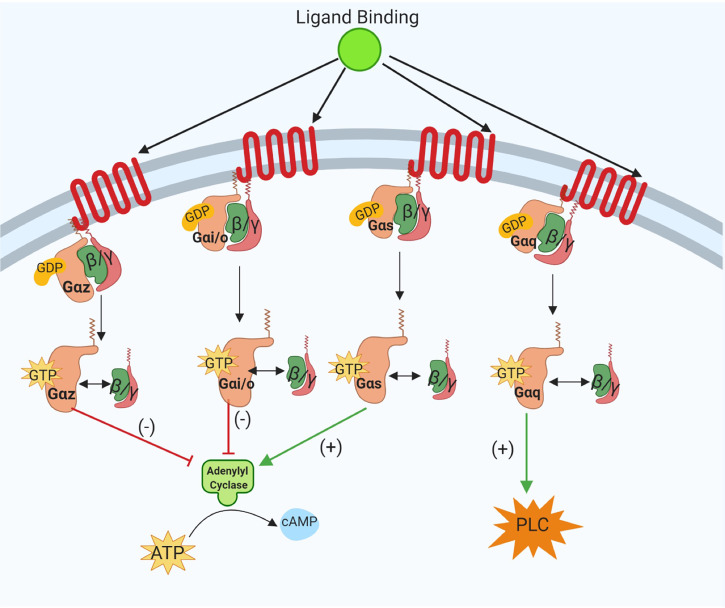
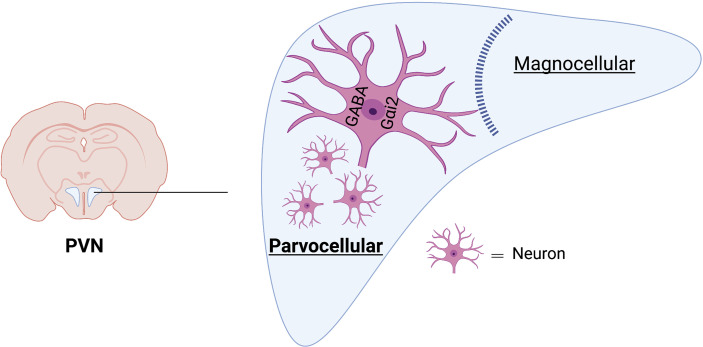
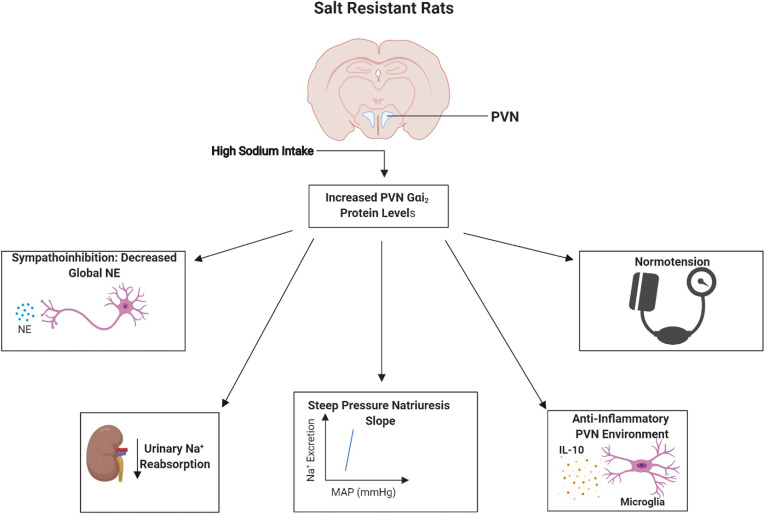
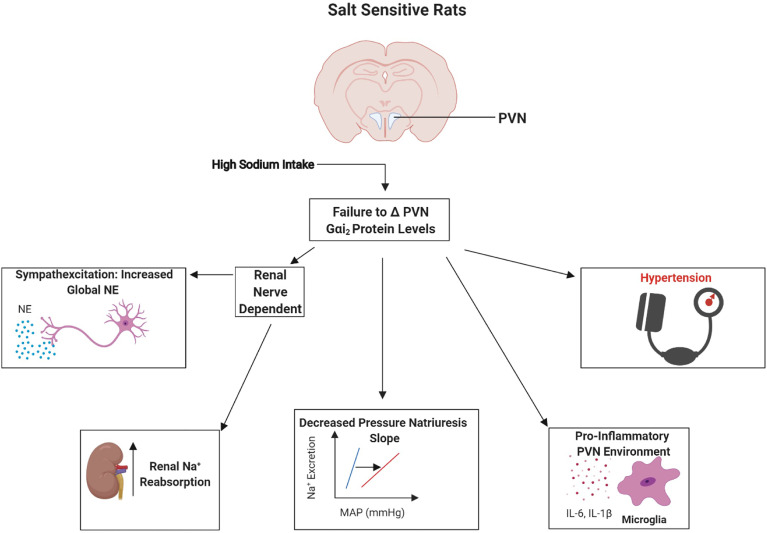
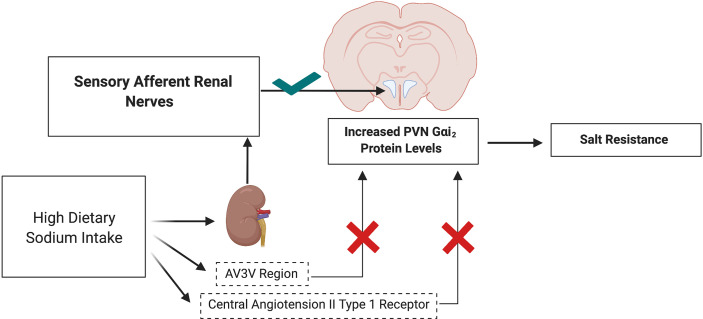
Hypertension, a major public health issue, is estimated to contribute to 10% of all deaths worldwide. Further, the salt sensitivity of blood pressure is a critical risk factor for the development of hypertension. The hypothalamic paraventricular nucleus (PVN) coordinates neuro-hormonal responses to alterations in plasma sodium and osmolality and multiple G Protein-Coupled Receptors (GPCRs) are involved in fluid and electrolyte homeostasis. In acute animal studies, our laboratory has shown that central Gαi/o subunit protein signal transduction mediates hypotensive and bradycardic responses and that Gz/q, proteins mediate the release of arginine vasopressin (AVP) and subsequent aquaretic responses to acute pharmacological stimuli. Extending these studies, our laboratory has shown that central Gαi proteins selectively mediate the hypotensive, sympathoinhibitory and natriuretic responses to acute pharmacological activation of GPCRs and in response to acute physiological challenges to fluid and electrolyte balance. In addition, following chronically elevated dietary sodium intake, salt resistant rats demonstrate site-specific and subunit-specific upregulation of Gαi proteins in the PVN, resulting in sympathoinhibition and normotension. In contrast, chronic dietary sodium intake in salt sensitive animals, which fail to upregulate PVN Gαi proteins, results in the absence of dietary sodium-evoked sympathoinhibition and salt sensitive hypertension. Using hybridization, we observed that Gαi expressing neurons in parvocellular division of the PVN strongly (85%) colocalize with GABAergic neurons. Our data suggest that central Gαi protein-dependent responses to an acute isotonic volume expansion (VE) and elevated dietary sodium intake are mediated by the peripheral sensory afferent renal nerves and do not depend on the anteroventral third ventricle (AV3V) sodium sensitive region or the actions of central angiotensin II type 1 receptors. Our translational human genomic studies have identified three G protein subunit alpha I2 (GNAI2) single nucleotide polymorphisms (SNPs) as potential biomarkers in individuals with salt sensitivity and essential hypertension. Collectively, PVN Gαi proteins-gated pathways appear to be highly conserved in salt resistance to counter the effects of acute and chronic challenges to fluid and electrolyte homeostasis on blood pressure a renal sympathetic nerve-dependent mechanism.
高血压是一个主要的公共卫生问题,据估计,它导致了全球 10%的死亡。此外,血压对盐的敏感性是高血压发展的一个关键危险因素。下丘脑室旁核(PVN)协调神经激素对血浆钠和渗透压变化的反应,并且多个 G 蛋白偶联受体(GPCR)参与了液体和电解质的稳态。在急性动物研究中,我们的实验室已经表明,中枢 Gαi/o 亚基蛋白信号转导介导降压和心率减慢的反应,而 Gz/q 蛋白介导精氨酸加压素(AVP)的释放和随后对急性药理学刺激的水合作用。扩展这些研究,我们的实验室已经表明,中枢 Gαi 蛋白选择性地介导急性药理学激活 GPCR 以及对液体和电解质平衡的急性生理挑战的降压、交感抑制和利钠反应。此外,在长期摄入高盐饮食后,盐抵抗大鼠在 PVN 中表现出特定部位和亚基特异性的 Gαi 蛋白上调,导致交感抑制和正常血压。相比之下,慢性盐敏感动物的高盐饮食摄入不能上调 PVN Gαi 蛋白,导致饮食钠诱发的交感抑制缺失和盐敏感高血压。通过杂交,我们观察到,在 PVN 的小细胞分裂中,表达 Gαi 的神经元强烈(85%)与 GABA 能神经元共定位。我们的数据表明,中枢 Gαi 蛋白对急性等容膨胀(VE)和高盐饮食的反应是由外周感觉传入肾神经介导的,不依赖于前腹第三脑室(AV3V)钠敏感区或中枢血管紧张素 II 型 1 受体的作用。我们的转化人类基因组研究已经确定了三个 G 蛋白亚基 alpha I2(GNAI2)单核苷酸多态性(SNP)作为盐敏感性和原发性高血压个体的潜在生物标志物。总之,PVN Gαi 蛋白门控途径在盐抵抗中似乎高度保守,以对抗急性和慢性对液体和电解质稳态对血压的挑战——一种肾交感神经依赖性机制。