Liu Ying, Zhang Xin, Zhang Li, Oliver Brian G, Wang Hong Guang, Liu Zhi Peng, Chen Zhi Hong, Wood Lisa, Hsu Alan Chen-Yu, Xie Min, McDonald Vanessa, Wan Hua Jing, Luo Feng Ming, Liu Dan, Li Wei Min, Wang Gang
Pneumology Group, Department of Integrated Traditional Chinese and Western Medicine, West China Hospital, Sichuan University, Chengdu, PR China.
Department of Respiratory and Critical Care Medicine, Clinical Research Center for Respiratory Disease, West China Hospital, Sichuan University, Chengdu, PR China.
Allergy Asthma Immunol Res. 2022 Jul;14(4):393-411. doi: 10.4168/aair.2022.14.4.393.
The molecular links between metabolism and inflammation that drive different inflammatory phenotypes in asthma are poorly understood. We aimed to identify the metabolic signatures and underlying molecular pathways of different inflammatory asthma phenotypes.
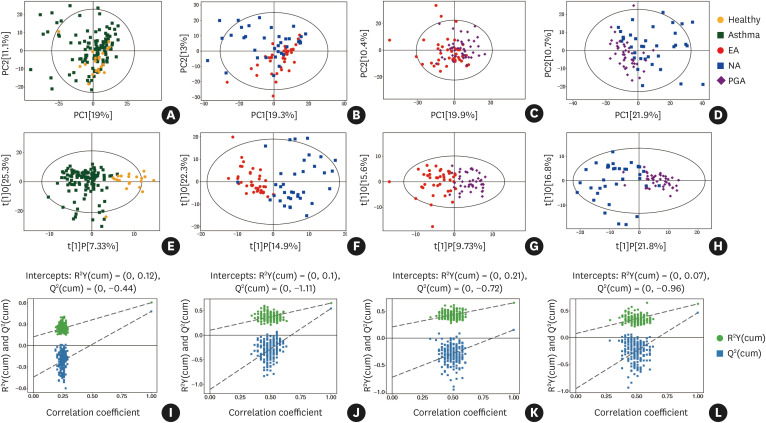
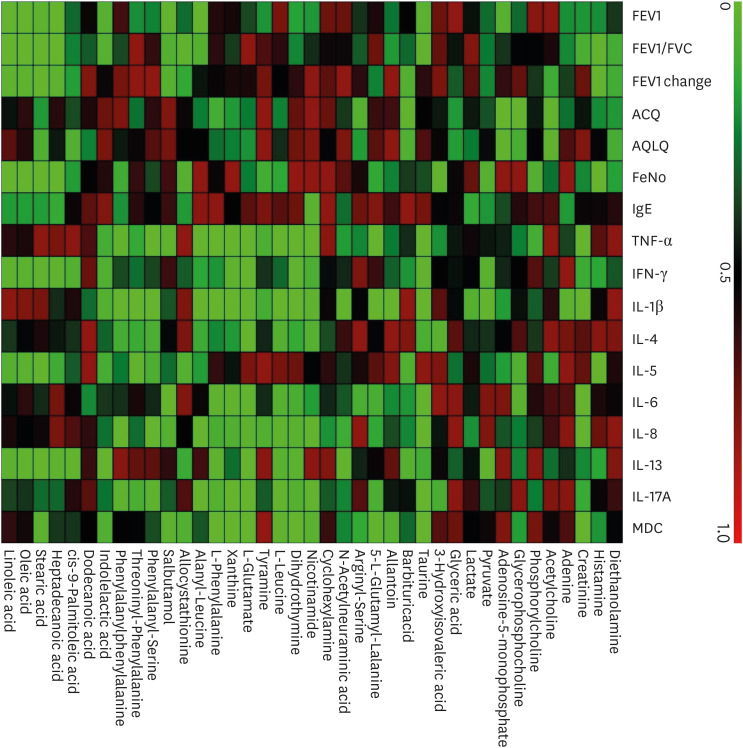
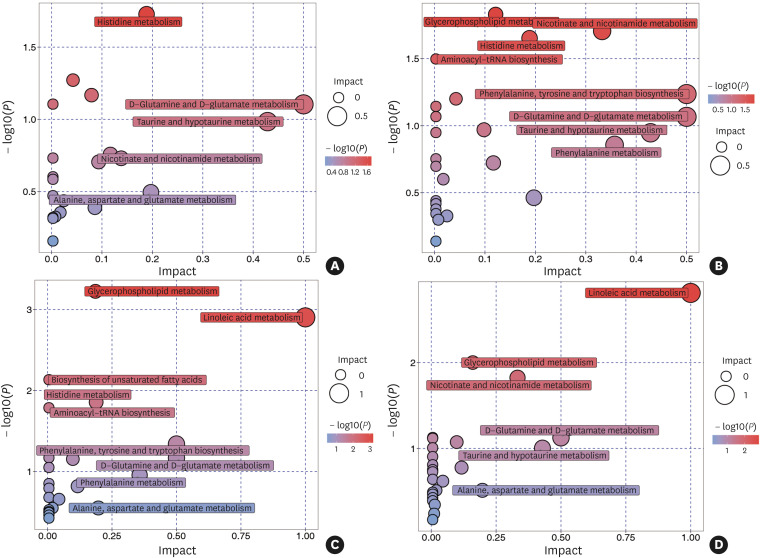
In the discovery set (n = 119), untargeted ultra-high-performance liquid chromatography-mass spectrometry (UHPLC-MS) was applied to characterize the induced sputum metabolic profiles of asthmatic patients with different inflammatory phenotypes using orthogonal partial least-squares discriminant analysis (OPLS-DA), and pathway topology enrichment analysis. In the validation set (n = 114), differential metabolites were selected to perform targeted quantification. Correlations between targeted metabolites and clinical indices in asthmatic patients were analyzed. Logistic and negative binomial regression models were established to assess the association between metabolites and severe asthma exacerbations.
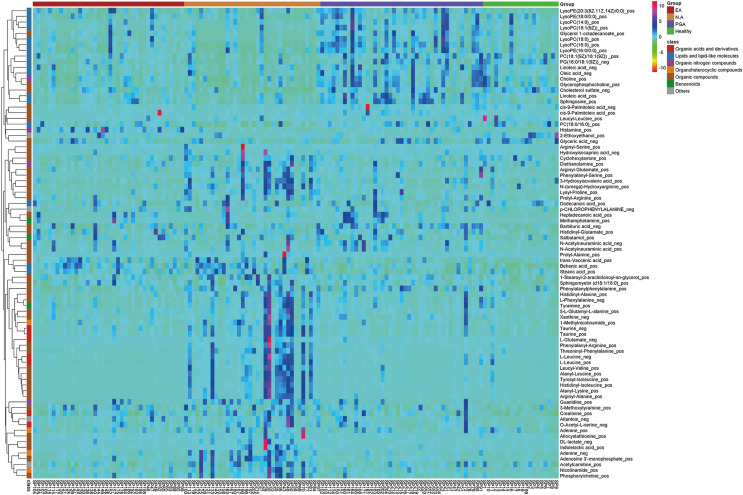
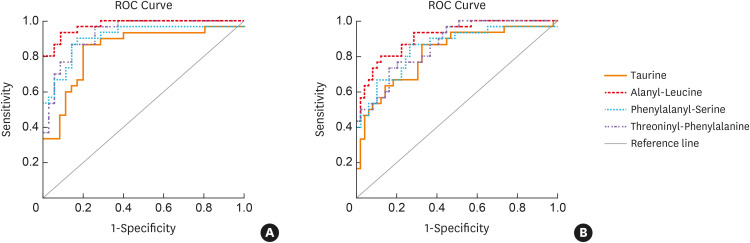
Seventy-seven differential metabolites were identified in the discovery set. Pathway topology analysis uncovered that histidine metabolism, glycerophospholipid metabolism, nicotinate and nicotinamide metabolism, linoleic acid metabolism as well as phenylalanine, tyrosine and tryptophan biosynthesis were involved in the pathogenesis of different asthma phenotypes. In the validation set, 24 targeted quantification metabolites were significantly expressed between asthma inflammatory phenotypes. Finally, adenosine 5'-monophosphate (adjusted relative risk [adj RR] = 1.000; 95% confidence interval [CI] = 1.000-1.000; = 0.050), allantoin (adj RR = 1.000; 95% CI = 1.000-1.000; = 0.043) and nicotinamide (adj RR = 1.001; 95% CI = 1.000-1.002; = 0.021) were demonstrated to predict severe asthma exacerbation rates.
Different inflammatory asthma phenotypes have specific metabolic profiles in induced sputum. The potential metabolic signatures may identify therapeutic targets in different inflammatory asthma phenotypes.
代谢与炎症之间的分子联系驱动了哮喘中不同的炎症表型,目前对此了解甚少。我们旨在确定不同炎症性哮喘表型的代谢特征和潜在分子途径。
在发现集(n = 119)中,采用非靶向超高效液相色谱-质谱联用技术(UHPLC-MS),运用正交偏最小二乘判别分析(OPLS-DA)和通路拓扑富集分析,对具有不同炎症表型的哮喘患者诱导痰的代谢谱进行表征。在验证集(n = 114)中,选择差异代谢物进行靶向定量分析。分析哮喘患者中靶向代谢物与临床指标之间的相关性。建立逻辑回归和负二项回归模型,以评估代谢物与严重哮喘加重之间的关联。
在发现集中鉴定出77种差异代谢物。通路拓扑分析发现,组氨酸代谢、甘油磷脂代谢、烟酸和烟酰胺代谢、亚油酸代谢以及苯丙氨酸、酪氨酸和色氨酸生物合成参与了不同哮喘表型的发病机制。在验证集中,24种靶向定量代谢物在哮喘炎症表型之间有显著表达。最后,证实5'-单磷酸腺苷(校正相对风险[adj RR]=1.000;95%置信区间[CI]=1.000 - 1.000;P = 0.050)、尿囊素(adj RR = 1.000;95% CI = 1.000 - 1.000;P = 0.043)和烟酰胺(adj RR = 1.001;95% CI = 1.000 - 1.002;P = 0.021)可预测严重哮喘加重率。
不同炎症性哮喘表型在诱导痰中具有特定的代谢谱。潜在的代谢特征可能为不同炎症性哮喘表型确定治疗靶点。