Department of Educational Governance, DIPF | Leibniz Institute for Research and Information in Education, Rostocker Straße 6, 30323, Frankfurt am Main, Germany.
Center for Research on Education and School Development (IFS), Technical University Dortmund, Vogelpothsweg 78, 44227, Dortmund, Germany.
J Youth Adolesc. 2022 Nov;51(11):2114-2129. doi: 10.1007/s10964-022-01651-z. Epub 2022 Jul 15.
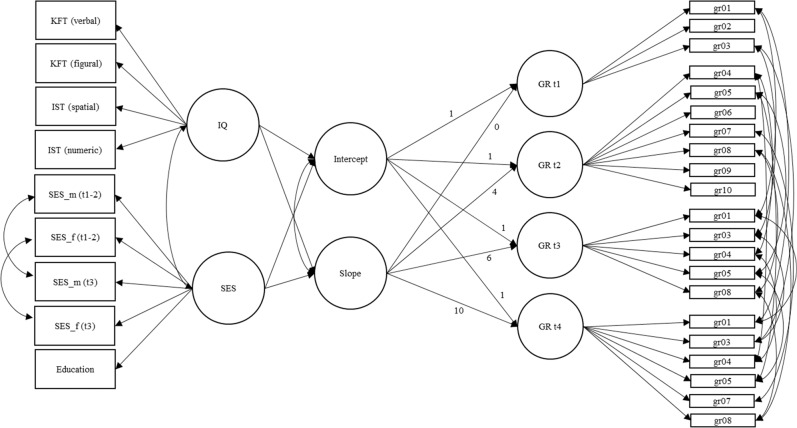
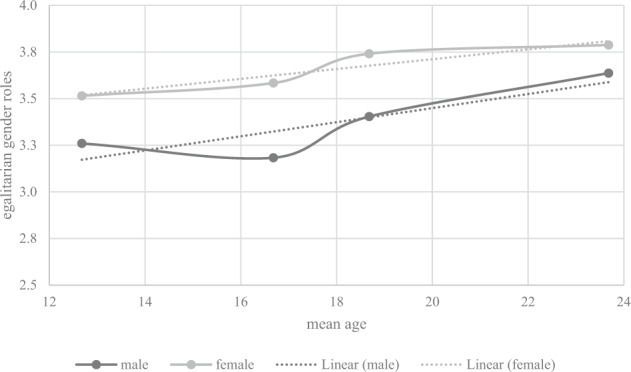
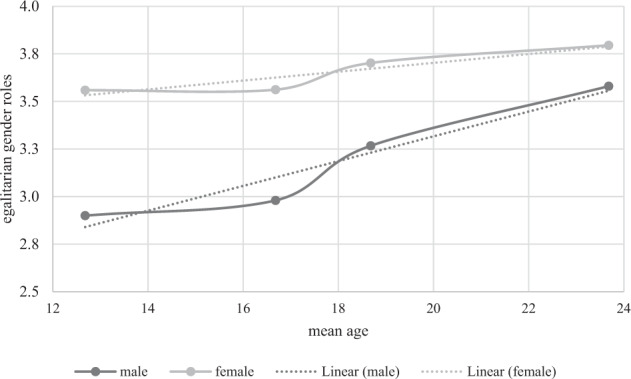
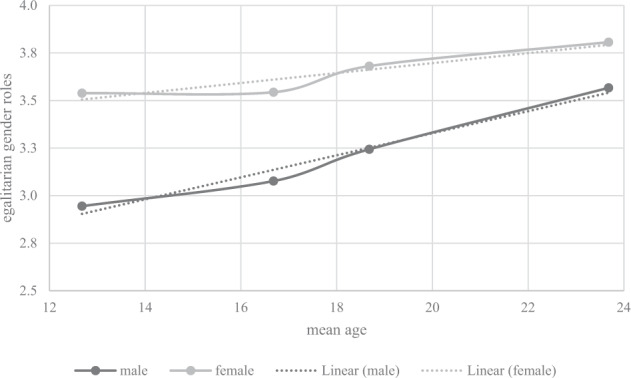
How gender role attitudes develop during adolescence, and how biological, social, and cognitive factors predict this development, remains a matter of debate. This study examines the development of gender role attitudes from early adolescence to emerging adulthood and investigates how the developmental trajectory is affected by sex, socioeconomic status, and cognitive abilities (intelligence). Four waves of the large-scale longitudinal German dataset BIJU between 1991 (grade 7; N = 3828, M = 13, SD = 0.61, 53.1% female, 96.4% German nationality), 1995 (grade 10, M = 17), 1997 (grade 12, M = 19) and 2001/2002 (university/career entry, M = 24) were used. Measurement invariance was examined across waves and gender. Latent growth curve models showed that adolescents developed more egalitarian gender role attitudes. Differences between the sexes decreased over time but remained significant. Socioeconomic status seemed less relevant, while adolescents, especially those with lower intelligence scores, developed more egalitarian gender role attitudes during adolescence. The results showed that teenagers developed more open and egalitarian attitudes during adolescence, and that the development trajectories of female and male adolescents converge.
性别角色态度在青春期是如何发展的,以及生物、社会和认知因素如何预测这种发展,仍然存在争议。本研究考察了性别角色态度从青春期早期到成年早期的发展,并探讨了发展轨迹如何受到性别、社会经济地位和认知能力(智力)的影响。本研究使用了大型纵向德国数据集 BIJU 的四个波次的数据,该数据集始于 1991 年(7 年级;N = 3828,M = 13,SD = 0.61,女性占 53.1%,德国国籍占 96.4%),随后分别在 1995 年(10 年级,M = 17)、1997 年(12 年级,M = 19)和 2001/2002 年(大学/职业开始,M = 24)进行了测量。本研究在各波次和性别之间检验了测量的不变性。潜在增长曲线模型表明,青少年的性别角色态度变得更加平等。随着时间的推移,性别差异逐渐缩小,但仍具有统计学意义。社会经济地位似乎不那么重要,而青少年,尤其是那些智力得分较低的青少年,在青春期发展出更加平等的性别角色态度。研究结果表明,青少年在青春期发展出更加开放和平等的态度,并且男女青少年的发展轨迹趋同。