
人类对高海拔的适应:基因组和蛋白质组特征趋同的综述。
Human adaptation to high altitude: a review of convergence between genomic and proteomic signatures.
机构信息
Peptide and Proteomics Division, Defence Institute of Physiology and Allied Sciences (DIPAS), Defence Research and Development Organisation (DRDO), Lucknow Road, Timarpur, Delhi, 110054, India.
出版信息
Hum Genomics. 2022 Jul 15;16(1):21. doi: 10.1186/s40246-022-00395-y.
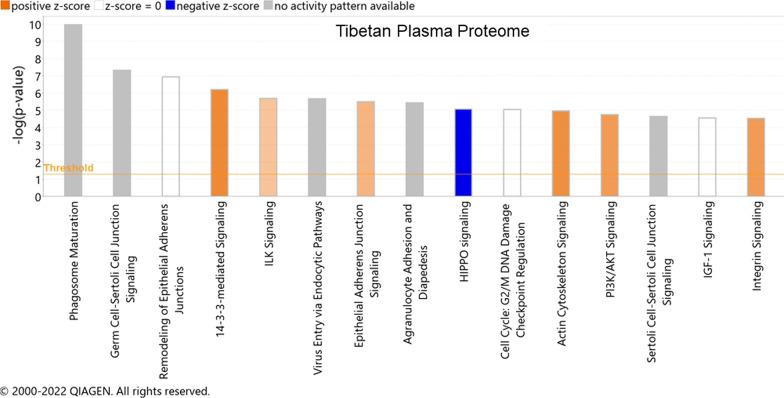
Both genomics- and proteomics-based investigations have identified several essential genes, proteins, and pathways that may facilitate human adaptive genotype/phenotype in a population-specific manner. This comprehensive review provides an up-to-date list of genes and proteins identified for human adaptive responses to high altitudes. Genomics studies for indigenous high-altitude populations like Tibetans, Andeans, Ethiopians, and Sherpas have identified 169 genes under positive natural selection. Similarly, global proteomics studies have identified 258 proteins (± 1.2-fold or more) for Tibetan, Sherpa, and Ladakhi highlanders. The primary biological processes identified for genetic signatures include hypoxia-inducible factor (HIF)-mediated oxygen sensing, angiogenesis, and erythropoiesis. In contrast, major biological processes identified for proteomics signatures include 14-3-3 mediated sirtuin signaling, integrin-linked kinase (ILK), phosphoinositide 3-kinase (PI3K)/protein kinase B (AKT), and integrin signaling. Comparing genetic and protein signatures, we identified 7 common genes/proteins (HBB/hemoglobin subunit beta, TF/serotransferrin, ANGPTL4/angiopoietin-related protein 4, CDC42/cell division control protein 42 homolog, GC/vitamin D-binding protein, IGFBP1/insulin-like growth factor-binding protein 1, and IGFBP2/insulin-like growth factor-binding protein 2) involved in crucial molecular functions like IGF-1 signaling, LXR/RXR activation, ferroptosis signaling, iron homeostasis signaling and regulation of cell cycle. Our combined multi-omics analysis identifies common molecular targets and pathways for human adaptation to high altitude. These observations further corroborate convergent positive selection of hypoxia-responsive molecular pathways in humans and advocate using multi-omics techniques for deciphering human adaptive responses to high altitude.
基于基因组学和蛋白质组学的研究已经确定了几个重要的基因、蛋白质和途径,这些基因、蛋白质和途径可能以特定于人群的方式促进人类适应性基因型/表型。本综述提供了一份最新的确定人类对高海拔环境适应反应的基因和蛋白质清单。对藏人、安第斯人、埃塞俄比亚人和夏尔巴人等土著高海拔人群的基因组学研究已经确定了 169 个受自然选择正向影响的基因。同样,全球蛋白质组学研究已经确定了 258 种蛋白质(±1.2 倍或更多)用于藏族、夏尔巴人和拉达克高地人。遗传特征确定的主要生物学过程包括缺氧诱导因子(HIF)介导的氧感应、血管生成和红细胞生成。相比之下,蛋白质组学特征确定的主要生物学过程包括 14-3-3 介导的 Sirtuin 信号、整合素连接激酶(ILK)、磷酸肌醇 3-激酶(PI3K)/蛋白激酶 B(AKT)和整合素信号。比较遗传和蛋白质特征,我们确定了 7 个共同的基因/蛋白质(HBB/血红蛋白亚基β、TF/转铁蛋白、ANGPTL4/血管生成素相关蛋白 4、CDC42/细胞分裂控制蛋白 42 同源物、GC/维生素 D 结合蛋白、IGFBP1/胰岛素样生长因子结合蛋白 1 和 IGFBP2/胰岛素样生长因子结合蛋白 2)参与了 IGF-1 信号、LXR/RXR 激活、铁死亡信号、铁稳态信号和细胞周期调节等关键分子功能。我们的综合多组学分析确定了人类适应高海拔的共同分子靶标和途径。这些观察结果进一步证实了人类缺氧反应分子途径的趋同正向选择,并主张使用多组学技术来破译人类对高海拔的适应反应。


 Zotero 插件